


 Sign In
Dominant 2nd House in the Natal Chart
In a natal chart, the 2nd House sheds light on how individuals establish material independence, make the most of their abilities, and give tangible value to what they own or produce. The lives of Elvis Presley, Leonardo DiCaprio, Kris Jenner, and Jean Gabin reveal four sharply contrasting expressions of this house, from the conspicuous spending of money to the patient accumulation of wealth. This sector describes income generated through personal activity, the management of acquired assets, and the need for resources stable enough to avoid dependence on others. When it ranks high among the dominants of the chart, these concerns can become a recurring theme throughout life. A strong 2nd House does not promise wealth or any particular attraction to luxury. It can just as readily reflect a desire for independence, a fear of scarcity, a sustained effort to consolidate existing assets, or the need to see one's work produce tangible results.
Among the twelve astrological houses, the 2nd House is a succedent house. Symbolically, it extends the self-assertion of the 1st House by giving the individual support, means, and a foundation on which to build. The basics of astrology help distinguish it from several areas that may seem similar. The 6th House is more concerned with daily work, tasks, constraints, and the practical conditions in which that work is carried out, while the 10th House describes career, ambition, social achievement, and the place one seeks to occupy in the world. The 2nd House instead indicates what individuals are able to derive from their activity and how they manage it. Opposite it, the 8th House refers in particular to shared capital, the assets of a spouse or business partners, inheritances, debts, and transactions involving resources beyond one's own. The 4th House, for its part, represents the home, roots, and family property as a source of grounding. The same piece of real estate may therefore belong to several houses symbolically, depending on whether we consider its value as a possession, its role as a residence, or its transmission to someone else.
The symbolism of the 2nd House extends far beyond the balance in a bank account. It encompasses the way we earn, save, spend, and manage capital, as well as our relationship with material goods, property, comfort, and tangible pleasures. It shows what we consider important enough to acquire, retain, or enhance over time. A strong 2nd House can foster an attachment to durable possessions, an awareness of price, the desire to build wealth, or the satisfaction of seeing the results of one's efforts increase. For others, the same sector appears in the enjoyment of their income, choosing objects with care, eating well, living in an appealing environment, or giving visible form to their success. Some of the preferences explored in our Lifestyle section may be outward manifestations of this tendency, but the underlying issue runs deeper. The 2nd House touches on the feeling of having a solid base and, in some charts, on the sense of one's own worth. Personal talents can also belong to its domain when they become skills that the individual puts to use to support themselves or improve their circumstances.
A well-integrated dominant 2nd House can foster realism, perseverance, practicality, financial independence, and the ability to build over time. Those with this emphasis often know what they wish to preserve and may show great consistency when it comes to ensuring their security or developing what they already possess. But a dominant indicates the importance of an area of life, never whether it will be favorable. A powerful 2nd House can just as easily accompany chronic difficulty obtaining sufficient income, a fear of scarcity, an uncomfortable economic dependence, or an excessive preoccupation with money. Attachment can turn into possessiveness, avarice, or a need for control. Conversely, the pursuit of pleasure or reassurance can lead to reckless outlays, an inability to hold on to what has been gained, or cycles of accumulation and dissipation. Challenging aspects can heighten losses, unstable earnings, disputes over possessions, or persistent dissatisfaction despite comfortable circumstances. For some, much of life seems organized around providing for themselves, consuming excessively, rebuilding, protecting, or reassessing what they own. A dominant 2nd House therefore does not promise affluence. Questions of material means remain difficult to push into the background.
The planets present in this sector show how these issues are experienced. The Sun can tie identity to the ability to produce, earn, or rely on one's own resources, while the Moon heightens the desire for security and sensitivity to changes in material circumstances. Mercury favors exchanges, transactions, commerce, or multiple income-generating activities. Venus tends to seek pleasure, quality, and a certain degree of comfort, while Mars pushes toward obtaining what one needs, sometimes with impatience or at the cost of impulsive spending. Jupiter expands possibilities as well as appetites, with no guarantee of moderation. Saturn may bring restrictions, restraint, slowness, or discipline before supporting lasting consolidation. Uranus can make income or possessions less conventional and sometimes irregular. Neptune may introduce idealization, generosity, vagueness, or imprudence. Pluto intensifies issues of control, loss, power, and rebuilding. These indications only take on meaning within the chart as a whole, since a planet considered benefic can encourage excess, while a demanding configuration can teach highly effective management.
Interpreting a dominant 2nd House ultimately requires examining the sign on its cusp, its ruler, the house in which that ruler is located, and the aspects it receives, in addition to the planets present in the sector. Venus also deserves special attention, as do repeated symbolic themes that may strengthen the connection with stability, pleasure, or possession. By analogy between signs and houses, the 2nd House is associated with Taurus and Venus. A dominant Venus, prominent Earth signs, or other configurations pointing in the same direction can reinforce part of this symbolism. The distribution of planets among the elements and quadruplicities provides an additional perspective without ever making sign, planet, and house interchangeable. The overall analysis offered in the personalized reports from our online store is based on this hierarchy of factors, which also lies at the heart of astrological characterology. When it is dominant, acquiring, using, preserving, or sometimes rebuilding what allows someone to feel materially independent becomes, in one form or another, one of the recurring threads of life.
Note: This article focuses specifically on house dominance and is therefore not intended as a complete psychological analysis of the personalities selected as examples. Other articles devoted to them can be found in our Celebrity Focus section.
Elvis Presley or the 2nd House Between Scarcity and Abundance

In Elvis Presley's life, the 2nd House accompanies a remarkable journey from the scarcity of his early years to the abundance that followed. Born on January 8, 1935, in Tupelo, Mississippi, he grew up in a working-class family with very limited means. His childhood was marked by several moves, and in 1948 his parents relocated with him to Memphis in the hope of improving their financial situation. Before finding success, Elvis held several jobs, including working as a delivery truck driver, until his music transformed his life within a few years. From 1956 onward, records, television, concerts, and movies made him an international star and brought him an income far beyond anything his family background could have suggested. In his natal chart, the 2nd House scores above 40% and ranks first among his dominant houses, giving particular resonance to this spectacular material transformation.
The astrological configuration is remarkably consistent. The Sun at 17°14, Mercury at 22°18, and Venus at 29°22 are all located in the 2nd House in Capricorn, the strongest of his dominant signs. The cusp of the 2nd House falls at 14°50 in the same sign, placing the Sun less than three degrees beyond the cusp. Saturn, ruler of the 2nd House, is at 25°45 Aquarius in the 3rd House, the chart's second dominant house. This connection between the 2nd and 3rd Houses is suggestive for an artist whose resources would come largely from his voice, recordings, media exposure, and public image. The Sun also receives an almost exact sextile from Jupiter, with an orb of 0°50. Since Jupiter is his leading planetary dominant, this relationship adds an expansive dimension to an already strongly emphasized house.
The transition from scarcity to ownership took concrete form with Graceland. In March 1957, Elvis was only twenty-two when he purchased the Memphis property for $102,500, and his parents and paternal grandmother moved in with him. The gesture was remarkable for a young man whose household had left Tupelo less than ten years earlier for economic reasons. His earnings were quickly converted into a house, land, and material security for those closest to him. Family bonds thus took on a very tangible dimension. Graceland remained his home until his death and became the most emblematic possession he ever acquired. The concentration in Capricorn, a sign associated with building and endurance, fits well with this desire to place a still-recent success on a solid foundation.
Once he rose to worldwide fame, however, Elvis's dominant 2nd House took on a far more conspicuous form. He loved clothes, jewelry, horses, expensive objects, and above all cars, with a particular fondness for prestigious models. His famous pink Cadillac, presented to his mother, neatly captures the way his enjoyment of possessions and his generosity became intertwined. By the 1970s, his wealth allowed him to go much further. In 1975, he purchased a Convair 880 and had it lavishly converted for private use, featuring a lounge, bedroom, and luxurious fittings. Elvis spent freely on himself, but also on his family, friends, and sometimes complete strangers. He supported charitable causes as well. Here, the 2nd House finds a generous and sensual expression, with money serving both the enjoyment of what success had brought him and the pleasure of sharing with others.
This profusion also reveals the more difficult side of a dominant 2nd House. Elvis earned enormous sums, but preserving and managing his wealth did not always keep pace with his spending. Several aspects in the chart give this issue a more unstable tone. Venus in the 2nd House is in a very tight square to Uranus, with an orb of 1°51, and an opposition to Pluto at 4°13. Mercury, also in the 2nd House, opposes Pluto with an orb of 2°49, forming a challenging Mercury-Pluto aspect. Pluto itself is located in the 8th House, on the axis opposite that of personal assets. Without treating these configurations as the cause of his financial choices, they fit well with an intense and at times excessive relationship with acquisition, spending, control, and the movement of very large sums of money.
The situation he left behind at his death on August 16, 1977, at Graceland extends this contradiction. Elvis still owned substantial assets and his estate was by no means depleted, but it faced cash-flow problems, while the upkeep and taxes on Graceland were then costing more than half a million dollars a year. Opening the property to the public in 1982 gradually transformed what had turned into a heavy financial burden, making it the economic center of the Presley legacy. The home he had bought to provide security for his family thus emerged as one of the most famous estates in the music industry. This permanence gives his relationship with possessions an almost paradoxical dimension. Despite a personal approach to money that placed little emphasis on long-term planning, what he acquired and shaped remains at the heart of his legend nearly half a century later.
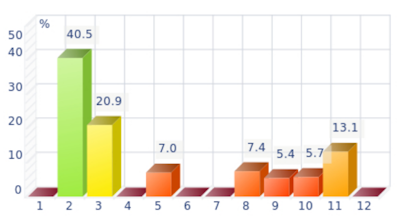
Dominant houses diagram for Elvis Presley
With Elvis Presley, the 2nd House shows the full range a dominant can take on when it becomes one of the recurring themes of a life. Three personal planets are located there in Capricorn, including the Sun, while Saturn, ruler of the house, connects this sector with the 3rd House and Jupiter closely supports the Sun. His biography echoes this pattern with exceptional force. The child raised in scarcity became one of the highest-paid artists of his era, quickly converted his earnings into property and prestigious possessions, then spent and shared his fortune with a freedom that eventually undermined his financial stability. From the small house in Tupelo to Graceland, from his first wages to luxury cars and private aircraft, the same theme returns in opposite forms. Earning, owning, enjoying, giving, and managing to preserve what he had built make his life an especially complete, and at times contradictory, illustration of a dominant 2nd House.
Elvis Presley


You can also consult the astrological portrait of Elvis Presley.
Below is Elvis Presley's birth chart:
Leonardo DiCaprio or the 2nd House Built to Last

Leonardo DiCaprio's path illustrates the 2nd House in a very different way, with far less conspicuous spending than in Elvis Presley's case and a much stronger emphasis on accumulation and the long term. Born on November 11, 1974, in Los Angeles, he grew up in modest circumstances and has often spoken about the rough neighborhoods of his childhood. After appearing in commercials and on television, This Boy's Life and then What's Eating Gilbert Grape revealed his acting talent at an early age. In 1997, Titanic transformed both his fame and his income potential. Yet he did not simply move from one mainstream success to another. Over the decades, a substantial share of his earnings has been converted into real estate, production ventures, and long-term projects. In his chart, the 2nd House accounts for nearly 47%, making it by far the dominant sector.
The planetary concentration is especially pronounced. The Sun at 18°40, Venus at 19°54, and Mars at 9°36 are all located in the 2nd House in Scorpio, while Mercury at 29°45 Libra, very close to the cusp, is also assigned to this sector. The cusp of the 2nd House falls at 0°28 Scorpio. Pluto, ruler of the sign and the chart's leading planetary dominant, occupies the 1st House, while Mars, the traditional ruler of Scorpio, is itself in the 2nd House. The Sun conjunct Venus at 1°13 brings identity, tastes, and a sense of value together. More importantly, the Sun forms a very tight trine to Saturn, with an orb of 0°08, while Venus is linked to Saturn by a trine at 1°05. With Saturn placed in the 10th House, this double connection creates a remarkably coherent link between personal resources and the patient construction of a career.
This same logic can be seen in the way DiCaprio has expanded his role within the cinema industry over time. Once established as one of the highest-paid actors of his generation, he founded Appian Way Productions and took part in bringing numerous projects to fruition. The Aviator, Shutter Island, The Wolf of Wall Street, and The Revenant are among the films released under its banner, several of them directed by Martin Scorsese. This evolution is particularly relevant to the 2nd House, since his professional value no longer depends solely on the fee he receives for an acting role. His reputation, experience, and ability to select projects serve as assets in their own right, capable of financing and supporting works over which he exercises greater control. The trine from Mars in the 2nd House to Jupiter in the 6th, exact within 1°29, adds a favorable connection between activity, effort, and the growth of personal resources.
Real estate provides an even more tangible expression of this dominant house. DiCaprio began investing in the 1990s, with early acquisitions in the Hollywood Hills, where his holdings included a residence formerly owned by Madonna. After Titanic, he bought an oceanfront property in Malibu that he kept for more than twenty years before selling it at a price well above what he had paid. Other transactions followed in Los Angeles, New York, Palm Springs, and Malibu. When he changes residences, he does not always dispose of the rest of his portfolio: he has retained several holdings for long periods, expanded some estates by acquiring neighboring parcels, and at times turned little-used dwellings into rentals. This continuity sets his approach to ownership apart from simple luxury consumption and fits well with the fixed nature of Scorpio combined here with a house devoted to personal assets.
For DiCaprio, the question of value takes on another dimension through his environmental commitment. In 2005, he purchased an island in Belize with plans to develop a sustainably designed resort. His involvement in climate issues, biodiversity, and species protection later expanded through various organizations and campaigns. His philanthropic initiatives have helped fund numerous conservation programs, and he is now one of the founders of Re:wild. This commitment connects with the theme of ecology, but it also sheds light on the 2nd House in a broader sense. The resources he has accumulated are used in support of values he considers important enough to devote money, influence, and time to.
His real estate portfolio nevertheless calls for some qualification of the overly perfect image this dominant house might otherwise suggest. Not every transaction has generated a profit, and some properties have been sold at a loss or for little more than their purchase price. A strong 2nd House does not make its owner an infallible investor. What stands out more clearly in DiCaprio's case is the continuity of the process. Wealth generated through film has gradually been diversified across real estate, film production, and chosen causes, while several acquisitions have been held for decades. Saturn in the 10th House, in an almost exact trine to the Sun in the 2nd, fits this pattern of consolidation particularly well. It tempers Scorpio's intensity with an ability to preserve over time what has been built, rather than seeking only its immediate enjoyment.
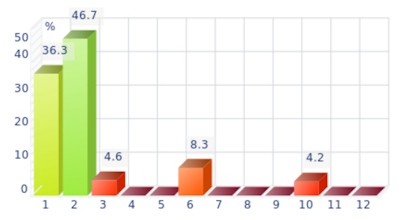
Dominant houses diagram for Leonardo DiCaprio
In Leonardo DiCaprio's chart, four personal planets gathered in the 2nd House give exceptional importance to resources, value, and accumulated wealth. The Sun and Venus are conjunct there in Scorpio, both harmoniously connected with Saturn in the 10th House, while Mars in the 2nd receives support from Jupiter. His biography reflects this structure with remarkable continuity. Starting from modest circumstances, he reached the highest levels of Hollywood earnings at a young age, then converted part of that success into property, production resources, and investments held for the long term. His case therefore illustrates a 2nd House less concerned with the display of possessions than with the ability to turn personal talent into lasting value, and then to decide how that value will be preserved, developed, or put to use.
Leonardo DiCaprio


You can also consult the astrological portrait of Leonardo DiCaprio.
Below is Leonardo DiCaprio's birth chart:
Kris Jenner or the 2nd House Built for Business

Kris Jenner's success rests largely on her ability to turn fame, relationships, and family ventures into organized and profitable businesses. Born on November 5, 1955, in San Diego, she worked as a flight attendant in the 1970s, long before her name became inseparable from those of her children. The turning point came in 2007 with Keeping Up with the Kardashians, which she executive-produced and which firmly established the family in popular culture. The show ran for twenty seasons until 2021, before The Kardashians took over on Hulu in 2022. In the meantime, Kris Jenner became the manager of several of her children's careers and business interests. In her natal chart, the 2nd House accounts for more than 47%, placing it clearly first among her dominant houses.
The 2nd House begins at 26°01 Libra. The Sun at 12°15 Scorpio, Saturn at 22°26 Scorpio, and Neptune at 28°30 Libra occupy this sector. Mercury, at 25°44 Libra, lies only 0°17 from the cusp and is also counted in the 2nd House according to the rule of shifting planets to the next house. Mercury is in fact her leading planetary dominant, further emphasizing the role of negotiation, contracts, exchanges, and organization in matters of personal resources. Venus, ruler of the 2nd House, is located in the 3rd. The connection between money, communication, and image-building therefore appears at several levels of the chart.
This pattern is reflected almost literally in her business model. Kris Jenner manages her children's activities and has explained that she receives a 10% commission on the gross income from the operations she oversees. Her role goes well beyond negotiating contracts. She takes part in assembling teams, organizing companies, choosing partnerships, and developing brands. She has also held stakes in several family enterprises. The success of Kim Kardashian through her various ventures, or of Kylie Jenner in cosmetics, therefore generates income for her while increasing the value of an ecosystem she helps to structure. Few public figures illustrate so clearly the 2nd House's ability to identify a resource, manage it, and make it grow.
Several aspects closely connect this house with professional visibility and recognition. The Moon in the 10th House is linked to Saturn in the 2nd by a trine with an orb of only 0°45, while Neptune in the 2nd makes an almost exact trine to the Midheaven at 0°06. Mercury in the 2nd is also trine the Midheaven at 2°53. This combination fits an activity in which branding, media exposure, management, and income are difficult to separate. Mercury is conjunct Neptune at 2°46, adding an ability to shape the family's reputation and narrative. A strong sense of organization becomes a professional resource in its own right.
Venus, ruler of the 2nd House, nevertheless introduces a more expansive dimension. Placed in Scorpio, it forms an extremely tight square to Jupiter at 0°28 and a square to Pluto at 0°45, both planets being located in the 11th House. This configuration fits a context in which the financial interests involved can be considerable and are tied to an extensive family and professional network. It also reminds us that a dominant 2nd House is not limited to saving or preserving wealth. In Kris Jenner's case, money circulates within a system that requires investment, negotiation, business development, equity stakes, and the constant conversion of public attention into economic value.
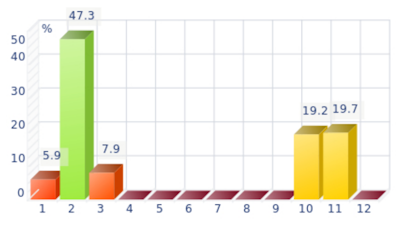
Dominant houses diagram for Kris Jenner
What makes Kris Jenner especially representative of the 2nd House is not so much the size of her fortune as the role she plays. Her talent lies in identifying commercial potential, giving it structure, negotiating how it will be monetized, and guiding its development. The Sun, Mercury, Saturn, and Neptune all occupy important positions in the 2nd House, while the 10th and 11th Houses connect these resources with public visibility and networks. In her case, possession therefore takes a distinctly contemporary form. The essential issue lies in the ability to turn celebrity, an audience, and a brand into lasting income.
Kris Jenner


You can also consult the astrological portrait of Kris Jenner.
Below is Kris Jenner's birth chart:
Jean Gabin or the 2nd House Rooted in the Land

In Jean Gabin's case, the 2nd House takes an especially tangible form. Born on May 17, 1904, in Paris, he became one of the leading figures of French cinema during the interwar years, before enjoying a new period of success in the 1950s. It was precisely at this time that he fulfilled a long-held dream by settling in Normandy and devoting a considerable share of his income to the land. The La Pichonnière estate gradually became a genuine working farm. In his natal chart, the 2nd House accounts for nearly 40%, placing it first among his dominant houses.
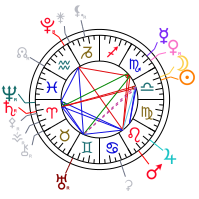
The astrological correspondence is striking. The 2nd House begins at 7°41 Taurus and contains four planets in the same sign: the Sun at 25°43, retrograde Mercury at 20°10, Venus at 11°35, and Mars at 29°14. Taurus itself ranks first among his dominant signs. Most importantly, Venus, ruler of the 2nd House, is in its domicile in Taurus and in the very house it rules, strongly reinforcing the symbolism of possession, stability, and attachment to tangible assets. The Sun is conjunct Mars at 3°31 and forms a conjunction with Mercury at 5°33. A substantial part of his identity, activity, and practical decision-making is therefore concentrated in the same sector.
Beginning in 1952, Gabin developed La Pichonnière over the course of about ten years until the estate covered nearly three hundred hectares. He raised around 230 cattle there and established a stud farm with some fifteen thoroughbreds. The actor devoted considerable time and money to the property, far from film sets and immersed in country life. In 1962, during a dispute with local farmers, he pointed out that the land represented forty-five years of work for him. The remark sums up his relationship with property remarkably well. Income earned through cinema was converted into acres, buildings, livestock, and horses: assets he could see, manage directly, and pass on.
The domestic dimension was an important part of the project. La Pichonnière became the home he shared with those closest to him, and he viewed farming as a tangible activity that could offer his family something enduring after his own career. His interest in animals, with a particular fondness for horses, went far beyond the hobby of a wealthy star. He organized a working estate, expanded his livestock, and even had a racetrack developed at Moulins-la-Marche. The 2nd House is expressed here less through ostentation than through the need to own something solid and lasting, acquired through sustained effort and capable of providing security.
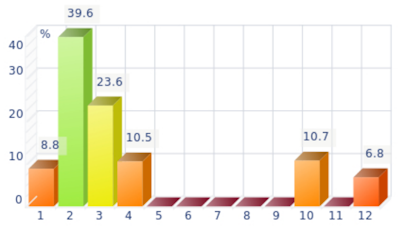
Dominant houses diagram for Jean Gabin
Jean Gabin ultimately provides one of the most literal expressions of this dominant house. Four planets occupy the 2nd House in Taurus, with Venus in its own sign and in the house it rules, while his biography takes the actor from substantial movie earnings to the patient creation of a vast agricultural estate. Where Elvis Presley illustrates the enjoyment and circulation of wealth, DiCaprio its accumulation, and Kris Jenner its monetization, Gabin brings the 2nd House back to its most elemental image. For him, the pattern comes down to earning in order to acquire, owning land, developing it, and turning it into a lasting legacy.
Jean Gabin


You can also consult the astrological portrait of Jean Gabin.
Below is Jean Gabin's birth chart:



 Title
Section
Title
Section

