Sign In
The Dominant Moon: The Lunarians
This article explores the Moon dominant, illustrated by the birth charts of Lewis Carroll, Farrah Fawcett, Liza Minnelli, and Joni Mitchell.
When the Moon dominates a natal chart, it becomes the organizing principle of the personality. The relationship to the world is not primarily shaped by self-assertion or action, but by perception, emotion, and inner resonance. The Lunarian, or lunar type, is defined above all by what is felt, by the way situations are experienced from within, often with an intensity that escapes external observation.
The Dominant Moon corresponds to a rich and deeply subjective inner life. The unconscious occupies a central place, influencing reactions, choices, and behaviors without necessarily passing through rational elaboration. The Lunarian is sensitive to atmospheres, people, and contexts, and tends to respond more to what is perceived than to what is consciously decided.
On an emotional level, the Dominant Moon fosters permeability and receptivity. Emotions are fluctuating, sometimes overwhelming, and follow an irregular rhythm marked by surges and retreats. This sensitivity can nourish imagination, empathy, and creativity, but it also exposes the individual to changing moods, temporary discouragement, and a certain degree of emotional dependence.
Femininity, in its symbolic sense, lies at the heart of lunar functioning. In women, it often expresses itself through an instinctive connection to emotion, the body, and motherhood, whether literal or symbolic. In men, the Dominant Moon frequently refers to the maternal figure, the spouse, or the search for a secure emotional environment. The need to feel protected, contained, and emotionally acknowledged is essential.
In practical life, Lunarians tend to favor adaptation over initiative, and continuity over rupture. They rarely act through sheer willpower, but rather according to their inner state and emotional surroundings. This attitude can give an impression of passivity, nonchalance, or slowness, sometimes accompanied by capricious behavior or an instinctive refusal of effort when it lacks emotional justification.
From a characterological perspective, the Dominant Moon most often corresponds to the types Emotive non-Active Primary, or more rarely Non-Emotive non-Active Primary. It refers to Nervous or Amorphous profiles, often described as lymphatic, in which emotional reaction or inner inertia prevails over action. In all cases, energy is subordinated to inner experience.
Finally, the Dominant Moon does not always manifest in a visible or demonstrative manner. It may hide behind a social, artistic, or even solar image, or express itself with great discretion. It is subjectivity, sensitivity, and the intimate relationship with the world that ultimately reveal, at a deep level, the lunar nature of the chart.
Note: This article focuses on the topic of planetary dominants and does not provide a psychological analysis of the celebrity in question, for which other articles are available in the focus section.
Lewis Carroll, the Lunar Imagination and the World of Childhood

A major figure of Victorian literature, Lewis Carroll offers an exemplary illustration of a Dominant Moon. His work, entirely built around childhood, dreams, and subjective logic, finds a direct echo in a chart where the Moon occupies a central place. With Alice's Adventures in Wonderland, he creates a universe in which imagination becomes an autonomous reality, governed by moods, associations of ideas, and shifts in meaning, according to a logic that is more inner than rational. Closely conjunct the Ascendant, the Moon shapes the personality in depth and imprints the perception of the world with an emotional, intuitive, and profoundly inner tone.
The Moon, located in the first house, structures identity itself. It reflects immediate sensitivity, extreme receptivity, and a way of being in the world governed by feeling rather than by will or conscious self-assertion. In Carroll's case, this configuration explains the primacy of imagination, the permeability between reality and the inner world, and a vision of life filtered through emotion, childhood, and the unconscious.
The lunar environment is reinforced by a planetary cluster in Sagittarius in the first house, including Venus and Mars, which projects the inner universe toward narrative, movement, and symbolic staging. The Moon, through its aspects to Jupiter and Pluto, amplifies this dynamic by giving it both expansive and transformative scope. Imagination is not a mere escape here, but a genuine parallel reality, structured, coherent, and fully inhabited.

Histogram of dominant planets for Lewis Carroll
The Dominant Moon in Lewis Carroll's chart therefore does not express itself through a conventional affective style, but through a permanent immersion in the world of childhood and subjectivity. It highlights a typical lunar temperament, marked by creative regression, nostalgia, and the primacy of imagination over rational logic. This strong Moon, intimately linked to identity, explains the singular nature of a body of work in which emotion, dreams, and the unconscious become the true engines of creation.
Lewis Carroll


You may also read the astrological portrait of Lewis Carroll.
Below is Lewis Carroll's birth chart:
Farrah Fawcett, Lunar Hypersensitivity Behind a Solar Icon

An emblematic figure of American popular culture in the 1970s, Farrah Fawcett offers a particularly telling illustration of a dominant Moon, despite a public image long associated with radiance, seduction, and media success. Behind this luminous appearance lies a personality largely governed by emotion, vulnerability, and a strong need for emotional recognition.
The Moon, placed in Cancer, its sign of rulership, and closely conjunct the Ascendant, occupies a central position in the chart. It directly structures the identity and colors the overall behavior. This configuration reflects marked hypersensitivity, strong emotional permeability, and a way of relating to the world based on immediate feeling rather than control or emotional distance.
The lunar dominance is reinforced by the many aspects involving the Moon, particularly its tensions with Neptune and Venus, which highlight emotional fragility, romantic disillusionment, and the difficulty of reconciling public image with intimate needs. Media exposure acts here as an emotional amplifier, making personal life even more vulnerable to projections, expectations, and external idealizations.

Histogram of dominant planets for Farrah Fawcett
The dominant Moon in Farrah Fawcett's chart therefore does not manifest as quiet gentleness or inner reserve, but through constant exposure of sensitivity. It reveals a deeply lunar temperament, marked by emotional dependency, receptivity to others, and difficulty protecting oneself emotionally. This angular Moon, powerful yet fragile, highlights the contrast between the solar icon perceived by the public and the intimate reality of a personality governed by emotion.
Farrah Fawcett


You may also read the astrological portrait of Farrah Fawcett.
Below is Farrah Fawcett's birth chart:
Liza Minnelli, An Inherited Moon Painfully Exposed

An iconic singer and actress, Liza Minnelli provides a particularly striking example of a dominant Moon, in which emotional life, family legacy, and inner vulnerability occupy a central place. Born into a prestigious artistic lineage, she carries from an early age the weight of a filiation marked by the maternal figure, a key element of lunar symbolism.
The Moon, placed in Cancer, its sign of rulership, and located in the fourth house, emphasizes the importance of roots, home, and emotional memory. Conjunct Saturn and Mars, it reflects a sensitivity that is both intense and heavily burdened, marked by constraint, emotional frustration, and difficulty finding a lasting sense of inner security. This configuration explains a deep fragility, often masked by the energy of performance and the demands of the stage.
The very tight conjunction of the Moon with the IC highlights the constant tension between private life and public exposure. career becomes a space where inner conflicts are projected, with external recognition compensating, yet never fully soothing, emotional deficits and past wounds. The dominant Moon manifests here through an alternation between emotional dependency and a strong need for control.

Histogram of dominant planets for Liza Minnelli
In Liza Minnelli's chart, the dominant Moon expresses itself neither through gentleness nor restraint, but through permanent emotional intensity. It sheds light on a destiny shaped by memory, lineage, and the difficulty of detaching from fundamental emotional bonds. This powerful Moon, both nurturing and constraining, stands as one of the essential driving forces behind her creativity as well as her personal ordeals.
Liza Minnelli


You may also read the astrological portrait of Liza Minnelli.
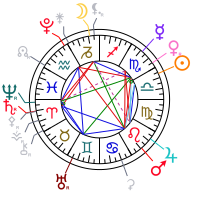
Below is Liza Minnelli's birth chart:
Joni Mitchell, An Exposed and Creative Lunar Sensitivity

A major singer-songwriter and performer on the North American scene, Joni Mitchell embodies a particularly expressive dominant Moon, in which emotional life and subjectivity directly nourish creation. Her work, deeply autobiographical, is based on a constant exploration of moods, emotional relationships, and inner movements, turning emotion into a primary artistic material.
The Moon, placed in Pisces and conjunct the Midheaven, occupies a strong angular position, closely linking vocation with sensitivity. This configuration reflects a public exposure of the intimate, where career becomes a direct extension of emotional life. Creativity is fueled here by hypersensitivity, fertile imagination, and an ability to grasp the most subtle nuances of inner experience.
The many challenging aspects involving the Moon, notably with Mars, Saturn, and Venus, highlight a permanent tension between the need for fusion, emotional demands, and a sense of lack. This emotional instability, far from hindering artistic expression, constitutes its primary driving force. It encourages lucid and sometimes painful writing, where fragility becomes a source of truth and authenticity.

Histogram of dominant planets for Joni Mitchell
In Joni Mitchell's chart, the dominant Moon does not retreat into the private sphere, but fully exposes itself in the public space through her work. It reveals a profoundly lunar temperament, marked by receptivity, subjectivity, and the ability to transform emotion into conscious creation. This angular, sensitive, and inspired Moon sheds light on the coherence of an artistic path in which the intimate becomes universal.
Joni Mitchell


You may also read the astrological portrait of Joni Mitchell.
Below is Joni Mitchell's birth chart:






 Title
Section
Title
Section


-Press-Photo-/00/s/MTAyNFg4NDU=/%24(KGrHqNHJBcE-dPs9M,cBPvQFczzdQ~~60_57.JPG?set_id=880000500F)