


 Sign In
Introduction
In the analysis of a birth chart, the Ascendant plays an essential role. It corresponds to the sign rising on the eastern horizon at the time of birth. It describes the spontaneous attitude, the way one approaches life, presents oneself to the world, and reacts to immediate circumstances.
However, the Ascendant does not work alone. Since each zodiac sign is ruled by a planet, the rising sign also has its ruling planet. A simple image is to compare the sign to a house, in the real estate sense rather than the astrological one: the planet that may be located there is the tenant, while the planet ruling the sign remains the owner. The latter therefore keeps a particular authority over the general atmosphere. In the case of the Ascendant, that is, the cusp or beginning of the 1st House, the ruling planet of the rising sign becomes the ruler of the Ascendant. Since the 1st House directly concerns identity, spontaneous behavior, incarnation, and the way one enters the world, its ruler is often called the chart ruler. It extends the Ascendant into the rest of the chart and indicates how this energy manifests, with what style, and in which area of life.
The chart ruler is not a magic formula that sums up the entire personality. It must be placed within the whole chart, along with the Sun, the Moon, the dominants, the occupied houses, the angles, and the aspects. Still, it remains one of the most valuable keys for understanding the deep orientation of behavior.
Sun, Ascendant, and Chart Ruler
The Sun, the Ascendant, and the chart ruler are often studied together, but they do not describe the same function. The Sun represents willpower, the center of consciousness, vital impulse, and the sense of identity. It indicates the direction toward which the individual tends to move in order to feel coherent with oneself.
The Ascendant shows the way one enters the world. It describes an initial attitude, an instinctive reaction, and a visible posture. It is often perceptible in behavior, appearance, style of contact, first impulse, and the ability to adapt to the environment.
The chart ruler links these two levels. The Ascendant is an angle, thus a point in the chart. Its ruler is a planet located in a sign and in a house, often connected to other planets through aspects, and therefore possessing a particular strength or fragility. It gives the Ascendant a concrete extension and shows where it seeks to express itself.
For example, an Ascendant in Gemini indicates a way of approaching life through curiosity, mobility, and exchange. Its ruler is Mercury. If Mercury is in the 10th House, intelligence, communication, or versatility may be strongly projected into the career. If Mercury is in the 4th House, the same energy may be directed more toward family, roots, intimate writing, or private life.
How to Find the Chart Ruler?
To find the chart ruler, for example on your birth chart, you simply need to identify the sign placed on the Ascendant, then the planet that rules this sign. This rule is based on the system of planetary rulerships, one of the foundations of traditional astrology.
The most common correspondences are the following:
- Aries rising: Mars
- Taurus rising: Venus
- Gemini rising: Mercury
- Cancer rising: the Moon
- Leo rising: the Sun
- Virgo rising: Mercury
- Libra rising: Venus
- Scorpio rising: Mars traditionally, Pluto in modern astrology
- Sagittarius rising: Jupiter
- Capricorn rising: Saturn
- Aquarius rising: Saturn traditionally, Uranus in modern astrology
- Pisces rising: Jupiter traditionally, Neptune in modern astrology
Astrologers do not all proceed in the same way with signs ruled by a modern planet. Some give priority to the traditional rulers, Mars for Scorpio, Saturn for Aquarius, and Jupiter for Pisces. Others use Pluto, Uranus, and Neptune as modern rulers. A balanced approach consists in taking both levels into account, while observing which one is more emphasized in the chart.
Historical Origin of Planetary Rulerships
The notion of chart ruler comes from the doctrine of planetary domiciles. In ancient astrology, the seven visible celestial bodies, the Sun, the Moon, Mercury, Venus, Mars, Jupiter, and Saturn, are associated with the twelve zodiac signs. Each planet has one or two signs in which it is considered to be at home.
This doctrine should not be attributed to a single inventor. It gradually took shape within ancient traditions, then was transmitted and organized by Hellenistic astrology. Authors such as Dorotheus of Sidon, Claudius Ptolemy, Vettius Valens, and Firmicus Maternus bear witness to the importance of these rules in ancient astrology and in its later development.
The classical logic of domiciles is based in particular on a symmetrical organization around Cancer and Leo. The Sun is associated with Leo, a sign of radiance, warmth, and centrality. The Moon rules Cancer, a sign of sensitivity, protection, and fluctuation. Starting from these two luminaries, the other visible planets are distributed on either side according to their traditional astronomical order.
Mercury rules Gemini and Virgo, Venus Taurus and Libra, Mars Aries and Scorpio, Jupiter Sagittarius and Pisces, and Saturn Capricorn and Aquarius. This structure, very coherent in ancient thought, is linked to a representation of the sky in which the visible planets form a symbolic hierarchy.
The Thema Mundi, the mythical horoscope of the world used in Hellenistic astrology, illustrates this logic. It is not a historical chart in the modern sense, but a symbolic diagram meant to explain several foundations of astrology, including domiciles, exaltations, and certain principles related to aspects.
The modern planets were integrated much later. Uranus, identified in the 18th century, received Aquarius as its sign of reference. Neptune entered astrological symbolism in the 19th century with Pisces, then Pluto in the 20th century with Scorpio. These modern attributions enrich contemporary interpretation, but they do not cancel the traditional architecture.
How to Interpret the Chart Ruler?
The chart ruler is always interpreted in several steps. The first consists in observing its planetary nature. For example, Mars does not describe the same dynamic as Venus, Saturn, or Jupiter. Mercury will emphasize intelligence, exchanges, and adaptation. Venus will be more oriented toward harmony, relationships, aesthetics, or the desire for conciliation. Mars will indicate energy for action, conquest, or immediate reaction.
The second step consists in studying its sign. The sign colors the planet's manner of operating. Mars in Aries moves with direct spontaneity, whereas Mars in Cancer may behave more defensively or emotionally. Mercury in Gemini readily shows intellectual mobility, while Mercury in Taurus seeks more stability, concreteness, and continuity.
The third step consists in looking at its house. This is often the most telling level for understanding the role of the chart ruler. The house shows the area where the Ascendant's energy naturally extends. It indicates toward which sector the individual is drawn, sometimes without even realizing it.
The aspects of the chart ruler then bring an additional nuance, especially when this planet is already emphasized in the chart. Thus, a planet well connected to Jupiter, Venus, or the Sun will not manifest in the same way as a planet strongly challenged by Saturn, Mars, Uranus, Neptune, or Pluto. However, an aspect should never be interpreted in isolation. Its orb, nature, the planet involved, and its overall importance in the chart must all be taken into account.
Finally, the planet's celestial and terrestrial condition deserves attention: domicile, exaltation, detriment, fall, retrogradation, combustion, angularity, or placement in a cadent or succedent house. These factors do not change the function of the chart ruler, but they may strengthen, slow down, internalize, or complicate its expression.
The Chart Ruler in a Sign
The sign of the chart ruler gives the planet its style. It is not enough to know that an Ascendant is ruled by Mercury, Venus, or Saturn. One must also know in which sign this planet is located.
When the chart ruler is in the same sign as the Sun, it often reinforces the solar tone. When its sign is identical to the rising sign, it strengthens the immediate expression of the Ascendant. In both cases, the personality may appear more concentrated around the same zodiacal color.
A chart ruler in a Fire sign tends to act with momentum, assertion, enthusiasm, or initiative. In an Earth sign, it gives a more concrete, cautious, realistic, or constructive orientation. In an Air sign, it emphasizes relationships, adaptation, thought, and the circulation of ideas. In a Water sign, it brings more sensitivity, intuition, emotional memory, or receptivity.
Planetary dignities further refine the interpretation. A planet in domicile acts more naturally. In exaltation, it may express a strong quality, sometimes very visibly. In detriment or fall, it is not necessarily weak, but it may need to find more complex paths in order to manifest. Here again, the synthesis of the chart remains decisive.
The Chart Ruler in a House
The house of the chart ruler shows the area of life toward which the Ascendant's energy is directed. It is one of the most useful pieces of information for moving from a general description of temperament to a more concrete interpretation of the chart.
In the 1st House, the chart ruler strengthens personal identity, presence, and the ability to act on one's own. In the 2nd House, it points toward resources, material security, talents, and the gradual building of stability. In the 3rd House, it emphasizes communication, learning, short trips, the immediate environment, and flexibility of adaptation.
In the 4th House, it brings the energy back toward roots, family, inner life, home, or real estate. In the 5th House, it highlights creativity, love, pleasures, children, or personal expression. In the 6th House, it stresses daily work, skill, service, health, organization, and self-improvement.
In the 7th House, it points toward the couple, associations, contracts, partnerships, and constructive confrontation with others. In the 8th House, it emphasizes deep transformations, intimacy, crises, shared resources, and the hidden realities of existence. In the 9th House, it pushes toward travel, higher education, philosophy, beliefs, spirituality, or the broadening of one's horizon.
In the 10th House, the chart ruler strongly connects identity with vocation, career, status, or social visibility. In the 11th House, it gives importance to friends, networks, group projects, protection, and collective commitments. In the 12th House, it directs the energy more toward inner life, behind-the-scenes activity, withdrawal, inspiration, psychic life, or experiences of solitude.
These indications should not be understood rigidly. The chart ruler in the 10th House does not guarantee a spectacular career, any more than the chart ruler in the 12th House condemns anyone to isolation. It only points to a privileged field of experience, whose quality will depend on the chart as a whole.
Aspects and Special Cases
The aspects of the chart ruler clarify the way this planet integrates into the rest of the chart. A harmonious aspect with the Sun may bring better coherence between willpower and behavior. A link with the Moon may make sensitivity more visible in the attitude. An aspect with Mercury may strengthen intellectual or verbal expression. A link with Venus, Mars, Jupiter, or Saturn also modifies the way the chart ruler manifests.
Aspects with Uranus, Neptune, or Pluto should be interpreted with caution. They may indicate a more unusual, inspired, unstable, intense, or transformative coloration, but they are never enough to define the whole personality. Their importance depends on the orb, the position of the planets, their status in the chart, and their relationship to the angles.
When the chart ruler is conjunct the Ascendant, it becomes particularly visible. The planet then manifests directly in behavior, physical presence, attitude, and the way one enters into relationship with the world. If it is close to the Midheaven, it may play a strong role in vocation, reputation, or social trajectory.
A retrograde chart ruler may indicate a more internalized, slower, or more reflective expression. It should not be seen as an automatic weakness. Retrogradation may signal a less direct way of using the planet, sometimes with greater depth or originality.
A chart ruler in the 12th House, in an intercepted sign, isolated, or strongly dissonant deserves particular attention. It may indicate detours, resistance, contradictions, or an expression that is not immediately readable. But here again, synthesis takes precedence over the rule. A difficult factor may be compensated for by angularity, dignity, constructive aspects, or a strong dominant.
Interpretation Examples
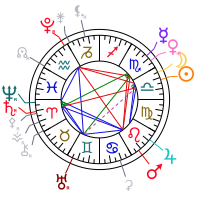
Examples help explain how the chart ruler works in practice. The point is not to isolate a single factor, but to show how it interacts with the Sun, the Moon, the dominants, the houses, and the aspects. The four selected personalities have reliable birth data, which is essential when working with the Ascendant and its ruler.
Madonna: Mercury, Ruler of the Virgo Ascendant
In Madonna's chart, the Ascendant is in Virgo. Its ruler is therefore Mercury, also in Virgo, at 5°39, retrograde, in the 12th House according to the house system and the 2-degree threshold for moving a planet into the next house used by Astrotheme. This case is particularly interesting, because Mercury is in domicile, dominant in the chart, and very close to the Ascendant.
Virgo emphasizes control, work, precision, strategy, and attention to detail. The 12th House adds a more hidden dimension: behind-the-scenes preparation, mastery of image, inner discipline, and the ability to transform oneself away from the immediate gaze of the public. Even though this position is close to the cusp of the 1st House, the 12th House interpretation remains meaningful for an artist who has often built her persona with remarkable lucidity.
The chart ruler obviously does not replace the Leo, Virgo, and Gemini dominants, nor the role of the Sun and the Moon. However, it connects them to a very strong Mercurial function, made of tactical intelligence, adaptability, and control of form.
Albert Einstein: the Moon, Ruler of the Cancer Ascendant
Albert Einstein has a Cancer Ascendant. The ruler of his Ascendant is therefore the Moon, located at 14°32 Sagittarius in the 6th House. This example shows that a chart ruler should never be interpreted too literally. The Moon does not spontaneously evoke the image of a scientist, but here it occupies a sign of the search for meaning and a house linked to work, method, and daily effort.
Cancer on the Ascendant underlines a particular receptivity, a vivid memory, and sensitivity to impressions and deep rhythms. The Moon in Sagittarius broadens this perception toward major questions, general principles, and distant horizons. Placed in the 6th House, it brings this quest back to concrete work, the organization of thought, and the patient repetition of effort.
The Pisces, Sagittarius, and Cancer dominants, as well as the importance of the Moon, Neptune, and the Sun, reinforce this impression of visionary intuition linked to research discipline. Here, the chart ruler helps us understand how very fine sensitivity can become an instrument of knowledge.
Marilyn Monroe: the Sun, Ruler of the Leo Ascendant
Marilyn Monroe offers a very instructive example, because her Ascendant is in Leo. The ruler of the Ascendant is therefore the Sun, placed at 10°27 Gemini in the 11th House, near the cusp. The link between the Leo Ascendant and the solar ruler immediately highlights the question of image, radiance, presence, and recognition.
The Sun in Gemini, however, nuances this radiance with a more mobile, youthful, changeable, and media-oriented dimension. It is not only a matter of shining, but of attracting attention through play, speech, apparent lightness, multiple facets, and great plasticity of expression. The 11th House adds the role of the public, networks, collective image, and social projection.
In this chart, the Leo, Gemini, and Aquarius dominants, as well as Neptune, the Sun, and the Moon, show that fame does not rely only on the Sun as ruler of the Ascendant. But the latter offers a simple and strong key: visible identity is built around solar radiance, diffused through the collective space of the 11th House.
Barack Obama: Saturn and Uranus, Rulers of the Aquarius Ascendant
Barack Obama has an Aquarius Ascendant. This sign illustrates the double rulership, traditional and modern. Saturn, the traditional ruler of Aquarius, is at 25°20 Capricorn in the 12th House. Uranus, the modern ruler, is at 25°16 Aquarius in the 7th House. Both planets are in signs of strength, which makes the example particularly interesting.
Saturn in Capricorn, in the 12th House, evokes inner mastery, discreet discipline, and the ability to carry responsibilities with restraint or solitude. Uranus in Aquarius, in the 7th House, places more emphasis on the relationship to the collective, alliances, opponents, partners, debates, and confrontation with others. The 7th House is essential for a political figure, since it concerns both agreements and oppositions.
This chart illustrates the value of not separating traditional and modern rulerships too sharply. Saturn indicates structure, patience, control, and long-term construction. Uranus evokes openness to change, the collective dimension, and an image of renewal. Together, they provide a richer interpretation of the Aquarius Ascendant and of its way of engaging in public life.
The Chart Ruler in the Chart Synthesis
The chart ruler is an important key to understanding the natal map, because it links a very personal point to an actual planet. It shows how the Ascendant unfolds, through which psychological function, in which sign, and in which area of life.
However, it should never be separated from the chart as a whole. A birth chart is not a mechanical addition of factors. It is an architecture in which each element takes on its value in relation to the others. The chart ruler must therefore be connected with the luminaries, the dominants, the major aspects, the angles, the occupied houses, and the general distribution of the planets.
Properly understood, it helps clarify the natural orientation of one's behavior. It indicates where the individual spontaneously seeks to invest energy, how the Ascendant is extended, and how one builds a relationship with the world.
In a personalized astrological portrait, the chart ruler in sign and house thus brings a valuable nuance to the interpretation of the Sun and the Ascendant. Its study helps turn a general description into a more individualized, vivid reading that is more faithful to the complexity of the birth chart.



 Title
Section
Title
Section