


 Sign In
After the planetary shifts of 2025 and the major reshaping of the sky in 2026, the trine between Jupiter and Saturn is one of the guiding threads of the 2026-2027 period. The aspect becomes exact three times, on August 31, 2026, April 3, 2027, and July 11, 2027, each time between Jupiter in Leo and Saturn in Aries.
In mundane astrology, a trine does not erase the crises or tensions present elsewhere in the sky. It points instead to a smoother flow between two planetary functions: here, Jupiter's expansion, confidence, and vision can find a framework, continuity, and method through Saturn. The repetition of the aspect, caused by successive retrograde phases, also reveals a multi-stage dynamic rather than an isolated event.
Jupiter and Saturn, Expansion and Structure
Jupiter amplifies, opens up perspectives, and supports development. Traditionally, it is also associated with law, principles, international exchanges, and the search for a broader horizon. Saturn, by contrast, narrows, organizes, tests solidity, and anchors achievements over time.
When these two planets form a harmonious aspect, especially a trine, their differences can prove complementary. Jupiter provides momentum and Saturn continuity; one develops what the other can structure. On the collective level, this combination is traditionally associated with periods when growth becomes more orderly, rules stabilize, and ambitious projects find concrete ways to endure.
Their current cycle began with the conjunction of December 21, 2020, in Aquarius. The 2026-2027 trine therefore does not mark its origin, but a stage in the development of the same cycle: what has emerged since the conjunction can now seek a more coherent, more viable, and better structured form.
A Fire Trine Between Leo and Aries
The distinctive feature of this series lies in its Fire emphasis. Jupiter moves through Leo, a sign of radiance, creativity, self-assertion, and ambition, while Saturn travels through Aries, a sign of initiative, action, and conquest.
Jupiter in Leo tends to broaden perspectives, stimulate the desire to excel, lead, or give a project greater scope. This placement can support confidence and a flair for presentation, but it also carries a risk of exaggeration, prestige sought for its own sake, or an overestimation of what is possible.
Saturn in Aries is in fall. The planet of patience and maturation must contend with a sign that prefers to act quickly and blaze a trail. Jupiter's trine can nevertheless help turn this tension into deliberate discipline: undertake, but with a strategy; move forward, while keeping the initiative viable.
The result is therefore less contemplative than constructive. This Fire trine can accompany phases in which ambition becomes more concrete, leadership acquires structure, and large-scale projects progress from impulse to implementation. It does not guarantee that what emerges is desirable in itself: a harmonious aspect can also bolster an existing system, authority, or balance of power.
Three Exact Passes and Four Periods of Influence
For this article, we use a relatively tight orb of 2°30'. This choice does not mean that the influence begins or ends at this threshold; it defines the periods when the trine stands out as a major configuration.
From October 17 to December 18, 2025, a first approach occurs without the aspect becoming exact. Jupiter is still in Cancer and Saturn in Pisces: the gap narrows to about 0°10' in mid-November, then widens again under the effect of the planetary motions. This phase foreshadows the series to come, but in Water signs and without the trine becoming exact.
From August 21 to September 10, 2026, the trine becomes exact for the first time on August 31, 2026, at 21:17 UT. Jupiter is direct, while Saturn is retrograde.
From March 20 to April 23, 2027, the aspect returns and becomes exact on April 3, 2027, at 11:59 UT. This time, Jupiter is retrograde and Saturn direct.
From June 20 to July 27, 2027, a final active period surrounds the third exact pass on July 11, 2027, at 22:16 UT. Jupiter and Saturn are then both direct.
This sequence is essential to understanding the transit. The first pass confronts Jupiterian expansion with a Saturn that is reassessing its structures; the second reverses the pattern, as Jupiter revisits its ambitions while Saturn moves forward; the third finally brings both planets together in direct motion. The retrograde phases therefore do not create three separate stories, but three stages of the same process of adjustment and consolidation.
The Three Exact Trine Charts
August 31, 2026, Constructive Potential Under Tension
On August 31, 2026, at 21:17 UT, Jupiter at 13°41' Leo forms its first exact trine with retrograde Saturn at 13°41' Aries. The harmonious nature of the aspect is real, but the rest of the sky immediately reminds us that this is not a uniformly easy period.
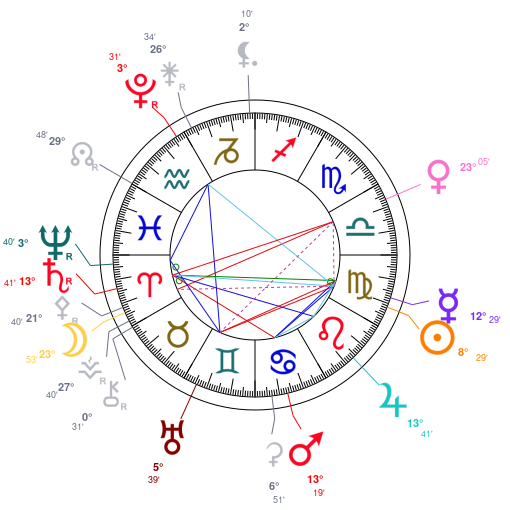
Mars at 13°19' Cancer forms a nearly exact square to Saturn, with an orb of 0°21'. Action therefore encounters constraints, delays, or resistance, which paradoxically reinforces the central theme of the trine: for something to last, an initiative must engage with reality rather than rely on enthusiasm alone.
At the same time, the collective backdrop is remarkably structured by the slow-moving planets. Neptune forms a sextile to Pluto with an orb of 0°09', Uranus a sextile to Neptune at 1°59' and a trine to Pluto at 2°08'. This harmonious network links deep transformation, innovation, and collective aspirations, while the square between the Sun and Uranus at 2°49' maintains an element of instability and unpredictability. Mercury sextile Mars at 0°50', by contrast, supports responsiveness, organization, and the translation of intentions into concrete decisions.
April 3, 2027, Revising to Build More Effectively
The second exact pass occurs on April 3, 2027, at 11:59 UT, with Jupiter and Saturn at 17°08' in Leo and Aries respectively. Jupiter is retrograde, while Saturn is direct: expansion, goals, and promises call for reassessment, whereas the Saturnian principle seeks to establish a clearer framework.
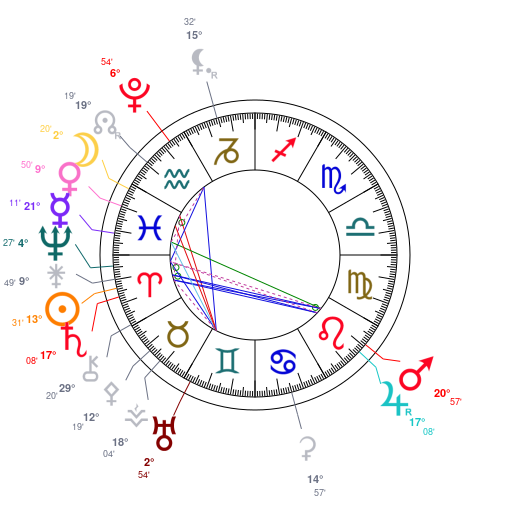
This chart strongly reinforces the Fire emphasis of the trine. The Sun is conjunct Saturn at 3°37' and trine Jupiter with the same orb; Mars is conjunct Jupiter at 3°48' and trine Saturn, again with an orb of 3°48'. Around the exact aspect, a highly coherent pattern of conjunctions and cross-trines emerges, combining will, action, expansion, and structure.
This second pass can correspond to a phase of revision: the emphasis is no longer only on imagining or launching, but on reworking what requires correction in order to give a project firmer foundations. The Moon square Uranus at 0°34' nevertheless signals a more nervous and unpredictable climate, while the Mercury-Mars quincunx at 0°14' calls for adjustments between thought, communication, and implementation.
The network of slow-moving planets is still present, with Uranus sextile Neptune at 1°32', Neptune sextile Pluto at 2°27', and Uranus trine Pluto at 3°59'. The Jupiter-Saturn trine therefore remains embedded in a broader collective transformation, even if its specific role here appears to be selecting, organizing, and making certain developments workable.
July 11, 2027, Toward More Direct Expression
The third and final exact pass occurs on July 11, 2027, at 22:16 UT, at 27°10' Leo-Aries. Jupiter and Saturn are both direct this time, which clearly changes the dynamic compared with the previous two passes: the review phase is less dominant, and decisions can more readily find outward expression.
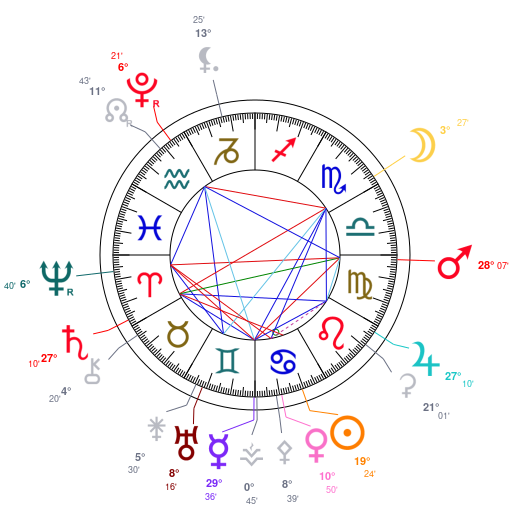
Mercury at 29°36' Gemini forms a sextile to Jupiter and a sextile to Saturn, with an orb of 2°25' in both cases. This double relationship symbolically favors articulation, negotiation, the circulation of information, agreements, and coordination between overall vision and practical constraints.
The sky is nevertheless not free of tension. Mercury is square Mars at 1°28', Mars forms a quincunx to Saturn at 0°57', and the Moon is square Pluto at 2°54'. Friction can therefore persist in implementation, along with power struggles or a tendency to move faster than concrete conditions allow.
The slow-moving planetary backdrop is even tighter than during the first pass: Neptune is sextile Pluto at 0°18', Uranus sextile Neptune at 1°36', and trine Pluto at 1°54'. This third chart thus presents a Jupiter-Saturn trine fully integrated into a set of deeper transformations, with greater possibilities for articulation and concrete realization, but without the tensions disappearing.
Building in a Changing World
In mundane astrology, the value of such an aspect lies in relating its symbolism to major collective spheres without mechanically assigning specific events to it. At the time of the first exact pass in 2026, the international context remains marked by protracted conflicts, notably the war between Russia and Ukraine and confrontations in the Middle East. These situations bring questions of security, alliances, negotiations, guarantees, reconstruction, and the reorganization of exchanges to the forefront.
In this context, the Jupiter-Saturn trine can correspond to a search for stronger frameworks: solutions that can work over time, more clearly defined institutional arrangements, or long-term coordination mechanisms. It would nevertheless be excessive to infer an automatic easing of tensions. A harmonious configuration can help an understanding endure, but it can also consolidate an alliance, a military strategy, or a balance of power.
The legal and administrative sphere is another natural field for this combination. Jupiter is associated with principles, law, and overall vision; Saturn with rules, obligations, and institutions. Their trine can accompany periods when standards become more precise, reforms seek a balance between ambition and feasibility, or long-term investments require greater financial and regulatory discipline.
The current artificial intelligence revolution illustrates this need for oversight particularly well, without implying that Jupiter-Saturn represents AI itself. Technological acceleration now calls on societies to develop infrastructure, mobilize substantial resources, adapt the law, organize training, and rethink part of the world of work. In this field, the trine can symbolize the shift from a phase of rapid expansion to one in which innovation must fit within sustainable economic, social, and legal models.
This technological shift belongs more broadly to the backdrop shaped by Uranus, Neptune, and Pluto. Their repeated harmonious aspects in all three charts create an exceptional underlying pattern. Jupiter and Saturn seem to describe less the disruption itself than the way some of these transformations can be absorbed and consolidated over time.
Conclusion, Building for the Long Term
The three exact passes of the Jupiter-Saturn trine form a particularly clear sequence. In August 2026, retrograde Saturn brings expansion up against the need to review structures; in April 2027, retrograde Jupiter calls for reassessing ambitions and promises; in July 2027, the two planets in direct motion open a phase more favorable to the concrete expression of what has been adjusted.
The strength of this aspect lies less in the prospect of ease than in the possibility of making growth more solid. Leo provides scope and confidence, Aries supplies impetus, while Saturn reminds us that every lasting achievement requires limits, method, and time.
In a collective sky deeply transformed by the slow-moving planets, the Jupiter-Saturn trine can thus act as a hinge between innovation and institutionalization, ambition and responsibility, openness and consolidation. It does not erase the world's crises, but symbolically offers more favorable ground for turning certain developments into structures capable of lasting.



 Title
Section
Title
Section