


 Sign In
Introduction
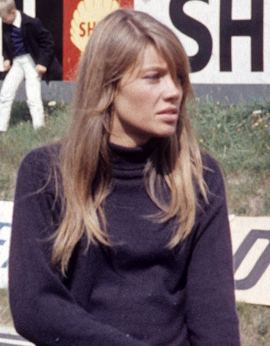
Françoise Hardy was born on January 17, 1944, in Paris. Drawn to music from an early age, she learned guitar and began composing her own songs before she was known to the public. In 1961, she landed a contract with Vogue, and the following year Tous les garçons et les filles, for which she wrote the lyrics and melody, propelled her into the spotlight. Her melancholy tone, gentle voice, and way of singing about longing, loneliness, and romantic disappointment stood apart from the carefree mood associated with many young stars of the era. At eighteen, she emerged as one of the emblematic figures of her generation.
Her success soon extended beyond France. She recorded in several languages, worked in London, represented Monaco at the Eurovision Song Contest in 1963, and gained admirers among artists abroad. Bob Dylan dedicated a text to her, while David Bowie later spoke of the fascination she exerted on him. She appeared in a handful of films, including Grand Prix in 1966, but her career remained centered on singing and songwriting. Her long, slender silhouette and understated style, with an androgynous edge, also made her a fashion icon of the 1960s.
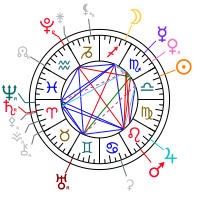
Her chart highlights Gemini, Capricorn, and Virgo as the dominant signs. Mars, Uranus, and Mercury rank first among the dominant planets, while the Houses 9th, 4th, and 2nd are the most prominent. Air and Earth, together with a strong Mutable emphasis, already suggest a characteristic blend of intellectual agility, perspective, lucidity, and a need to keep potentially overwhelming experiences under control.
Mars-Uranus at the Midheaven and the Need for Independence
The most striking configuration in the chart is the conjunction of Mars and Uranus in Gemini, with an orb of just 0°06'. Her two leading planetary dominants are separated by only six minutes of arc and lie in the 9th House, a little over two degrees from the Midheaven. Mars is conjunct the MC with an orb of 2°32', and Uranus with 2°39'. Such a concentration links action, speed, daring, and the need for autonomy with career direction and public image. Hardy's rise was like a bolt of electricity. Within a few months, a deeply reserved teenager was catapulted to national stardom.
Gemini gives this conjunction a cerebral, restless, and curious expression. It suits an artist who writes as well as performs, pays close attention to words, works with sound, and moves easily from one cultural world to another. The 9th House, the most dominant house in the chart, broadens the scope. Foreign countries, languages, travel, and systems of thought all take on importance. Hardy recorded in English, German, and Italian at an early stage, sought more modern arrangements in London, and built part of her career outside French conventions. Much later, this same 9th House would also resonate with her deep interest in astrology and broader frameworks for understanding human nature.
Uranus adds an instinctive refusal to be boxed into a role. Even as she became an emblematic figure of the yé-yé era, Hardy disliked the constraints of fame and eventually gave up touring and live performance. Her freedom came more through choosing her songs, collaborators, and arrangements than through the pursuit of spectacle. Mars also forms a trine to Neptune with an orb of 1°00'. The energy of this highly charged conjunction can therefore be channeled into inspiration, atmosphere, and creative work that is far more sensitive than combative. Pluto lends further support through a sextile to Mars at 2°37', strengthening determination and the ability to mobilize inner resources over the long term.
Virgo Ascendant and Mercury's Inner Laboratory
The Ascendant is in Virgo, the chart's third dominant sign. This placement corresponds to reserve, keen observation, discretion, and a tendency to notice first what could be improved rather than what deserves admiration. In Françoise Hardy's case, the contrast between the enormous appeal she exerted on her generation and the much harsher view she held of herself is striking. Her chart ruler, Mercury, is also the third dominant planet. Retrograde in Capricorn in the 4th House, it strengthens introspection, the need to analyze the past, and a serious, sometimes anxious habit of revisiting personal experiences.
Mercury forms a square to Neptune with an orb of 4°45'. Since Mercury rules both the Virgo Ascendant and Gemini, the chart's leading dominant sign, this aspect carries more weight than its orb alone might suggest. It can make the mind swing between lucidity and imagination, meticulous checking and feared scenarios, accurate intuition and excessive worry. Hardy often spoke openly about her shyness, her lack of confidence, and her tendency to anticipate the worst. In writing, the same combination becomes fertile. Reality is observed in fine detail, then imbued with a poetic, nostalgic, almost dreamlike resonance.
Her interest in astrology went far beyond a celebrity's curiosity about her Sun sign. From the 1970s onward, she contributed to specialized books, took part in Le Grand Livre de la Vierge, later co-hosted the program Entre les lignes, entre les signes on Radio Monte-Carlo with graphologist Anne-Marie Simond, and published Les Rythmes du zodiaque in 2003. She was particularly drawn to the work of astrologer Jean-Pierre Nicola and the conditionalist school of astrology. Mercury, ruler of the Ascendant and of dominant Gemini, combined with a prominent 9th House and powerful Uranus, gives remarkable coherence to an intellectual passion that remained with her for decades.
Venus Opposite Saturn and Love at a Distance
In relationships, the opposition between Venus and Saturn, with an orb of 3°09', is one of the chart's essential configurations. Venus is in Sagittarius in the 4th House, while Saturn is in Gemini in the 10th House. The need for warmth, closeness, and private security therefore meets a planet associated with time, distance, waiting, and restraint. This kind of aspect does not doom love; it often subjects it to the test of duration and reality, sometimes in forms that depart from a conventional partnership.
Her relationship with Jacques Dutronc offers a telling example. They met in the 1960s, became a couple in 1967, had their son Thomas Dutronc in 1973, and married in 1981. Over the years they came to live more and more apart, especially after Dutronc settled in Corsica, yet they never divorced and remained close until the end. Hardy spoke openly about her romantic anxieties, jealousy, and sense of loneliness. In her memoirs, she even recalled panicking at the idea that Dutronc might work with Charlotte Rampling, whom she found irresistible; the film project never materialized.
The chart, however, offers an important counterweight. The Moon in Libra forms an exceptionally tight sextile to Venus, with an orb of only 0°04', and a trine to Saturn at 3°04'. It therefore acts as a mediator between the two ends of the opposition. Tenderness and attachment can outlast frustration, while Saturn turns time into a factor of continuity rather than simple rupture. This configuration fits a relationship that changes form without disappearing. Their marriage was anything but conventional, yet it endured for decades.
The Moon in Libra and Melancholy Elegance
The Moon in Libra, in the 2nd House, combined with its nearly perfect sextile to Venus, brings a softness that contrasts with the electricity of Mars-Uranus and the more austere tone of the Virgo Ascendant and Capricorn Sun. Libra favors balance, harmony, and beauty without ostentation. Hardy possessed precisely this quality, one that is difficult to manufacture. Even in spectacular clothes, she rarely seemed to be trying for effect. Much of her charm came from restraint, her gaze, and an almost distant way of letting the image speak for itself.
In the 1960s, her long, slender silhouette helped establish a new kind of femininity, more graphic than voluptuous, later compared with that of Jane Birkin, even though the two women projected very different temperaments. Hardy embraced slim trousers, boots, minidresses, structured jackets, and futuristic designs. She became one of the muses of Paco Rabanne, whose famous metal dresses she wore. Her androgynous streak fits the blend between lunar and Venusian grace on one side and the strong imprint of Uranus and Gemini on the other. The result is a refined femininity resistant to predictable codes.
Neptune, also in the 2nd House, reinforces the intangible quality of her presence. It contributes to her light, instantly recognizable voice, her way of suggesting more than asserting, and the melancholy atmosphere running through much of her repertoire. The contrast is striking. Behind a tightly controlled appearance, something always seems to float just out of reach. This is probably one reason Françoise Hardy's image has aged so well. Her appeal belongs less to a particular era than to this rare blend of distance and fragility.
The Sun in Capricorn and a Lasting Body of Work
The Sun is at 26°37' Capricorn in the 5th House. Capricorn, the chart's second dominant sign, gives self-expression a demanding, serious, and enduring cast. The 5th House is the realm of creativity, the works we produce, and the pleasure of shaping something that comes from within. Françoise Hardy belonged to a generation in which many young performers depended on professional songwriters; from her first record, by contrast, she insisted on making room for her own songs. This creative standard helps explain how she moved beyond the simple status of a yé-yé idol.
The Sun in the 5th House also places transmission and the child at the heart of identity. Thomas remained central in her life and in turn became a musician, guitarist, and singer. Their artistic bond deepened over the years, and he took part in some of his mother's projects. This placement thus neatly connects two forms of continuity through works that endure and a son who carries the family's creative legacy forward in his own way. Capricorn adds a sense of duration. Hardy evolved, withdrew from the spotlight, returned, wrote books, and kept recording well beyond the era that first made her famous.
Her later years were marked by serious illness and grueling treatments. It would be inappropriate to look for an astrological explanation for a disease in a natal chart. What can be noted, however, is how the Capricorn-Earth tone of the chart resonates with the clear-eyed way she approached aging, suffering, and the end of life, subjects she discussed with growing candor. After going through lymphoma and later health problems, she still released Personne d'autre in 2018, her final album. Françoise Hardy died on June 11, 2024, at age eighty, leaving behind more than six decades of songs, writing, and an influence extending far beyond the generation that first discovered her.
Conclusion
Françoise Hardy's chart rests on a clear contrast. A reserved, analytical, and controlled exterior, shaped by the Virgo Ascendant and Capricorn, contains a highly mobile, independent Mars-Uranus core that resists imposed frameworks. The discreet icon thus concealed a personality far freer and bolder than her public manner might have suggested.
The exact softness of Moon-Venus and the gravity of Venus-Saturn give this independence its recognizable emotional tone, made up of a longing for connection, distance, loyalty, and melancholy. From Tous les garçons et les filles to her books on astrology, from Jacques to Thomas Dutronc, Françoise Hardy followed a remarkably consistent thread, trying to understand what binds people together while preserving the inner space she seemed to need in order to create.
Françoise Hardy


You can also consult the Astrotheme astrological portrait of Françoise Hardy.
Below, you will find Françoise Hardy's interactive birth chart:
Aries
Taurus
Gemini
Cancer
Leo
Virgo
Libra
Scorpio
Sagittarius
Capricorn
Aquarius
Pisces
Sun 26°37' Capricorn, in House V
Moon 17°38' Libra, in House II
Mercury 8°58' Я Capricorn, in House IV
Venus 17°33' Sagittarius, in House IV
Mars 5°13' Gemini, in House IX
Jupiter 25°09' Я Leo, in House XII
Saturn 20°42' Я Gemini, in House X
Uranus 5°07' Я Gemini, in House IX
Neptune 4°13' Я Libra, in House II
Pluto 7°50' Я Leo, in House XI
North Node 6°50' Leo, in House XI
Lilith 4°43' Я Virgo, in House XII
Fortune 21°32' Sagittarius, in House IV
Vertex 20°19' Aquarius, in House VI
East Point 4°06' Virgo, in House XII
Ascendant 12°32' Virgo
House II 4°54' Libra
House III 3°16' Scorpio
House IV 7°46' Sagittarius
House V 14°17' Capricorn
House VI 16°16' Aquarius
House VII 12°32' Pisces
House VIII 4°54' Aries
House IX 3°16' Taurus
Midheaven 7°46' Gemini
House XI 14°17' Cancer
House XII 16°16' Leo
Ascendant 12°32' Virgo
Midheaven 7°46' Gemini


* A planet less than 1° from the next House cusp is considered to be posited in the said House. 2° when the AS and the MC are involved



 Title
Section
Title
Section
.jpg)