


 Sign In
A tight square appears in your birth chart. An opposition connects two important planets. Should you immediately expect complications, failures, or a life strewn with obstacles? Challenging aspects have earned their reputation. In astrological interpretation, they describe genuine tensions.
The square and the opposition are the two best-known challenging aspects. Some conjunctions can also take on a dissonant character, depending on the planets involved and the other aspects they receive. Yet a difficulty does not always produce the consequences we imagined. Some vulnerabilities diminish with age. Others become unexpected resources through sustained effort. But it would be naive to claim that every ordeal does us good in the end. Life has a way of exposing the limits of such optimism.
Much also depends on what we are studying. A challenging aspect in a natal chart is not interpreted in the same way as a transit. And synastry has a few surprises in store. Three situations, then, and three ways of understanding what "negative" really means.
In the Natal Chart, a Difficulty Can Become a Strength
A square connects two functions that struggle to work together naturally. An opposition creates a pull between two poles, sometimes experienced as alternating impulses or projected onto other people. Both aspects remain challenging in natal interpretation, but they do not call for the same inner work or produce identical reactions.
The Sun, associated with identity and willpower, may struggle to find common ground with Saturn, the planet of demands and limitations. A Sun–Saturn square, for example, may accompany a lack of confidence, a difficult relationship with authority, or the fear of never measuring up. Over the years, some people learn to handle this inner pressure more effectively. They retain Saturn's seriousness while developing greater independence and resilience. For others, inhibitions remain burdensome. The passage of time guarantees no automatic transformation.
Harmonious aspects in the chart have a valuable role to play. They bring natural advantages, support personal abilities, and can help someone overcome an area of vulnerability. But they do not erase the dissonances. Two seemingly contradictory tendencies may coexist for decades. Visible success in one area does not mean that everything there is free of inner turmoil.
That is why a challenging aspect must be assessed in terms of its exactness, the dominants, the houses involved, and the other aspects that support or complicate it. A planet opposite the Midheaven, for instance, is also conjunct the Imum Coeli (IC), the angle of the 4th house. We must interpret this conjunction to the opposite angle, rather than mechanically predicting career difficulties.
It would be just as misleading to assert that Saturn under difficult aspects in the 2nd house necessarily means poverty, or that a challenging aspect in the 10th house rules out an outstanding career. A birth chart describes, first and foremost, a pattern of tendencies and subjective experiences. It does not hand down a material verdict on each area of life. And some inner conflicts remain painful without turning into special qualities.
Jennifer Lawrence: When a Tension Finds a Way to Express Itself
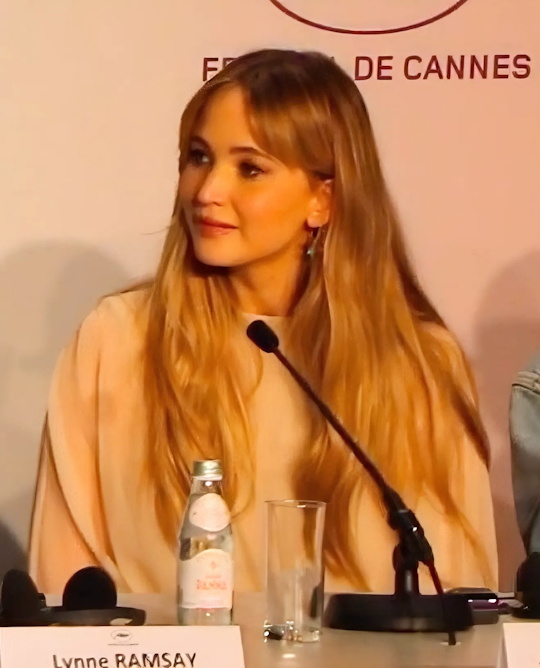
The case of Jennifer Lawrence, whose recorded birth time has an AA reliability rating, is revealing. Her Moon in Gemini and in the 7th house squares Mercury in Virgo, conjunct the Midheaven, with an orb of just 1°32'. This Moon–Mercury dissonance is all the more interesting because the Moon is in conflict with its own ruler, Mercury, which nevertheless occupies a particularly strong position.
Indeed, Mercury belongs to a remarkably precise Grand Trine in Earth. It is linked to Saturn by a trine with an orb of 0°12', and to Mars by another trine at 1°55'. The Mars–Saturn trine has an orb of 1°42'. This is a powerful indication of unusual professional discipline and an exceptional capacity for work. It does not, however, eliminate a more nervous sensitivity or a concern about how others perceive her.
In 2015, the actress spoke about earning less than her male co-stars for the film American Hustle. She admitted that she had not pushed harder during salary negotiations because she feared seeming difficult and wanted to be liked. She then said she intended to stand up for herself. Her account, covered by Vogue, echoes this square between the Moon in the 7th house, associated with agreements, and Mercury on the Midheaven, linked to communication in public life.
This interpretation does not pretend that astrology explains pay inequality. It illustrates something else. A person may have remarkable resources for success and still find it difficult to assert herself in certain relationships. Talent does not erase these vulnerabilities. Jennifer Lawrence recognized the problem and expressed her determination to change how she approached it.
Jennifer Lawrence's Birth Chart
Aries
Taurus
Gemini
Cancer
Leo
Virgo
Libra
Scorpio
Sagittarius
Capricorn
Aquarius
Pisces
Sun 22°42' Leo, in House IX
Moon 21°11' Gemini, in House VII
Mercury 19°38' Virgo, in House X
Venus 2°18' Leo, in House VIII
Mars 21°34' Taurus, in House VI
Jupiter 29°28' Cancer, in House VIII
Saturn 19°51' Я Capricorn, in House II
Uranus 5°58' Я Capricorn, in House II
Neptune 12°11' Я Capricorn, in House II
Pluto 15°05' Scorpio, in House XII
North Node 7°15' Aquarius, in House II
Lilith 16°08' Sagittarius, in House I
Fortune 1°20' Libra, in House X
Vertex 17°55' Cancer, in House VIII
East Point 19°07' Sagittarius, in House I
Ascendant 2°52' Sagittarius
House II 4°29' Capricorn
House III 10°55' Aquarius
House IV 17°08' Pisces
House V 17°43' Aries
House VI 12°12' Taurus
House VII 2°52' Gemini
House VIII 4°29' Cancer
House IX 10°55' Leo
Midheaven 17°08' Virgo
House XI 17°43' Libra
House XII 12°12' Scorpio
Ascendant 2°52' Sagittarius
Midheaven 17°08' Virgo


* A planet less than 1° from the next House cusp is considered to be posited in the said House. 2° when the AS and the MC are involved
In Forecasting, a Difficult Phase Does Not Necessarily Mean Failure
Astrological transits raise a different question. They no longer describe only an enduring disposition, but the atmosphere of a particular period. A square from Saturn or an opposition from Uranus may coincide with restrictions, weariness, anxiety, or a need to reconsider one's direction. These feelings can be intense even when no dramatic external event takes place.
This distinction is essential. In forecasting, astrology primarily indicates the probability of a subjective experience, not the certainty that a specific event will occur. When powerful, close, and repeated transits converge, particularly alongside other consistent indicators, the likelihood of a concrete manifestation increases. Yet an inner experience and actual external circumstances are not interchangeable.
Consider a simple example. Someone goes through a period of professional tension. They fear losing their position, feel trapped, and become increasingly uncomfortable in their working environment. Eventually, they leave a job that no longer suits them and find an occupation that is a better fit. The transition may have been painful, but it opens the way to a new balance. A move or a separation may follow a similar pattern. The difficulty itself was not pleasant. What matters is the change that became possible afterward.
Challenging transits can therefore accompany major turning points. They may reveal what can no longer be sustained, undermine old certainties, or bring forward a decision that has long been postponed. Secondary progressions and solar returns, depending on the methods used, may offer additional indications. But we must still weigh the various factors and keep the natal chart as the foundation of interpretation.
We must not turn the possibility of rebuilding one's life into a universal law. A serious illness, an accident, the loss of a loved one, or an act of violence suffered does not become a blessing because an astrologer insists on finding meaning in everything. Some ordeals leave irreversible scars. Presenting them as necessary steps toward fulfillment would be as unfair as it is absurd. Nor can a particular tragedy be deduced from one isolated aspect.
Some difficult periods end with nothing more than relief, without a revelation or a dramatic change of direction. That is already something. The purpose of an astrological forecast is to help people gain perspective, understand the tone of the period, and make the best use of their freedom to act. It should neither trap readers in the expectation of disaster nor promise that every hardship will ultimately benefit them.
In Synastry, Not All Oppositions Are Unfavorable
Comparing two birth charts introduces a further nuance, and a significant one. An opposition that is interpreted as challenging within a natal chart can become a source of complementarity in a relationship. Its meaning then depends heavily on the planets involved, their nature, and how the partners experience their differences.
For example, a Sun–Moon opposition between two people can be highly favorable. What creates an inner conflict in an individual chart takes the form of two functions shared between partners. Each brings qualities that complement the other's. With Venus and Mars, certain oppositions can work along similar lines, although their interpretation in a natal chart is much less favorable. These contrasts can attract, stimulate, and enrich a relationship.
By contrast, a Moon–Saturn square between two charts can become painful when one partner's sensitivity is met with persistent coldness, criticism, or demands from the other. An opposition between planets whose natures are hard to reconcile can also strain the relationship. In synastry, it would be a mistake to treat every square and every opposition as interchangeable.
Not all friction is pointless. Partners who resemble each other in every respect may lack stimulation, while a difference in temperament can open up new perspectives. Talking, negotiating, adjusting, and getting to know each other bring a relationship to life. But there is a line between a disagreement that enriches the bond and a tension that hurts or wears people down over time.
Synastry can never be reduced to counting harmonious and challenging aspects. We need to examine their nature, exactness, repetition, and consistency with both individual charts. Our advice on understanding synastry explores the subject further. The essential point here is that an "opposition" does not automatically mean a "conflict" when two people are involved.
Conclusion
Dissonant aspects are not blessings in disguise. They represent tensions, contradictions, or resistance that may require a great deal of effort. In the natal chart, some can be mastered through hard work and become a source of maturity. In forecasting, trying periods may precede positive changes. In synastry, certain oppositions prove to be genuine assets for a couple.
But there is no automatic rule. Harmonious aspects do not make dissonances harmless, any more than dissonances cancel out a chart's strengths. They coexist, sometimes on entirely different levels. Interpretation means understanding how they interact, not tallying the good points against the bad.
So what should we tell someone who has just discovered several squares in their birth chart and is worried by them? They do not condemn you to failure. Nor do they promise some hidden strength as a reward for every painful experience. They point to issues to face, understand, and, where possible, move beyond. Everything else depends on the whole chart, your personal history, and your decisions. That is precisely what makes astrology more interesting than sorting aspects into two neat columns.


 Title
Section
