


 Sign In
Nature and Foundations of the Method
Secondary progressions, also known as progressions, are a forecasting technique based on a symbolic analogy between astronomical time and lived time. The principle is that one day after birth symbolically corresponds to one year of life.
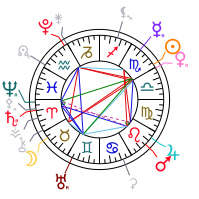
Thus, to study the age of thirty, planetary positions are observed thirty days after birth. The resulting chart is called the progressed chart. It does not represent the actual state of the sky at a given date, but rather a symbolic construct intended to reflect an inner development of the individual.
Unlike transits, which describe external influences related to the real motion of the planets, secondary progressions are often interpreted as reflecting a gradual maturation of the personality and the potentials contained in the natal chart.
How Progressions Are Calculated
The calculation of secondary progressions consists of determining planetary positions for a number of days equal to the number of years elapsed since birth. This symbolic equivalence of one day for one year forms the basis of the method.
The positions of the faster planets change noticeably in the progressed chart, especially the Moon, which moves through the zodiac in just over twenty-seven days, corresponding to a cycle of about twenty-seven years in progression. The Sun advances by about one degree per year, making it possible to follow changes of sign over the course of life.
By contrast, the slower planets change very little in the progressed chart, as their motion over a few dozen days is minimal. Their role therefore remains close to what it is in the natal chart.
The angles of the chart, especially the Ascendant and Midheaven, can also be calculated in progression. However, their determination depends on the house system used and may introduce significant technical variations.
Historical Background
The principle of directions has its roots in ancient astrology, where various techniques were already in use, including primary directions. These relied on complex calculations related to the diurnal motion of the celestial sphere.
Secondary progressions, in their current form, developed much later, beginning in the 19th century and becoming more widely used during the 20th century. They were popularized in modern Anglo-Saxon astrology largely through the work of Alan Leo, who helped promote a more psychological approach to astrology.
Other authors such as Dane Rudhyar reinforced this orientation by emphasizing the evolutionary and inner dimension of progressions. Later, contemporary astrologers continued in this direction, integrating progressions into a broader view of personal development.
At the same time, primary directions gradually fell out of favor due to the complexity of their calculations and the uncertainties involved in their interpretation, particularly regarding the accuracy of birth data required.
Interpretive Framework
The interpretation of secondary progressions is based on a strict hierarchy of factors in order to avoid any dispersion.
The progressed chart itself constitutes a first level of observation. Changes of sign of the Sun, the Moon, or the progressed Ascendant are considered particularly significant, as they mark important phases in personal development.
Among the faster planets, the Moon plays a central role due to its relative speed. Its aspects and changes of sign describe sensitive cycles that are often noticeable in daily life.
The relationships formed between planets in the progressed chart provide an additional level of analysis, but they must be interpreted with caution, as they can be numerous and are not always clearly meaningful.
The comparison between the progressed chart and the natal chart is generally regarded as the most significant step. The connections between progressed and natal planets help identify periods when the potentials of the natal chart are activated.
Hierarchy of Factors, Nature of Aspects, and Orbs
In practice, a strict hierarchy is essential. Aspects between the progressed chart and the natal chart constitute the primary level of interpretation. Next come changes of sign, especially for the Sun, the Moon, Mercury, Venus, Mars, and sometimes the angles. Internal configurations of the progressed chart are of secondary importance and should remain subordinate to the overall structure. This priority given to comparing the progressed and natal charts is widely observed in modern astrology.
As for which aspects to consider, there is no absolute consensus. Many astrologers primarily focus on conjunctions, sometimes including oppositions and squares, as these are the most distinct and easiest to time. Others extend the analysis to the five major aspects, namely conjunction, opposition, square, trine, and sextile.
For interaspects between the progressed chart and the natal chart, tight orbs are essential. At Astrotheme, the choice of 2°30' for major aspects and 1°30' for minor ones appears reasonable, as it limits the proliferation of combinations and preserves clear interpretive hierarchy.
For internal configurations within the progressed chart itself, practice varies more widely. Some astrologers use very tight orbs, considering that the symbolic nature of these connections requires a high degree of precision, while others adopt slightly wider orbs, viewing them as describing an evolving background rather than a precise trigger. In practice, it seems reasonable to stay around 1° for major aspects, possibly a little more for a conjunction involving the Sun or the Moon, and to significantly reduce or exclude minor factors in order to preserve clarity. However, no clear standard exists here comparable to that used for progressed to natal interaspects.
In other words, the more one expands the range of configurations and allowable orbs, the greater the risk of producing a text that is overly abundant, repetitive, and difficult to structure. For this reason, from a professional standpoint, it seems preferable to retain a limited number of patterns, with tight orbs, and to focus on the most meaningful ones.
The progressed chart itself should therefore be understood as an evolving background and a general framework. As a rule, it should not be given more importance than the activations it forms with the natal chart, except in a few clearly marked cases such as a change of sign of the Sun or the Moon, or a very tight conjunction to a progressed angle.
The Issue of Contradictory Aspects
A common question concerns how to interpret planetary relationships when their nature differs between the natal chart and the progressed chart.
There is no clear consensus on this matter. One widely used approach consists of interpreting progressed aspects according to their own nature, independently of the natal chart. In this view, a square or an opposition in progression is generally seen as a factor of tension or difficulty, even if the planets involved are in harmony in the natal chart.
A second, more nuanced approach considers the natal chart as the primary reference. This perspective is particularly developed in humanistic astrology, notably by Dane Rudhyar and Stephen Arroyo. Within this framework, progressions are viewed as activators of potentials already present. Thus, a dissonant aspect in progression between two planets that are harmoniously related in the natal chart may be interpreted as a dynamic activation rather than a real difficulty. Conversely, a harmonious aspect in progression between two planets in tension in the natal chart may indicate a phase of relative easing, without fundamentally altering the underlying potential.
In practice, many astrologers implicitly combine these two approaches. However, from a rigorous standpoint, it seems advisable never to disregard the natal chart, which remains the frame of reference, and to view progressions as factors of activation or modulation.
Comparison with Other Techniques
Secondary progressions differ from transits in their symbolic nature. Transits are based on the actual positions of the planets in the sky and make it possible to locate influences in time with much greater precision. They allow for a hierarchy based on the duration, repetition, and intensity of planetary movements. For this reason, their concrete predictive value is generally considered more reliable.
By contrast, this method primarily describes an inner development, a maturation, or the gradual activation of natal potentials. It provides valuable insight into the psychological climate and the major phases of development, but it is less suited to timing events with precision. This is why it is often used alongside transits rather than as a substitute.
Solar arc directions consist of moving the entire natal chart by an angle equivalent to the average progression of the Sun, approximately 0°59'08'' per year according to the key of Naibod. All planets and angles are thus advanced by the same amount. This method has the advantage of being simple, consistent, and relatively easy to structure. However, it is also more schematic than secondary progressions, as it does not take into account the individual motion of each planet.
Symbolic directions are also based on a conventional equivalence between time and celestial positions, but without recalculating the actual motion of the planets. They follow an even more abstract logic, which explains why they are now more marginal and far less widely accepted than secondary progressions or solar arc directions.
The solar return, on the other hand, operates from a different perspective. It aims to describe the general climate of a year between two birthdays, based on the chart cast for the exact return of the Sun to its natal position. It provides indications of atmosphere, context, or yearly themes, but does not by itself offer a precise timeline of sensitive periods within the year.
Primary directions belong to another major family of techniques. They are based neither on the one day for one year principle nor on a uniform shift of the chart, but on the diurnal rotation of the celestial sphere, that is, the apparent primary motion of the sky caused by the Earth's rotation. Historically prestigious, they long held an important place in scholarly astrology. However, their calculation is complex, their use requires a very accurate birth time, and they are now much less commonly used.
In summary, each method follows a different logic. Transits remain the most reliable for timing and ranking influences. Secondary progressions and solar arc directions provide complementary insight into phases of development. The solar return helps define the tone of a year. As for primary and symbolic directions, they belong more to specialized traditions and are less frequently used in contemporary practice.
Caution and Astrotheme’s Approach
Secondary progressions offer clear theoretical value, but their practical use requires great caution. The accumulation of factors and their symbolic nature can easily lead to subjective or even contradictory interpretations.
For this reason, Astrotheme does not use this technique in its paid reports. The site favors an approach based on planetary transits, which provide better hierarchy and essential timing accuracy.
A simplified solar return is also offered in order to give a general indication of the yearly climate, within a clear and concise framework.
A Complementary Technique to Be Used with Discernment
Secondary progressions can enhance the understanding of personal cycles, especially from a psychological or evolutionary perspective. They provide valuable insight into phases of maturation and inner transformation.
However, their use is best kept as a complement to transits and the solar return, which offer more concrete and directly applicable reference points.
When applied with discernment and within a rigorous methodological framework, progressions represent an additional tool, but they cannot replace the most reliable forecasting techniques.



 Title
Section
Title
Section