


 Sign In
Definition and Principle
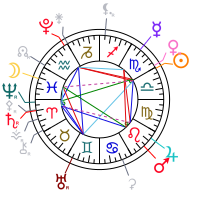
The solar return is a forecasting technique that consists of casting an astrological chart for the exact moment when the Sun returns to the position it occupied at birth. This moment corresponds to the Sun's return to the same ecliptic longitude as in the natal chart. Contrary to common belief, it rarely coincides with the exact time of the civil birthday. In fact, the tropical year does not last exactly 365 days, nor even 365.25 days as suggested by the alternation of leap years. It is slightly shorter, and the precession of the equinoxes also slowly modifies the celestial reference points.
For these reasons, in practice the solar return may occur up to about twenty-four hours before or after the date and time of birth. This precise astronomical moment, and it alone, serves as the basis for calculating the solar return chart.
The chart thus created is interpreted for the period between two birthdays. It is intended to describe the general atmosphere of the twelve months ahead, that is, the dominant trends and the areas of life likely to be activated during the year.
In practice, the interpretation of a solar return begins with the study of the annual chart itself. The examination usually starts with identifying the dominant planets of the solar return, which set the main tone of the period and indicate the most active symbolic forces.
The Ascendant and Midheaven of the solar return chart then provide important reference points, particularly through their placement in the houses of the natal chart. This comparison helps identify the areas of life most likely to be involved in the experiences of the year.
The central element of interpretation remains the examination of the aspects formed between the planets of the solar return chart itself. These configurations describe the internal dynamics of the annual chart and help outline, with appropriate caution, the major trends of the year's astrological climate.
Some astrologers also examine aspects between the planets of the solar return and those of the natal chart. This approach can provide further insight, but it is often considered secondary and used with caution, since too many combinations can quickly produce an overly complex set of factors that are difficult to organize in a clear hierarchy.
The solar return never replaces the study of the natal chart, which remains the foundation of all astrological interpretation. Rather, it provides a temporary perspective on the atmosphere of a given year.
History of the Method
The principle of the Sun's annual return is ancient. It already appears in certain early astrological traditions, where the moment of the solar return was observed in order to judge the influences of the year. However, the technique as it is practiced today mainly developed during the twentieth century.
In modern European astrology, several authors contributed to popularizing and structuring the use of the solar return. One of the best known is Alexandre Volguine, whose work proposed a very detailed method for interpreting the annual chart. His books played a major role in spreading this technique among French-speaking astrologers.
Over time, the solar return became established as a complementary tool to transits, especially with the development of modern astrology software capable of easily calculating planetary positions and aspects.
Some astrologers nevertheless sought to simplify this practice in order to make it clearer and more directly usable. This orientation was notably followed by the late Christophe de Cène, through the Galilée software, which favors a synthetic reading of the year's overall climate.
Principles of Interpretation
The interpretation of a solar return is based on several key elements.
The Ascendant of the annual chart plays an important role, as it provides a general indication of the orientation of the period and the way events may be experienced. The house in which the Sun of the solar return falls is also examined carefully, since it often highlights the main field of expression for the year.
The dominant planets of the annual chart, the placement of the solar return Ascendant and Midheaven in the natal houses, as well as the aspects formed between the planets of the solar return chart provide useful reference points for understanding the broad outlines of the period.
Some practitioners also take into account additional correspondences between the annual chart and the natal chart, but this extension of the method must remain cautious, since the accumulation of factors can quickly reduce the overall clarity of the interpretation.
The goal is to identify the major trends of the year. It is not intended to describe a precise sequence of events, but rather to outline a general atmosphere within which experiences may unfold.
The Astrotheme Approach
In Astrotheme's practice, the solar return is approached through a deliberately synthetic method. The goal is not to accumulate every possible factor, but rather to highlight those that appear most significant in characterizing the year.
The interpretation first focuses on the two dominant planets of the solar return chart, followed by the placement of the solar return Ascendant and Midheaven in the natal houses. The study then gives a central role to the aspects of the solar return itself, which form the core of the annual chart's dynamics.
This approach is inspired by the method of Christophe de Cène and the Galilée software, both of which emphasize clarity and focus on the essentials. It avoids multiplying correspondences between the solar return chart and the natal chart excessively, since such a profusion of combinations often produces texts that are too numerous, difficult to prioritize, and sometimes contradictory.
This choice reflects the idea that a solar return is most useful when it remains readable and coherent. A more concise study, centered on the major factors, makes it easier to understand the climate of the year than an exhaustive interpretation that becomes overly abundant.
Limits of the Solar Return
Despite its value, the solar return has several limitations that should be clearly understood.
The first lies in its very nature. The annual chart describes a general trend between two birthdays but does not specify the exact moment when influences will manifest. It therefore does not provide precise timing indications within the twelve-month period.
This characteristic clearly distinguishes the solar return from planetary transits, which allow influences to be placed in time and ranked according to their duration and intensity.
A second difficulty appears when a very detailed interpretative method is applied. If every possible element of the annual chart is systematically examined, the number of combinations becomes very large: solar return aspects, planets in houses, correspondences with the natal chart, and so on.
This accumulation can produce a large number of interpretations. In some cases, this may represent several dozen or even more than a hundred paragraphs. Such abundance makes reading difficult and often introduces contradictory information, which may create confusion rather than clarity.
For this reason, many astrologers today favor a more synthetic approach, seeking to identify the dominant factors rather than examining every configuration exhaustively.
A Complementary Method to Transits
The solar return can be useful for outlining the general orientation of a year, but it often works best when used alongside other forecasting techniques.
Planetary transits, in particular, make it possible to refine the timing of influences and identify the most significant periods of the year. They also offer a natural hierarchy based on the duration of the transits and on the nature of the planets involved.
In astrological practice, the solar return is therefore generally considered a complementary study that provides contextual background, while transits provide the timing needed to interpret events.
Used with discernment and within a synthetic perspective, the solar return can therefore enrich the study of individual cycles while preserving a clear and coherent reading of the year's overall astrological climate.



 Title
Section
Title
Section
