


 Sign In
Introduction
In astrology, a planetary return occurs when a planet in transit returns to the position it occupied at the time of birth. The idea may seem simple, but it opens the door to a very rich reading of astrological time. Each return marks the reactivation of a function in the birth chart, according to the nature of the planet involved, its place in the chart, its aspects, and the general context of the transits.
The Saturn return is probably the best known to the wider public. It is often associated with the passage into adulthood, responsibilities, decisive choices, and important reassessments. Yet it is not the only one that gives structure to the stages of existence. The Jupiter return, the Uranus opposition, the cycles of Neptune and Pluto, as well as the faster returns of the Moon, Mercury, Venus, and Mars, each contribute in their own way to this cyclical vision of life.
However, an overly mechanical reading should be avoided. A planetary return does not automatically promise a specific event. Rather, it indicates a period of symbolic reactivation, renewal, assessment, or relaunch. Its scope depends on the birth chart as a whole, the planet involved, the house it occupies, its aspects, and the importance it has in the overall structure of the chart.
This is why not all returns carry the same weight. The faster ones can be useful for following short rhythms, but they do not mark an entire existence in the way Saturn, Jupiter, or Uranus can. The purpose of this article is therefore to present the main planetary returns with a clear hierarchy, in order to distinguish the major milestones of life from more passing cycles.
An Ancient Notion Enriched by Modern Astrology
The notion of return is not a recent invention. In the astrological tradition, it first appears in a very important form through solar and lunar returns. The solar return, based on the return of the Sun to its natal position, is one of the oldest and most widely used predictive techniques. It consists of casting a chart for the precise moment when the Sun returns to its birth longitude, in order to study the symbolic climate of the year ahead.
Ancient and medieval authors worked extensively on these methods. Abu Ma'shar, a major astrologer of the ninth century, devoted an important treatise to the annual revolutions of nativities, within the framework of a predictive astrology that notably combined revolutions, profections, directions, and transits. Later, Morin de Villefranche dealt with solar and lunar returns in the Astrologia Gallica. William Lilly, in Christian Astrology, also addressed directions, returns, profections, and transits in his approach to nativities.
In modern times, Alexandre Volguine played a notable role with La Technique des Révolutions solaires, a work that has remained a reference for many French-speaking astrologers. His approach belongs to a tradition in which the solar year is studied as a specific cycle, to be interpreted in relation to the birth chart and not as an independent chart.
The reflection on cycles later broadened. Dane Rudhyar profoundly renewed the understanding of soli-lunar cycles and the symbolic dynamics of time. Alexander Ruperti, in Cycles of Becoming, proposed a humanistic reading of planetary cycles and stages of growth. Stephen Arroyo emphasized the transformative role of the transits of Saturn, Uranus, Neptune, and Pluto. Finally, André Barbault developed a powerful theory of planetary cycles, especially in the field of mundane astrology.
It should nevertheless be specified that not all these authors treated planetary returns as a single category in the contemporary sense. Some mainly studied solar or lunar returns, others transits, soli-lunar cycles, stages of growth, or historical cycles. The present article therefore offers a pedagogical synthesis, faithful to the spirit of these traditions, but organized for today's reader.
Not All Returns Carry the Same Weight
The first rule is to establish a hierarchy. A return of the Moon cannot be placed on the same level as a return of Saturn. A return of Mercury does not have the same scope as an opposition of Uranus. Fast-moving planets describe frequent rhythms, while slow-moving planets correspond to deeper, rarer, and often more significant stages.
The major planetary appointments are first those of Jupiter, Saturn, and Uranus. Jupiter returns several times over the course of existence and accompanies phases of expansion, confidence, or development. Saturn marks the major thresholds of maturity, with a first passage especially well known around the age of thirty. Uranus, for its part, manifests above all through its opposition to its natal position in midlife, then through its late return around the age of eighty-four.
The cycles of Neptune and Pluto require a different approach. These planets do not return to their natal position during an ordinary human life. Their importance comes rather from the major aspects they form with their natal position or with the personal planets in the chart. They indicate phases of transformation that are slower, more collective, or more inward-looking.
The case of the Sun should be treated separately. Its annual return is the basis of the solar return, a historically central method. It does not belong to the major life cycles in the sense of Saturn or Uranus, since it repeats every year, but it occupies an important place in predictive techniques.
Finally, the faster returns of the Moon, Mercury, Venus, and Mars can refine an analysis, but they should not be overinterpreted. Their frequency makes them useful for observing short-term climates or temporary reactivations, not for defining the main stages of life by themselves.
Jupiter: the Stages of Expansion
The Jupiter return occurs approximately every twelve years. It therefore takes place several times over the course of a lifetime, especially around the ages of twelve, twenty-four, thirty-six, forty-eight, sixty, and seventy-two. These ages should not be understood as rigid thresholds, because the exact date depends on Jupiter's natal position, the planet's actual motion, and whether it is moving direct or retrograde, but they provide a convenient reference point.
Symbolically, Jupiter corresponds to expansion, confidence, growth, opportunities, transmission, studies, travel, beliefs, and the search for meaning. Its return can therefore mark a period when a person feels called to develop more fully what Jupiter represents in his or her birth chart.
A Jupiter return may coincide with a phase of opening. It may involve a change of horizon, a promotion, a course of study, a journey, a stimulating encounter, or renewed confidence. But it may amplify an already existing tendency. Jupiter does not guarantee success. It increases, dilates, and encourages, sometimes excessively. If the birth chart shows a disposition toward imprudence, wastefulness, or naive optimism, the return may also bring these traits into sharper relief.
The interpretation depends first on the natal Jupiter. A Jupiter in the ninth house will not resonate in the same way as a Jupiter in the second, tenth, or twelfth house. Its natal aspects are also essential. A Jupiter harmoniously connected to the Sun, Venus, or the ruler of the Ascendant may indicate a more fluid dynamic of confidence. A strongly dissonant Jupiter may require more discernment in order to avoid excess, dispersion, or overestimating one's resources.
The Jupiter return is often lighter than the Saturn return. It does not necessarily confront the person with an obligation or a limit. Rather, it invites a broadening of vision. In a balanced reading, it can be understood as a moment when life asks one to open a door, learn, transmit, believe again in a possibility, or give more space to a potential already inscribed in the chart.
Saturn: the Most Famous Return
The Saturn return has become one of the most popular themes in contemporary astrology. It comes back approximately every twenty-nine and a half years and corresponds to important periods of maturation. The first return, around the age of twenty-nine or thirty, is often experienced as a decisive passage. It is no longer merely a matter of becoming an adult in the social or legal sense, but of taking clearer responsibility for the form one wishes to give to one's life.
Saturn symbolizes time, structure, effort, responsibility, limits, patience, construction, and the reality principle. During its return, these themes come to the forefront. What is solid may be consolidated. What rests on a fragile foundation may require revision. What has been avoided may present itself more clearly. Saturn does not necessarily act through spectacular crises, but it often compels us to look at reality with greater lucidity.
The first Saturn return corresponds to a sorting process. Certain orientations adopted through imitation, social expectations, chance, or a desire for conformity may lose their obviousness. The person is invited to distinguish what truly belongs to them from what was only a provisional role. This passage may concern the career, the couple, the family, the place of residence, the relationship to the body, money, or social identity.
The example of Elizabeth II illustrates the symbolic scope of a first Saturn return quite well: this is not about an isolated event, but about a period during which a function of responsibility, already inscribed in the chart, becomes consolidated over time.
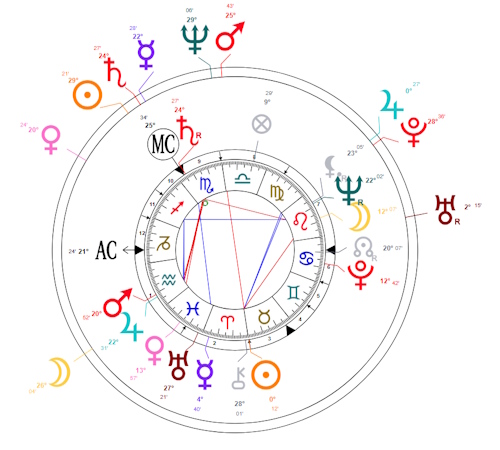
The second return, around the ages of fifty-eight to sixty, has a different tone. It no longer asks only for construction, but for an assessment of what has been built. It may correspond to a reorganization of one's social role, transmission, a new sobriety, or a more demanding selection of priorities. Certain ambitions may be abandoned, while others take on a more essential form.
The third return, around the ages of eighty-seven to eighty-nine, belongs to a more stripped-down relationship with time. It may evoke legacy, memory, wisdom, solitude, acceptance, or symbolic transmission. Not everyone experiences this return under the same conditions, but it retains a strong meaning in a reading of the great cycles of existence.
It is worth remembering that the exact return is not the only significant moment in the Saturnian cycle. The squares and opposition of Saturn to its natal position form key intermediate stages. The waxing square, around age seven, the opposition around fourteen or fifteen, the waning square around twenty-one or twenty-two, then the same phases during the following cycles, mark the relationship to time, authority, limits, and duty.
A Saturn return can be demanding, but it is not negative in itself. It often makes it possible to clarify a structure, gain solidity, accept a responsibility that is chosen rather than endured, or give lasting form to what was still scattered. As always, the house of natal Saturn, its aspects, its rulership, and its place in the chart determine the nature of the work required.
Uranus: the Great Awakening of Midlife
Uranus takes approximately eighty-four years to return to its natal position. Its complete return is therefore late in life. By contrast, its opposition to its natal position, around the age of forty-one or forty-two, is one of the great astrological passages of midlife. It is often this opposition that speaks most clearly to readers, because it corresponds to a period when a person may feel a more pressing need for freedom, authenticity, or renewal.
Uranus symbolizes awakening, independence, rupture, invention, surprise, difference, liberation, and sometimes instability. When it forms an opposition to its natal position, certain frameworks that have become too narrow may be called into question. What has been built up to that point is not necessarily rejected, but it may need to open to a form that is more alive, more personal, or freer.
This passage may translate into professional, relational, geographical, or inner changes. It may also correspond to a less visible but very deep realization: the person understands that they can no longer continue playing certain roles in the same way. They then look for a breath of fresh air, a space of autonomy, or a more sincere relationship with their own life.
In everyday French, this period sometimes evokes what is called le démon de midi, literally the "noonday demon": a moment when the need for change, freedom, or a fresh start may appear with unusual intensity. The expression is colorful, but on a symbolic level it corresponds quite well to this midlife crisis associated with the Uranus half-cycle.
Uranus should not be reduced to crisis. The Uranus opposition can be destabilizing if life has become too locked in, but it can also release considerable creative forces. It sometimes favors innovation, a change of perspective, the breaking of routine, or the discovery of a more personal path. The point is not to destroy everything, but to recognize what needs to be renewed.
The complete Uranus return, around the age of eighty-four, can be read as a moment of lucidity, detachment, or inner independence. It is no longer the same urgency as in midlife. The question becomes more about freedom in relation to time, conventions, dependencies, or old images of oneself.
Neptune and Pluto: Major Cycles, but Not Complete Personal Returns
Neptune and Pluto must be approached with caution in an article on planetary returns. Neptune takes about one hundred and sixty-four years to travel through the zodiac, while Pluto requires nearly two and a half centuries, with a duration that varies greatly from one sign to another. Neptune and Pluto therefore do not complete a full cycle back to their natal position in an ordinary human life.
Nevertheless, these planets play an essential role in major astrological cycles. Their action is expressed through the aspects they form to their natal position, or through their transits over the personal planets, angles, and important points in the chart. They do not structure the ages of life in the same way as Jupiter, Saturn, or Uranus, but they can accompany very deep transformations.
Neptune is connected with ideals, inspiration, compassion, dreams, dissolution, illusion, sacrifice, and the search for meaning. Its major transits may correspond to periods of uncertainty, heightened sensitivity, spiritual calling, artistic impulse, or the questioning of certainties. They may also reveal disillusionment, when what had been idealized can no longer be maintained.
Pluto, for its part, evokes transformation, crisis, intensity, stripping away, regeneration, power dynamics, and the deep forces of the unconscious. Its major transits are not limited to external events. They often correspond to phases in which a person must shed an old skin, go through an experience of truth, or reconnect with an inner power that had long been buried.
The distinction is therefore important: Neptune and Pluto fully belong to the reading of major cycles, but not to that of complete personal returns. Presenting them as ordinary returns would be misleading. Studying them instead as slow cycles, both collective and individual, makes it possible to better understand certain periods of profound transformation.
The Fast Returns: Moon, Mercury, Venus, and Mars
Fast returns are numerous and sometimes useful, but they should be interpreted with moderation. Their frequency makes them less structuring for an entire life. They can nevertheless help refine a climate, follow a short period, or better understand the recurrence of certain personal rhythms.
The return of the Moon is very frequent. It can be used to observe an inner mood, a private atmosphere, a family rhythm, or a particular sensitivity. It concerns daily life, impressions, emotional needs, and spontaneous reactions more than the major biographical stages.
The return of Mercury can reactivate themes linked to thought, exchanges, procedures, decisions, learning, travel, or negotiations. It may be interesting when it accompanies other, more important transits, but it remains too fast to be interpreted alone as a major marker.
The return of Venus concerns values, tastes, attachments, relationships, affection, pleasure, the search for harmony, and sometimes financial questions. It may signal a renewed contact with what attracts, soothes, or seduces. Here again, however, its scope depends on the birth chart and the context.
The return of Mars reactivates the energy of action, desire, initiative, fighting spirit, the will to assert oneself, and sometimes impatience. It may correspond to a dynamic relaunch, a decision, a confrontation, or a physical effort. It becomes more significant if it combines with a transit of Saturn, Jupiter, Uranus, or Pluto.
These fast returns are therefore not useless. They belong to a fine observation of astrological time. But they should not be confused with the major cycles that structure the ages of life. Their role is to accompany, specify, or color, not to summarize an entire period.
How to Interpret a Planetary Return Correctly
A planetary return should never be interpreted in isolation. The first step is to refer back to the birth chart. The planet that returns to its original position already has a personal significance, linked to its sign, its house, its aspects, its rulerships, and its importance in the chart. This phenomenon does not create that meaning. It reactivates it.
The natal house of the planet is essential. A Saturn return in the fourth house will not speak in the same way as a Saturn return in the tenth house. The first may place more emphasis on roots, family, home, or inner life. The second may touch more directly on career, status, responsibilities, or social visibility. The planet remains the same, but its field of experience changes.
The transited house at the time of the return also deserves to be observed, especially when the house system used changes the planet's position according to the place where the return occurs or according to the return chart being studied. The aspects formed on that date should also be taken into account. A planet that passes again over its natal position while receiving an aspect from Jupiter, Saturn, Uranus, Neptune, or Pluto will not express itself in the same climate.
The sign gives the planet its coloration. The same planet does not return with the same style depending on whether it is placed in Aries, Taurus, Gemini, Cancer, Leo, Virgo, Libra, Scorpio, Sagittarius, Capricorn, Aquarius, or Pisces. The return therefore reactivates not only a planet, but also a particular way of experiencing that planet.
Retrogradation can make the interpretation more complex. A slow-moving planet may pass several times over its natal position: first in direct motion, then in retrograde motion, and finally in direct motion again. In this case, the return is not limited to a single date. It describes a sequence, with an initial activation, a phase of revision, then a resumption or integration.
Finally, the return must be placed back in its general context. Other transits may be more important at the same time. A solar return may confirm or nuance the trend. Progressions or directions may provide a different background. A planetary return is therefore a valuable reference point, but it never replaces astrological synthesis.
Summary Table of the Main Returns
The following table provides general reference points. The durations are approximate and must always be adjusted according to the exact natal positions and the actual motion of the planets.
| Astrological factor | Approximate rhythm | Main scope |
|---|---|---|
| Moon | About one month | Emotional climate, intimate life, spontaneous reactions, daily rhythm. |
| Mercury | About one year, with variations linked to retrogradation | Thought, exchanges, procedures, decisions, mental mobility. |
| Venus | About one year, with variations linked to retrogradation | Affection, values, tastes, relationships, search for harmony. |
| Mars | About two years | Action, energy, desire, initiative, fighting spirit. |
| Jupiter | About twelve years | Expansion, confidence, learning, opportunities, broadening of horizons. |
| Saturn | About twenty-nine and a half years | Maturity, responsibility, limits, construction, life assessment. |
| Uranus | Opposition around age forty-two, return around age eighty-four | Freedom, awakening, change, independence, renewal. |
| Neptune | No complete return in an ordinary human life | Ideal, inspiration, dissolution, search for meaning, possible disillusionment. |
| Pluto | No complete return in a human life | Deep transformation, crisis, regeneration, power, stripping away. |
| Lunar Nodes | Return around eighteen and a half years | Complementary reference point for orientation, bifurcation, or rebalancing. |
Appendix: the Returns of the Lunar Nodes
The Lunar Nodes deserve special mention, but it is preferable not to place them on the same level as planetary returns. First, they are not planets. They correspond to points of intersection between the orbit of the Moon and the ecliptic. Second, their importance varies greatly according to different astrological schools. Some astrologers give them major significance, especially in karmic, spiritual, or evolutionary approaches. Others use them with more reserve, sometimes much more.
The return of the Lunar Nodes occurs approximately every eighteen and a half years. It can therefore be observed around the ages of eighteen or nineteen, thirty-seven, fifty-six, then seventy-four or seventy-five. The reversal of the Nodes, around the ages of nine, twenty-seven or twenty-eight, forty-six, and sixty-five, can also be studied as a moment of rebalancing.
When they are used, the Lunar Nodes often evoke an orientation, a trajectory, an axis of experience, or a tension between old habits and a new calling. Their return may correspond to a period when certain life choices take on a different meaning, as if a guiding thread had to be reexamined. However, they should not be turned into an automatic key or interpreted independently from the rest of the chart.
In an article devoted to planetary returns, the Lunar Nodes therefore find a better place in an appendix or an inset. They enrich the reflection on life cycles without blurring the distinction between real planets and astrological points.
Conclusion: a Symbolic Calendar of Life
Planetary returns offer a simple and profound way to understand astrological time. They show that life does not unfold only as a linear sequence of events, but also as a succession of cycles, renewals, thresholds, and reactivations. A planet returns to its natal position, and with it an old question reappears, sometimes in a new form.
Jupiter reminds us of the possibilities of expansion, confidence, and growth. Saturn confronts us with time, responsibility, and construction. Uranus awakens the need for freedom and renewal. Neptune and Pluto accompany slower, more inward, or more collective transformations. The fast-moving planets, for their part, make it possible to observe finer rhythms, useful but less structuring.
A planetary return should never be considered an automatic promise. It does not announce a specific event by itself. Rather, it indicates a period when a function of the birth chart is reactivated. To interpret it correctly, one must return to the birth chart, the houses, the aspects, the rulerships, the dominants, and the general context of the transits.
Properly understood, planetary returns do not reduce existence to a fixed calendar. They provide reference points. They help us recognize certain moments of maturation, expansion, questioning, or transformation. Above all, they remind us that astrology, when practiced with prudence and subtlety, offers a nuanced reading of major human cycles.



 Title
Section
Title
Section