


 Sign In
Introduction
Human life does not unfold as a uniform whole. A child discovering language, a teenager awakening to desire, an adult seeking a place in the world, someone later striving to consolidate what has been built, and an older person gaining perspective do not experience existence in the same way. Early in its history, astrology associated these broad stages with the symbolic functions of the seven traditional planets, from the Moon to Saturn.
This model is known as the planetary ages. It presents a simple sequence in which the Moon governs the earliest years, followed by Mercury, Venus, the Sun, Mars, Jupiter, and finally Saturn. Each planet corresponds to a period when certain functions move to the foreground. Across these stages, the emphasis shifts from receiving and growing to learning, loving, asserting oneself, acting, passing on experience, and ultimately integrating it and coming to terms with the passage of time.
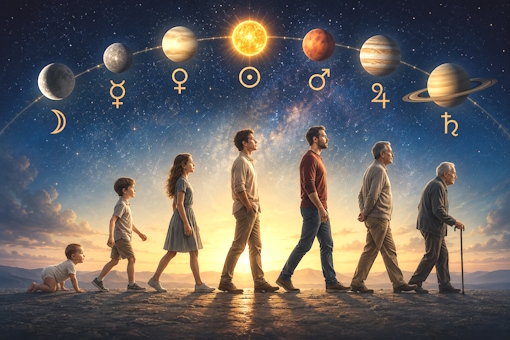
This is not a technique of individual forecasting, much less a calendar capable of announcing what will happen at a precise age. Planetary ages instead outline a broad framework of human development. The birth chart, life circumstances, and personal choices naturally give this pattern a distinct form in each case.
The age limits transmitted by ancient authors must also be understood in their historical context. Lifespan, education, entry into the workforce, age at marriage, family structure, and access to information have changed profoundly. An eight-year-old child who uses a smartphone, communicates at a distance, and can instantly explore a vast range of knowledge experiences a Mercurial awakening in an environment antiquity could never have imagined. The traditional figures therefore remain interesting, but they are best read as reference points rather than rigid boundaries.
The Origins of the Seven Planetary Ages
One of the best-known accounts of this doctrine appears in Book IV of the Tetrabiblos by Claudius Ptolemy, the second-century astronomer, geographer, and astrologer. The system should not necessarily be regarded as his personal invention. It belongs to a broader ancient astrological tradition, which he presented in a particularly clear form.
His reasoning rests on the seven celestial bodies known to classical astrology and on their arrangement within the geocentric cosmos. Life begins with the Moon, regarded in that worldview as nearest to Earth, then progresses toward Saturn at the outer boundary of the planetary realm. The sequence therefore runs from the Moon to Saturn through Mercury, Venus, the Sun, Mars, and Jupiter.
Ptolemy does not merely assign numbers at random. He associates each period with the qualities of its corresponding planet. The Moon suits rapid growth and the infant's dependence; Mercury, the development of intelligence and language; Venus, the awakening of love and desire; the Sun, ambition and responsibility; Mars, effort and struggle; Jupiter, perspective, counsel, and dignity; and Saturn, slowing down and old age.
| Planet | Approximate Traditional Age | Main Theme |
|---|---|---|
| Moon | Birth to age 4 | Growth, dependence, basic needs |
| Mercury | Ages 4 to 14 | Learning, language, curiosity |
| Venus | Ages 14 to 22 | Attraction, desire, relationships |
| Sun | Ages 22 to 41 | Identity, ambition, place in the world |
| Mars | Ages 41 to 56 | Action, effort, self-assertion in adversity |
| Jupiter | Ages 56 to 68 | Perspective, fulfillment, passing on experience |
| Saturn | Age 68 onward | Time, letting go, experience, wisdom |
These boundaries call for a flexible reading. They describe a general model, not an instantaneous change of personality on the day of a birthday. The periods develop gradually, overlap, and extend into one another. Such caution is even more necessary today because the major social milestones of life have shifted since Ptolemy's time.
From Ancient Ages to Modern Life
The system's value lies less in the precision of its divisions than in the logic of its sequence. It would be unconvincing to claim that a person crosses a sharp boundary from Venus to the Sun at twenty-two, or that Jupiter disappears as soon as Saturn begins. By contrast, the progression of functions is strikingly clear. Human beings first receive the world, learn to understand it, discover attraction and connection, seek their own place, confront resistance, broaden their experience, and ultimately face the passage of time.
Modern society inevitably alters how this chronology unfolds in practice. Schooling and formal education may continue well beyond the age of twenty, financial independence sometimes comes late, and partnership or parenthood may be postponed. At the other end of the lifespan, someone in their seventies today may travel, work, start a business, fall in love, and maintain an active social life. The term old age therefore no longer carries exactly the same meaning it did two thousand years ago.
It would nevertheless be a mistake to revise Ptolemy by inventing a new rigid timetable meant to apply to everyone. The most reasonable approach is to keep the traditional divisions as a historical and symbolic reference, then observe how their stages shift or overlap in contemporary life. Above all, the planet indicates a function that becomes especially prominent; the exact age remains secondary.
This interpretation also avoids the misconception that a planet becomes inactive outside its assigned period. The Moon remains fundamental throughout life, Mercury never ceases to govern exchange and learning, Venus continues to shape emotional experience, and Mars retains its link with action. A planetary age marks a symbolic emphasis, not a succession of switches being turned on and off.
The Moon: Being Born, Receiving, and Growing

The first age is naturally associated with the Moon. At the beginning of life, an infant depends almost entirely on the immediate environment. The child receives before acting. The earliest experiences involve food, warmth, protection, sleep rhythms, familiar gestures, voices, smells, and the presence of caregivers. This receptivity reflects lunar symbolism.
Ptolemy emphasizes rapid bodily growth, flexibility, nutritional requirements, and frequent changes in the infant's condition. Psychologically, the Moon also represents the formation of basic security. A very young child does not yet possess the Mercurial tools needed to explain what they feel; they first experience the world in terms of atmosphere, comfort and discomfort, presence and absence.
In a contemporary reading, the lunar age can therefore be understood more broadly as the time when the first emotional imprints and fundamental habits take shape. This does not mean that the Moon's position in the birth chart tells the whole story of early childhood. It is one of the major symbolic factors and must be considered alongside other astrological elements and lived experience.
The lunar tradition ultimately reminds us of something simple. Before seeking to understand the world, a human being must first be able to inhabit it. The Moon symbolizes that initial sense of belonging, what provides reassurance, and what later allows Mercurial curiosity to develop.
Mercury: Learning, Naming, and Discovering the World

After lunar receptivity comes Mercury, the planet of language, exchange, movement, and practical intelligence. The child no longer simply feels the surroundings, but begins to name and compare them, ask questions, memorize rules, and develop strategies. The world becomes an immense field of learning.
In Ptolemy's division, this period extends approximately from ages four to fourteen. This long phase corresponds to the rapid acquisition of basic knowledge and skills through school, reading, writing, arithmetic, bodily coordination, and expanding social contacts. Mercury builds connections and learns to move quickly from one piece of information to another.
Our era accentuates this dimension. Children encounter interfaces, images, messages, videos, search engines, and remote communication at a very early age. A smartphone in the hands of an eight-year-old is almost a caricature of the Mercurial world, combining constant curiosity, a steady flow of information, shifting attention, and rapid discovery of widely differing realms.
None of this means that intelligence is complete by fourteen. The age of Mercury instead represents the establishment of tools that will later make it possible to think, communicate, choose, and adapt. These abilities remain available throughout life, but their initial acquisition gives this phase of childhood its particular tone.
Venus: Pleasing, Loving, and Awakening to Desire

With Venus, the center of gravity shifts. Learning and understanding no longer stand alone; the person becomes especially sensitive to how others see them, to attraction, appearance, affinities, and the pleasure of relating. The traditional period from fourteen to twenty-two therefore corresponds to adolescence and the beginning of young adulthood.
The wish to appeal to others should not be understood only in romantic terms. We also want to be appreciated by friends, develop our style, belong to a group, share tastes in music and clothing, enjoy the same activities, or embrace similar values. Venus helps us discover what attracts or repels us, what we find beautiful, pleasant, desirable, or worthy of love.
Sexuality and first romantic experiences naturally gain prominence, but Venusian symbolism is broader and concerns learning to form relationships based on affinity. Our family of origin is largely given to us; Venus accompanies the stage when we begin to choose the people we feel drawn to, test our power of attraction, and discover reciprocity.
In contemporary society, this period may start earlier in some respects and extend much later in others. Social codes surrounding appearance and desirability are encountered at a young age, while stable relationships are often delayed. Here again, the Venusian function matters more than the exact chronological boundary.
The Sun: Becoming Yourself and Finding Your Place

The Sun stands at the center of the sequence, just as it occupied the middle sphere in the cosmological order used by Ptolemy. Its age corresponds to the time when a person is called upon to become the author of their own path. After receiving, learning, and discovering relationships, one must now choose a direction, assume an identity, and take a place in the world.
The symbolism of the Sun is especially well suited to building adult life. It encompasses ambition, the drive for achievement, the search for recognition, career choices, major decisions, the creation of a home or a body of work, and the development of genuine autonomy. Ptolemy places this period approximately between ages twenty-two and forty-one.
This does not necessarily mean succeeding in conventional social terms. The solar age asks us above all to define what we want to do with our lives and gradually move beyond the frameworks inherited from childhood, school, or the group. For some, self-assertion takes the form of a visible career; for others, it may involve creative work, family, a vocation, commitment to a cause, or a quieter kind of independence.
Contemporary society may postpone this consolidation. Longer education, career shifts, geographic mobility, and changes in relationships can make the solar phase less linear than it once was. One question remains. What are we going to build under our own name, through our choices and our responsibility?
Mars: Acting, Struggling, and Defending What Has Been Built

After solar expansion comes Mars. The contrast is meaningful because choosing a direction is no longer enough. One must also have the energy required to maintain it and face competition, obstacles, conflicts, and unexpected developments. The real world pushes back, calling for the ability to respond.
Ptolemy places this period approximately between ages forty-one and fifty-six. He sees it as a more austere phase, marked by work, concerns, and the awareness that the first peak of youth is receding. The ancient description is severe, but it retains an insight that remains relevant. Midlife often confronts a person with the need to assess what has been accomplished and what can still be conquered.
Mars then represents the struggle to continue along the path begun under the Sun. One may need to defend a professional position, revive a project, take risks, go through a separation, care for several generations of the family at once, or devote more energy to achieving the same results. Competitiveness and courage may become more visible, but so can impatience or weariness when effort is poorly directed.
Reducing this age to a "midlife crisis" would be simplistic. Many people move through the period without any dramatic break. The principle is broader. Mars tests in concrete terms the strength of what has been built and asks where we still want to invest our energy.
Jupiter: Expanding, Reaping, and Passing On Experience

With Jupiter, one's relationship to life may become less confrontational. Accumulated experience allows greater perspective, synthesis, and confidence in what one can do. The daily need to prove personal worth through constant struggle may recede, leaving more room to organize, advise, pass on knowledge, broaden horizons, and fully enjoy what has been built.
Ptolemy assigns Jupiter the period from approximately fifty-six to sixty-eight. He describes a gradual withdrawal from the most arduous work, along with foresight, counsel, honor, dignity, and a form of independence. These ideas fit well with Jupiterian symbolism involving growth, broad understanding, and benevolent authority.
In modern life, the Jupiterian age may coincide with the peak of a career, passing on expertise, a mentoring role, a desire to travel, or the expansion of one's interests. For others, it may bring a new direction that allows accumulated experience to be used with greater freedom. Success is not necessarily financial or social; it can lie in the feeling of having learned enough to give something back.
Jupiter is also associated with confidence and amplification. Its age can therefore carry a risk of excess, for example when a person overestimates their strength, rests on an established position, or gives advice that nobody asked for. Jupiterian maturity finds its best expression when expansion is tempered by moderation.
Saturn: Time, Letting Go, and Wisdom

Saturn governs the final stage of the traditional system, from around age sixty-eight until the end of life. Ptolemy's description reflects the ancient conception of old age, with the cooling of the body, slowing down, diminished desire, and reduced capacity for action. This view must of course be placed in its historical context.
The symbolism of Saturn allows for a much broader contemporary reading. The planet represents time, limits, the need to select and focus, and the ability to build for the long term. At an age when it is no longer possible to undertake everything as one might at twenty, the issue is not simply decline. It becomes a matter of choosing what is essential.
Long experience can bring new freedom from social expectations, deeper self-knowledge, greater patience, and a clearer sense of priorities. Saturn does not automatically promise wisdom, any more than Jupiter guarantees success, but its age symbolically favors perspective, the transmission of what deserves to endure, and acceptance of what cannot be controlled.
Longer life expectancy makes this period especially interesting today. At seventy or eighty, many people remain independent, curious, in love, active, and creative. Saturn therefore does not mean the disappearance of earlier functions; instead, it requires them to come to terms with the reality of time.
Some modern astrological readings also connect very advanced age with lunar values such as a return to the private sphere, the growing importance of home and family, memory, the need for protection, and sometimes physical dependence. The idea is symbolically appealing because it brings the beginning and end of life together. It is not, however, part of the classical division presented by Ptolemy, in which Saturn governs the final stage for the rest of the lifespan.
The Ages Follow One Another Without Erasing What Came Before
The strength of the model appears when it is read as an accumulation rather than a substitution. The Moon is not abandoned when Mercury arrives, since a child still needs security while learning. Venus uses those newly developed abilities to create bonds and attract others. The Sun builds an identity from what has been received, understood, and loved. Mars defends that construction, Jupiter draws a broader vision from it, and Saturn preserves what is essential.
The progression can be summarized in seven verbs: receive, learn, love, become, fight, pass on, and integrate. This sequence obviously does not explain an entire life, but it gives the system its coherence. The planets are not arranged at random, since each stage prepares the next.
Differences from one chart to another remain considerable. A pronounced Saturnian temperament may convey seriousness, reserve, or maturity from childhood onward; a powerful Mercurial influence can sustain remarkable curiosity and intellectual mobility well into later life; a strongly emphasized Venus or Mars may keep relationship concerns or the need for action in the foreground for a very long time. The planetary dominants therefore color the way each person moves through the general sequence of ages.
Life also brings earlier themes back. A new relationship may reawaken Venus at sixty, returning to study may stimulate Mercury at seventy, and a late professional venture may restore a strong solar or Martian tone. A planetary age indicates an underlying symbolic emphasis; it never prevents the other functions from becoming active again.
Planetary Ages, the Birth Chart, and Forecasting Techniques
It is important not to confuse planetary ages with techniques that actually track the movements of the sky. These stages are the same for everyone. In the classical system, each person passes through the sequence of the Moon, Mercury, Venus, the Sun, Mars, Jupiter, and Saturn. They describe a general architecture of human life.
Astrological transits, by contrast, depend on the actual positions of the planets at a given time and their relationship with the birth chart. Planetary returns follow their own cycles, while secondary progressions or directions use a different temporal logic. These methods may naturally coincide with certain stages of life, but they should not be mixed together.
It may be symbolically interesting, for example, that major Saturnian milestones accompany periods of structuring or review, or that Jupiter regularly marks phases of expansion. Such correspondences enrich observation, but they do not prove that planetary ages are derived from modern transit techniques. This seven-part system has its own, much older logic.
The birth chart remains indispensable when one wishes to go beyond the general level. The Sun, Moon, Mercury, Venus, Mars, Jupiter, and Saturn do not have the same importance or condition for everyone. Their signs, houses, aspects, angularity, and rulerships modify how they are expressed. Planetary ages therefore provide a symbolic framework; the natal configuration shows how each function is personally experienced.
Why Are the Trans-Saturnian Planets Not Included in the Seven Ages?
Uranus, Neptune, and Pluto were discovered long after this system was established. Extending the sequence past Saturn would disrupt its architecture and lead to periods reaching far beyond a normal human lifespan. The seven ages belong to the framework of the visible planets of traditional astrology, which includes the Sun and Moon.
This does not mean that the three trans-Saturnian planets are unimportant in modern astrology. Their cycles and transits play a major role in the study of collective and individual transformation. They are relevant to other techniques and need not be inserted artificially into a historical model with its own internal coherence.
Conclusion
Planetary ages offer a genuine symbolic biography in seven stages. The Moon receives and nurtures, Mercury learns and connects, Venus discovers attraction and love, the Sun builds identity, Mars tests that construction through effort and adversity, Jupiter broadens experience and passes it on, while Saturn gradually brings attention back to what is essential and to the long view of time.
Ptolemy's age limits should not be used as a rigid calendar. Two millennia of social change have shifted many stages of existence, and every life follows its own rhythm. The main value of the system lies in this progression, which describes with striking simplicity the movement from dependence to autonomy, then from self-assertion to experience and perspective.
As always in astrology, a general framework works best when kept in its proper place. It illuminates certain rhythms without locking anyone into a fixed chronology. The seven planetary ages then appear in their most interesting light. Rather than serving as a rule for dating events, they offer an elegant way to think about the different forms a life takes over time.



 Title
Section
Title
Section