


 Sign In
Introduction
In a birth chart, some planets seem immediately more present than others. They do not merely operate in the background: they mark the attitude, behavior, life path, or the way the individual is perceived. This is often the case when a planet is very close to one of the four angles of the chart: the Ascendant, the Midheaven, the Descendant, or the Imum Coeli.
This is what is meant by an angular planet. The notion is easy to understand, yet it holds a major place in astrological interpretation. A planet near an angle becomes more visible, more expressive, and sometimes almost unavoidable. It can give a very recognizable color to the personality, to one's vocation, to relational life, or to inner roots.
In practice, strongly angular charts often have a distinctive sense of prominence and depth. This does not mean that an angular planet guarantees celebrity, talent, or success, but it frequently makes a planetary function more noticeable than average. At the Ascendant, it can strengthen presence, charisma, or the singularity of temperament; at the Midheaven, it can accompany a more marked vocation, social exposure, or a more visible public path. At the Descendant and the Imum Coeli, its action is sometimes less spectacular, but it can play a decisive role in relationships, alliances, roots, or inner construction.
Angularity does not replace the whole analysis, however. It must be connected with the Sun, the Moon, planetary dominants, houses, aspects, and rulerships. It nevertheless remains one of the most telling indicators for understanding why a planet truly dominates a chart.
The Angles, Power Points of the Birth Chart
The four angles of the chart are the points formed by the meeting of the celestial sphere and the exact place of birth. They depend closely on the time, date, and location of birth. This is why they strongly individualize the birth chart. Two people born on the same day may have the same planetary positions in signs, but very different angles if they were not born at the same time or in the same place.
The Ascendant corresponds to the point rising on the eastern horizon. It describes the way one enters life, immediate presence, spontaneous attitude, and style of contact with the world. The Midheaven, or MC, designates the highest point of the chart. It provides information about vocation, social image, career, reputation, and the direction life takes in its public dimension.
The Descendant, opposite the Ascendant, concerns the relationship with others, partners, associations, contracts, and confrontations. The Imum Coeli, or IC, opposite the Midheaven, refers to roots, family, intimacy, home, deep memory, and the psychological foundation. These four points have already been studied in the article devoted to the four angles of the birth chart.
When a planet comes close to one of these angles, it is placed in an extremely sensitive area of the chart. It is no longer merely located in a sign or in a house: it touches one of the pivotal points of the chart. This proximity gives it a particular power.
Why an Angular Planet Becomes Dominant
An angular planet does not change its nature. Mars remains Mars, Venus remains Venus, and Saturn remains Saturn. However, their function becomes more directly perceptible. An angular planet acts as if it had more immediate access to the concrete expression of life. It is not merely present in psychology or character traits: it can be seen in behavior, choices, circumstances, lifestyle, or the way destiny seems to take shape.
This visibility explains why angularity is one of the important components of the calculation method for planetary dominants used by Astrotheme. The strength of a planet does not depend on a single criterion. It results from a combination of several parameters, weighted together in order to avoid excessive simplifications.
The first parameter is Activity. It takes into account the number of active aspects received or formed by the planet, with weighting according to the nature of each aspect, the planets involved, the orb, and the overall context. A planet strongly connected to the rest of the chart naturally becomes more active.
The second parameter is Quality, or dignity, applied with nuance. It consists in observing whether the planet is in domicile, exaltation, detriment, or fall, without turning this factor into an absolute verdict. A planet in a favorable condition can express its function with greater ease, while a planet in difficulty may have to take more complex paths.
The third parameter is Rulership. Planets ruling the Ascendant, the Midheaven, the Sun, or the Moon receive a bonus, because they have a particular responsibility in the architecture of the chart. They are not necessarily the most visible, but they govern essential points of the map.
The fourth parameter is Angularity. A planet located within 15 degrees of an angle begins to count in this factor. The closer it gets to the angle, the more its weight increases, in a linear way, up to the exact conjunction, where its angular influence reaches its maximum. This rule makes it possible to measure the effect without reducing it to an artificial cutoff between "angular" and "non-angular".
A planet very close to an angle can therefore become dominant even if it is not the only factor that counts. Conversely, a non-angular planet may remain powerful if it has strong Activity, important Rulership, or remarkable Quality. The purpose of the method is precisely to place angularity back into a coherent whole.
An Ancient Notion That Remains Alive
The importance of the angles is not a modern invention. It belongs to the very foundations of Western astrology. In the ancient tradition, angular houses, namely houses I, X, VII, and IV, are considered the strongest, because they correspond to the places where the stars rise, culminate, set, or reach their lowest point below the horizon.
Hellenistic astrologers already attached particular value to planets located near these zones. Claudius Ptolemy, Vettius Valens, Dorotheus of Sidon, and Firmicus Maternus each bear witness, in their own way, to the importance of angles in interpretation. Angles are used to assess the strength, visibility, and effectiveness of astrological factors.
Later, medieval and Renaissance authors preserved this hierarchy. William Lilly, in the 17th century, very clearly expressed the idea that planets placed on angles manifest their effects with greater force. This view belongs to the classical distinction between angular, succedent, and cadent houses, the first being the most active and visible.
In modern times, the question of angularity was also approached from a different perspective through the work of Michel and Françoise Gauquelin. Their statistical research, especially around what became known as the Mars effect, gave rise to many debates and controversies. Without confusing it with traditional astrological interpretation, one may nevertheless point out that it helped bring the zones near rising and culmination back to the center of important discussions.
The notion of an angular planet therefore runs through the history of astrology. Its vocabulary changes from one period to another, but the underlying idea remains the same: a planet placed near an angle acts with particular intensity.
Four Angles, Four Arenas of Expression
An angular planet does not manifest in the same way depending on the angle involved. Proximity to the Ascendant makes the planet immediately perceptible in attitude, appearance, one's first contact with the world, and instinctive dynamics. A planet conjunct the Ascendant strongly colors the visible personality. It can give the impression that the individual "wears" this planet.
A planet close to the Midheaven has a stronger effect on vocation, reputation, career, ambition, or social radiance. It can show what one projects outward, what one seeks to accomplish, or what the world notices in the life path. It is often very revealing in the charts of public figures, but it also matters in more discreet charts, because it suggests a direction of achievement.
A planet close to the Descendant manifests through relationships. It may describe a quality one attracts in others, projects onto partners, or makes central in alliances, contracts, oppositions, and married life. This angularity is sometimes less immediately recognized by the person themselves, because it expresses itself through the mirror of others.
A planet close to the Imum Coeli acts in a more intimate zone. It touches roots, family memory, home, childhood, inner life, and psychological foundations. It may be less visible publicly, but very powerful in the deep construction of the individual. An angular planet at the IC can leave a lasting mark on the relationship to origins, security, or private life.
These four expressions should not be separated too rigidly. A chart functions as a whole. A planet at the Ascendant can have professional consequences if it rules house X. A planet at the Midheaven can modify identity if it is the ruler of the Ascendant. A planet at the Descendant can become very public if it is strongly connected to the MC. The angle indicates the entry point, not the whole meaning.
Distance to the Angle, Orb, and Position Before or After
The strength of an angular planet first depends on its distance from the angle. The exact conjunction is the most powerful case. The planet is then located on the sensitive point itself, and its influence manifests with maximum clarity. The farther it moves away from the angle, the more its effect gradually diminishes.
In the Astrotheme method, angularity begins to be taken into account when the planet is located within 15 degrees of an angle. The effect then increases linearly up to 0 degrees of distance, that is, up to the exact conjunction. A planet 2 degrees from an angle is therefore much more angular than a planet located 12 degrees away, but the latter is not ignored either.
This approach avoids a frequent problem: overly abrupt thresholds. In practice, a planet located 4°59 from an angle does not suddenly become powerful while a planet at 5°01 would cease to count. Angularity is a progressive intensity. It strengthens as the planet approaches the exact point.
The question of the position before or after the angle also deserves nuance. A planet placed just before the Ascendant, in house XII, can be very strong if it is tightly conjunct the angle, but it sometimes expresses itself in a more inward, more prepared, or less immediately perceptible way. Just after the Ascendant, in house I, it often becomes more directly embodied in attitude, behavior, and presence.
The same reasoning can apply to the Midheaven. A planet located just before the MC may evoke an energy pushing toward culmination, sometimes with preparation, aspiration, or a rise toward visibility. Once it has passed beyond the MC, it belongs more to the field of social accomplishment, public image, or career. The difference is not always spectacular, but it can refine the interpretation.
At the Descendant and the Imum Coeli, the nuance is just as important. A planet very close to the Descendant can act strongly in the relationship to others, whether it is located slightly before or after the angle. A planet very close to the IC can mark inner and family life, even if it technically belongs to house III or house IV, depending on the house system and the exact distance.
It would therefore be too simplistic to say that a planet is always stronger before or always stronger after the angle. Exact proximity remains the main criterion. The house, symbolic direction, rulerships, and aspects then make it possible to specify the mode of expression.
The Tone of Each Angular Planet
Each angular planet gives a particular tone. The angular Sun strengthens radiance, willpower, charisma, presence, and the need for self-assertion. It can accentuate individual visibility, the feeling of having a personal mission, or the desire for recognition.
The angular Moon makes sensitivity more apparent. It emphasizes receptivity, imagination, memory, emotional needs, popularity, or the relationship with the public. It can give a great capacity for adaptation, but also a strong dependence on atmospheres.
Angular Mercury places the emphasis on intelligence, speech, writing, mobility, observation, and the ability to create links. It often favors communication, curiosity, adaptability, and mental quickness.
Angular Venus makes charm, taste, affection, the desire for harmony, seduction, or aesthetic sense more visible. It may indicate a pleasant, diplomatic personality, or one very sensitive to beauty and to the quality of the bond.
Angular Mars gives energy, fighting spirit, frankness, boldness, courage, or impatience. It makes action more direct and can accentuate the ability to decide, fight, undertake, or confront obstacles.
Angular Jupiter amplifies confidence, expansion, optimism, generosity, natural authority, or the taste for broad horizons. It can favor recognition, protection, teaching, travel, or high ambitions.
Angular Saturn gives seriousness, restraint, perseverance, a sense of responsibility, and sometimes an impression of distance. It may indicate slow construction, a strong awareness of time, duties, or limits.
Angular Uranus makes singularity more visible. It accentuates independence, originality, rupture, inventiveness, or the refusal of overly narrow frameworks. It can give a life path marked by rapid changes or unconventional choices.
Angular Neptune brings inspiration, idealism, permeability, mystery, or a form of subtle magnetism. It can favor art, spirituality, empathy, and imagination, but also vagueness, projection, or indecision.
Angular Pluto gives intensity, depth, transformative power, and sometimes a notable psychological impact on those around the person. It can signal a life marked by crises, rebirths, power struggles, or a will for radical truth.
Articles devoted to each of the ten planetary dominants are available.
Several Angular Planets or a Contradictory Reading
A chart may contain several angular planets. In this case, interpretation becomes richer, but also more complex. Two planets close to the same angle may merge their meanings. A Venus-Mars conjunction at the Ascendant, for example, is not interpreted as Venus alone and then Mars alone, but as a combination of charm, desire, drive, spontaneity, and power of attraction.
When planets are distributed over several angles, they can create a structuring tension. A planet at the Ascendant and another at the Descendant bring the identity-relationship axis into play. A planet at the Midheaven and another at the Imum Coeli emphasize the career-private life axis, exposure-roots, and outer achievement-inner foundations.
It may also happen that an angular planet seems to contradict the rest of the chart. A very angular Venus in an otherwise Martian or Saturnian chart may soften the general expression without erasing the other dominants. An angular Saturn in a very Jupiterian chart may give gravity, high standards, or caution that tempers expansion. Angularity does not erase the other factors: it adds a strong presence to the whole.
Conversely, a very dominant planet may not be angular. It may owe its strength to its aspects, rulerships, dignity, or repetition within the structure of the chart. This is why it is important not to confuse an angular planet with a dominant planet. Angularity is one path toward this preeminence, but it is not the only one.
The task of synthesis is therefore to establish a hierarchy. A planet exactly on an angle almost always requires special attention. But its interpretation will depend on its sign, house, aspects, rulerships, and role in the overall economy of the chart.
Examples of Interpretation
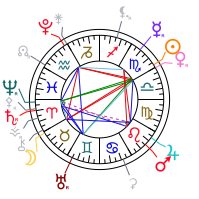
Examples of personalities help us understand how an angular planet becomes immediately readable in a chart. The four cases selected are based on reliable birth data, with very tight conjunctions to the Ascendant, the Midheaven, the Imum Coeli, or the Descendant.
Angelina Jolie: Venus Conjunct the Ascendant in Cancer
In Angelina Jolie's chart, Venus is conjunct the Ascendant in Cancer with an orb of 0°43'. This angularity makes charm, emotional aura, feminine image, and personal power of attraction particularly visible. Cancer adds a protective and sensitive note, perceptible in her maternal, humanitarian, and committed figure, while Jupiter very close to the Midheaven further strengthens the dimension of public success.
Kim Kardashian: Jupiter Conjunct the Midheaven in Sagittarius
In Kim Kardashian's chart, Jupiter is conjunct the Midheaven in Sagittarius with an orb of 0°25'. The planet of expansion culminates in its own sign, illustrating very clearly international fame, media amplification, and the construction of an extraordinary public status. Her chart also shows the Moon conjunct the Imum Coeli in Pisces, another major angularity, which highlights the importance of family image, exposed intimacy, and the emotional dimension in her path.
Emma Watson: The Moon Conjunct the Imum Coeli in Sagittarius
In Emma Watson's chart, the Moon is conjunct the Imum Coeli in Sagittarius with an orb of 0°19'. This position emphasizes the importance of roots, childhood, and inner life, which is all the more striking since her fame was built very early. Sagittarius connects this intimate foundation with a quest for meaning, studies, and openness, visible in her academic path as well as in her public commitments.
Bob Dylan: Mercury Conjunct the Descendant in Gemini
In Bob Dylan's chart, Mercury is conjunct the Descendant in Gemini with an orb of 2°43'. Words, poetry, and speech addressed to the public become a major way of relating to the world: the audience is less a mere recipient than a true symbolic interlocutor. The Mercury-Neptune square adds an inspired, ambiguous, and mythical dimension, which partly explains the richness of interpretation of his lyrics.
Conclusion
Angular planets are among the most visible factors in a birth chart. Their strength comes from their proximity to the most individualized points of the map: the Ascendant, the Midheaven, the Descendant, and the Imum Coeli. They often give a clear, immediately perceptible signature, which helps us understand why certain planetary functions stand out more than others.
This power must nevertheless be interpreted with due caution. An angular planet does not explain everything, and a non-angular planet may be dominant through other paths. This is why the Astrotheme method takes several components into account: Activity, Quality, Rulership, and Angularity. The real weight of a planet in the chart arises from their combination, not from a single criterion.
Properly understood, angularity helps quickly refine the reading of a birth chart. It shows what is visible, what acts strongly, and what is placed at the chart's key thresholds. It does not replace synthesis, but it is one of its most effective entry points.



 Title
Section
Title
Section