


 Sign In
Introduction
A solar eclipse occurs when the Moon passes between the Earth and the Sun, covering all or part of the solar disk for a given region. Astronomically, there is nothing mysterious about the phenomenon: it results from orbital geometry and is possible only near a New Moon. Yet it remains spectacular because, for a few minutes or a few hours, it turns a monthly event, the conjunction of the Sun and Moon, into a genuinely visible occultation.
Eclipses have occupied a special place in the history of societies as well as in the history of astrology. They long inspired fear or wonder before their mechanism came to be understood. Astrologers, for their part, have often assigned them greater importance than an ordinary New Moon, particularly in mundane astrology. One essential question remains: is this additional importance justified, and how can it be incorporated without turning a remarkable phenomenon into an automatically exceptional omen?
The total solar eclipse of August 12, 2026, visible as a partial eclipse from New York and many other parts of the Northern Hemisphere, offers an excellent opportunity to revisit these questions.
How a Solar Eclipse Occurs
A solar eclipse can occur only at New Moon, when the Moon, as seen from Earth, lies in the same general direction as the Sun. Yet there is no eclipse every month. The Moon's orbit is tilted by about five degrees relative to the ecliptic plane, so during most New Moons the Moon passes slightly above or below the Sun and its shadow misses the Earth.
For an eclipse to occur, the New Moon must take place sufficiently close to one of the lunar nodes, the two points where the Moon's orbit crosses the ecliptic plane. This proximity to the nodes is the true geometric feature that distinguishes eclipses. It also explains why solar and lunar eclipses occur in periods known as eclipse seasons, separated by a little less than six months.
When the Moon's apparent diameter is large enough and its central shadow reaches the Earth's surface, the eclipse is total within a narrow path. If the Moon appears slightly smaller than the Sun, a bright ring remains visible around it: the eclipse is annular. Outside the central path, or when the alignment is less complete, an observer sees only a partial eclipse. Hybrid eclipses exist, appearing total in some regions and annular in others.
The varying distance between the Earth and the Moon therefore plays an important role. Because the Moon's orbit is elliptical, its apparent diameter changes over the course of the month. A total eclipse requires the lunar disk, from the location in question, to be able to cover the Sun completely; during an annular eclipse, it cannot. What is seen thus depends both on the overall alignment of the three bodies and on the observer's precise location on Earth.
Frequency, Cycles, and Visibility
Between two and five solar eclipses occur somewhere on Earth each year. The phenomenon is therefore not exceptional on a planetary scale, but it becomes much rarer when a specific location is considered. A city may experience relatively frequent minor partial eclipses while waiting decades, or even centuries, to lie within the path of totality.
Eclipses recur according to several cycles. The best known is the Saros, lasting about 18 years, 11 days, and 8 hours, or 223 lunations. Eclipses separated by one Saros have similar geometry, but the extra fraction of a day shifts their visibility zone by roughly one third of the Earth's circumference. A single Saros series also moves slowly in latitude over the centuries, so it never represents the exact return of the same eclipse to the same place.
The timing of an eclipse also depends on the point of view adopted. In astrology, the Sun-Moon conjunction is calculated geocentrically: it is the moment when the two luminaries have the same ecliptic longitude as seen from the center of the Earth. The global maximum of an eclipse is a different instant, defined by the geometry of the Moon's shadow on Earth. Finally, for an observer in New York, Madrid, or Reykjavik, lunar parallax changes the Moon's apparent position and produces yet another local maximum.
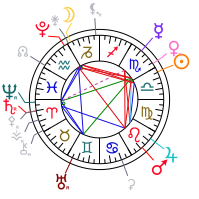
August 12, 2026, also illustrates this distinction. The geocentric New Moon occurs at about 5:37 PM UT, with the Sun and Moon near 20°02' Leo. The global maximum of the eclipse follows about nine minutes later. In New York, however, the partial eclipse begins at about 1:08 PM local time, reaches its maximum around 1:54 PM, when about 9.5% of the Sun's surface is covered, and ends around 2:39 PM. The visible phase from New York therefore lasts approximately one hour and thirty-one minutes.

The eclipse as a whole runs from about 3:34 PM to 7:58 PM UT, with a global maximum around 5:46 PM; the chart also displays the lunar nodes, Lilith, and the main asteroids.
In New York, local time, it is visible approximately from 1:08 PM to 2:39 PM, with about 9.5% of the Sun's surface covered at maximum around 1:54 PM.
Two figures that are often confused describe the extent of a partial eclipse. Eclipse magnitude measures the fraction of the Sun's diameter covered along a given direction; the percentage of surface covered indicates how much of the solar disk is actually hidden by the Moon. In New York on August 12, 2026, the magnitude is about 0.19, while approximately 9.5% of the Sun's surface is hidden by the Moon. These two values therefore do not represent the same measurement.
To observe a solar eclipse, glasses specifically designed for solar viewing are essential throughout every partial phase. Ordinary sunglasses, even very dark ones, do not protect the retina. Optical devices, binoculars, telescopes, and camera lenses also require a suitable solar filter placed in front of the instrument.
Solar Eclipses in History and Astrology
Before their mechanism was understood, eclipses ranked among the most impressive celestial phenomena. The sudden disappearance of the Sun in broad daylight inspired many myths, omens, and political or religious narratives. Babylonian astronomers nevertheless identified recurring patterns very early, allowing them to anticipate periods favorable to eclipses, while Greek scholars gradually developed geometric explanations based on the motions of the Earth, Sun, and Moon.
This progress did not remove their astrological importance. In Book II of the Tetrabiblos, Ptolemy devotes several chapters to eclipses and presents them as major factors in mundane astrology. He takes into account where they are visible, their duration, their zodiacal position, and the planets associated with the phenomenon. Some of his rules, such as those mechanically linking the time an eclipse lasts to the supposed persistence of its effects, clearly belong to the tradition of his time and should not be viewed today as demonstrated laws.
The tradition nevertheless continued. William Lilly, one of the major figures of 17th-century English astrology, wrote a treatise in 1639 devoted to the solar eclipse of May 22 that year. In the 20th century, Dane Rudhyar also wrote about eclipses, relating them to the Sun-Moon cycle and the nodal axis, with particular attention to eclipses affecting a degree occupied by a luminary, planet, or angle in the natal chart. These approaches differ considerably, but they show that the question of what makes eclipses astrologically distinctive runs throughout the history of astrology.
It is important to distinguish this history from the validation of the rules that have been proposed. The fact that a technique is old, widespread, or appealing for its symbolism does not prove that it works with the strength attributed to it. The main value of traditional texts is to show how astrologers tried to give meaning to a striking celestial event, and then to compare those hypotheses with a more cautious modern practice.
Is a Solar Eclipse Simply a Sun-Moon Conjunction?
At the most fundamental level, a solar eclipse remains a Sun-Moon conjunction, and therefore a New Moon. No new astrological aspect appears simply because the Moon's disk covers the Sun. The sign, house, and relationships of the Sun-Moon pair with the rest of the chart follow the same basic logic as in any other lunation.
There is, however, one objective difference: an eclipse can occur only near the nodal axis. The meeting of the two luminaries is necessarily linked to nodal geometry. This is enough to make it distinctive, but not enough to conclude automatically that it is two, three, or ten times more powerful than an ordinary New Moon. There is no sound basis for any such coefficient.
Another common confusion should also be avoided. The astronomical proximity to a node required for an eclipse does not always imply a very tight conjunction with that node according to usual astrological orbs. On August 12, 2026, for example, the Sun and Moon meet near 20° Leo, while the True South Node lies near 29°48' of the same sign, almost ten degrees away. Proximity to the nodal axis physically explains the eclipse, but the Sun and Moon do not necessarily form a tight conjunction with the node in every eclipse chart.
The most reasonable position is therefore to regard an eclipse as a special lunation rather than as an entirely separate category. Its local rarity, the actual occultation of a luminary, and its structural connection with the nodes may justify closer attention. Its spectacular nature, however, is not enough to announce exceptional events, still less catastrophes. In mundane astrology, the zone of visibility may be retained as an interesting traditional factor, but it too should be handled with caution.
This approach preserves what is distinctive about an eclipse without adding arbitrary rules. The phenomenon may increase the significance of a Sun-Moon conjunction, especially when it affects an important point with a tight orb, but its interpretation should remain subordinate to the structure of the chart rather than to the label "eclipse" alone.
Lunar Nodes, Lilith, and the Part of Fortune in the Natal Chart
Among the factors associated with the Moon, the nodes occupy a distinct place because they are essential to the formation of eclipses. In an individual chart, an eclipse within a tight orb of a natal node may deserve attention when it also affects a luminary, an angle, or a fast-moving planet. The astronomical role of the nodes, which is essential to the phenomenon, must be distinguished from their astrological significance: their presence alone is not enough to turn an eclipse into a major configuration for the person concerned.
Lilith, or the Black Moon, belongs to a different geometry. It corresponds to the apogee of the Moon's orbit and plays no part in the mechanism of an eclipse. A very precise relationship between the eclipse degree and natal Lilith can be studied like any astrological configuration involving Lilith, but there is no particular reason to assign it extra strength simply because the Sun is eclipsed. The same caution applies to the other secondary factors or objects shown on an astrological chart.
The Part of Fortune is different again: it is a calculated point based on the Ascendant, Sun, and Moon. In a natal chart, an eclipse that touches it very precisely can be taken into account, but it remains a secondary factor compared with the luminaries, angles, and personal planets. In the eclipse chart itself, it should also be remembered that at the exact New Moon, the Sun and Moon have the same longitude: the Part of Fortune formula then places it essentially on the Ascendant. By itself, it therefore adds no independent indication.
How to Interpret a Solar Eclipse in Astrology
For the astrological approach presented here, the most coherent reference point remains the exact geocentric Sun-Moon conjunction rather than the local maximum visible from a particular city. This instant defines the New Moon's zodiacal degree and provides the degree to compare with the natal chart. The local maximum is essential for astronomical observation, but it answers a different question.
In an individual chart, the analysis should prioritize precise relationships between the eclipse degree and the most personal factors. A tight conjunction or opposition to the Sun, Moon, or chart angles, particularly the Ascendant and Midheaven, carries more weight than a wide aspect to a slow-moving planet. Mercury, Venus, and Mars can be significant depending on their role in the chart. The Ascendant ruler deserves attention when contacted within a tight orb. As in astrology more broadly, the tighter the orb and the more central the natal factor, the more relevant the interpretive hypothesis becomes.
The natal house in which the eclipse falls then indicates the area concerned. The astrological houses make it possible to distinguish, for example, an emphasis on identity, relationships, career, home, or projects. The astrological aspects formed by the Sun and Moon to natal planets complete the reading. An eclipse that activates no important point in the chart should not be artificially elevated to the status of a major personal event.
In mundane astrology, the region of visibility, the eclipse's zodiacal position, and its contacts with charts of countries, leaders, or events may be added, in keeping with a long tradition. Here again, caution is essential. An eclipse is not the cause of an event and, on its own, cannot be used to announce a political crisis, natural disaster, or specific collective change. It becomes more relevant when it forms part of a set of converging configurations.
An eclipse can be treated as a notable Sun-Moon conjunction whose context requires close examination. This method remains compatible with the usual study of luminaries, nodes, houses, angles, and astrological transits, without creating a parallel system based on rules that are difficult to justify.
Conclusion
A solar eclipse is both simple in principle and exceptional in appearance. It arises from a New Moon close to the nodal axis, but what can actually be seen depends on the precise geometry of the Moon's shadow and the observer's location. This is why the Sun-Moon conjunction, the global maximum, and the maximum visible from a given place occur at different times.
In astrology, eclipses have a long history and have often been regarded as lunations of major importance. This tradition deserves to be understood, from Ptolemy to Lilly and later authors, without turning every old rule into a certainty. What the eclipse adds above all to the conjunction of the luminaries is its nodal context and its astronomically remarkable character.
The best approach is therefore to avoid two extremes: reducing the eclipse to a phenomenon with no particular significance, or automatically assigning it extraordinary power. Its degree, aspects, and the natal factors it touches make it possible to judge its actual importance. As is often the case in astrology, the chart's hierarchy remains more informative than the spectacular nature of the eclipse itself.



 Title
Section
Title
Section