


 Sign In
Interpreting a birth chart involves many factors that complement one another. Among them, the distribution of the planets across the various regions of the chart offers a distinct perspective on personality. Astrology enthusiasts are generally familiar with what these regions represent.
At the top of the chart, in the South, are the areas associated with public life, outward activity, and our place in the world. At the bottom, in the North, privacy and personal concerns carry greater weight. On the left, in the East, the emphasis is on willpower and self-assertion. On the right, in the West, attention turns toward other people, relationships, and the ability to adapt to outside influences.
These contrasts offer a starting point, but they do not tell the whole story. The chart's two main axes also divide it into four quadrants, each containing three houses and having its own character. Studying them can reveal interesting tendencies, as long as a general indication is not mistaken for a definitive judgment about personality.
How can we identify these sectors and assess their importance? Is counting the planets enough? We also need to consider their nature and strength within the chart. This gives the analysis greater depth.
North and South, Between Inner Life and Public Life
The Ascendant-Descendant axis, known as the horizon line, divides the chart into two hemispheres. In the usual representation of a birth chart, the North occupies the lower half, containing houses 1 to 6. The South corresponds to the upper half, containing houses 7 to 12. This arrangement sometimes surprises beginners. In a birth chart, South is indeed at the top.
The Northern Hemisphere, the Need for a World of One's Own
A concentration of planets in the North traditionally emphasizes inner life. The need to protect one's privacy, build solid foundations, and find time away from public view may be more pronounced. The individual often places great value on home life, personal concerns, and what they experience on a deeper level.
It would be excessive, however, to infer a shy or solitary personality. Some people with a strong Northern Hemisphere emphasis nevertheless lead very public lives. Their inner priorities simply do not always align with their public visibility. What they show the world does not necessarily reveal what matters most to them.
The Southern Hemisphere, the Need to Take Part in the World
The South places greater emphasis on outward expression. It suggests a desire to participate in society, engage with the wider world, and pursue activities with a visible impact. Social, professional, or public concerns may be important, although they are not the only areas involved.
This orientation promises neither fame nor professional success. It describes a way of relating to the outside world. Someone with a pronounced Southern Hemisphere emphasis may be quite discreet in their behavior, yet often seek to participate in activities beyond their private sphere.
East and West, Between Initiative and Relationships
The second division follows the Midheaven-Imum Coeli axis. The East lies on the Ascendant side, to the left in the conventional chart layout. It includes houses 10, 11, 12, 1, 2, and 3. The West, on the Descendant side, occupies the right half, with houses 4, 5, 6, 7, 8, and 9.

The Eastern Hemisphere, Personal Initiative
When planets are concentrated in the East, independence and the ability to make one's own decisions often stand out. The individual may feel a need to follow their own path, act according to their convictions, and retain control over their choices. Taking the initiative may come more naturally than waiting for an outside impulse.
Yet the East does not imply selfishness or indifference to others. Independence can go hand in hand with generosity and a genuine sense of cooperation. The way this manifests varies with the planets involved and the rest of the chart.
The Western Hemisphere, the Importance of Others
A dominant Western Hemisphere highlights exchanges, partnerships, and situations that call for cooperation. The individual often develops through encounters and relationships. They pay attention to how those around them respond, seek common ground, or discover strengths of their own through contact with others.
This is not necessarily a sign of dependence. A person can be highly independent and still have a strong Western Hemisphere emphasis. The distribution mainly suggests that relationships play an active part in decisions and experiences. It may also indicate a tendency to respond to circumstances rather than set events in motion.
The Four Quadrants, a More Detailed Reading
When the two axes intersect, they form four quadrants. Each combines a Northern or Southern orientation with an Eastern or Western one. The twelve astrological houses are thus divided into four groups of three. Their sequence represents a symbolic progression, from the development of the self to engagement with the wider world.

The Northeast Quadrant, Houses 1 to 3
This first sector, at the bottom left, brings together identity, resources, and early exchanges with the environment. It emphasizes self-assertion, learning, and discovering one's own means of action. The individual tends to draw on immediate experience to understand and organize the world.
A dominant Northeast quadrant may reinforce the need for independence and confidence in one's own judgment. This does not mean rejecting advice. Rather, decisions tend to become meaningful once the person has made them their own.
The Northwest Quadrant, Houses 4 to 6
At the bottom right, this sector links private life with relationships. It encompasses roots, creativity, everyday activities, and the desire to be useful. The individual may seek to build, develop, or refine something in a relatively private setting, while remaining attentive to the needs of others.
The Northwest often favors preparation, attention to detail, and accomplishments that take shape behind the scenes. It may also accompany strong creative abilities. Here, personal expression does not necessarily involve seeking public recognition.
The Southwest Quadrant, Houses 7 to 9
At the top right, engagement with the world becomes more outward-looking. This quadrant includes partnerships, shared experiences, periods of reassessment, the search for meaning, and the broadening of horizons. Exchanges with others may play a decisive role. We learn and change, sometimes seeing things differently because of an encounter or confrontation.
A dominant Southwest quadrant underscores the importance of collaboration and interactions with others. It does not guarantee harmony, nor does it imply that someone must be in a relationship. Dialogue with the outside world is, above all, a valuable avenue for personal development.
The Southeast Quadrant, Houses 10 to 12
At the top left, this final sector combines personal initiative with a concern for the wider world. Ambitions, participation in society, collective projects, and the pursuit of accomplishments that extend beyond immediate interests may become central. The individual often wants to give their life a clear direction and act according to a personal vision.
Yet the Southeast is not limited to career or power. Through houses 11 and 12, it also encompasses commitments, ideals, reflection, and less visible activities. The desire to accomplish something can take very different forms, sometimes far removed from conventional social ambition.
Assessing a Dominant Sector, Beyond a Simple Planet Count
The first step is to locate the ten principal planets, from the Sun to Pluto, in relation to the two axes. We look at the distribution between North and South, then between East and West. Finally, we identify the quadrant containing the most planets. This count gives an immediate overview, but it remains a rudimentary approach.
Not all planets carry the same weight. The Sun, Moon, Mercury, Venus, and Mars have a more personal influence. Jupiter and Saturn contribute their own nuances, while Uranus, Neptune, and Pluto, being very slow-moving, call for greater caution. Their house positions remain relevant, but their mere presence in a sector is not enough to determine which sector is dominant.
Astrotheme uses a weighting method to avoid this oversimplification. Each planet is assessed according to its nature, activity, dignity, and angularity. A planet's activity depends in part on the aspects it forms, their importance, and their exactness. Angularity measures proximity to the four angles of the chart. Planetary dignity also contributes to the assessment of a planet's strength.
The full method is described in our article on calculating planetary dominants. The principle matters here. A six-to-four split does not always carry the same significance. The balance can shift substantially if the luminaries or the most powerful planets are on the apparently less populated side.
It is also important not to rely too heavily on the visual impression made by the chart. A planet close to an axis may catch the eye even though its exact position places it on one side rather than the other. The assessment therefore relies on the chart's coordinates, the chosen house division system, and the rule governing the shift into the next house, rather than a cursory glance. The diagrams in this article follow the usual arrangement of houses around the chart's four angles.
Integrating Hemispheres and Quadrants into Chart Interpretation
Spatial distribution provides a framework, not a complete description of personality. A specific birth chart shows how a dominant quadrant takes on its full meaning when we consider the houses and planets it contains.
An Example with Pierre Teilhard de Chardin
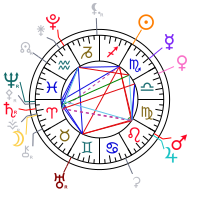
The birth chart of Pierre Teilhard de Chardin shows an exceptional concentration. Nine of his ten planets are in the Southeast quadrant, comprising houses 10, 11, and 12. According to Astrotheme's weighted calculation of astrological dominants, this quadrant accounts for 91.5% of the result, compared with 8.5% for the Northwest, where Uranus is located. This figure therefore reflects more than a simple count of planets.

Yet this concentration is not primarily clustered around the Midheaven. Five planets, including the Sun and Moon, occupy the 12th house. Mercury, Jupiter, and Saturn are in the 11th, while Mars is in the 10th. The 12th house gives the whole configuration an inward-looking, spiritual quality. The 11th house evokes ideals and projects that go beyond the individual. With Mars in the 10th, the drive to act and achieve remains present.
This interpretation resonates with Teilhard de Chardin's life. A Jesuit priest, paleontologist, and thinker, he devoted himself to scientific research and to reflection on human evolution and its spiritual dimension. His dominant Southeast quadrant does not merely suggest social ambition or a desire for the spotlight. In his case, it finds expression in intellectual work and a commitment guided by an ideal. Yet no single dominant can sum up an entire personality.
One point deserves emphasis. A dominant quadrant necessarily contributes to the two hemispheres to which it belongs, but this does not mean that both hemispheres also dominate the chart as a whole. The results partly overlap. They are not three independent pieces of evidence for the same personality trait, but one structure viewed at different levels.
Clusters of planets must also be considered alongside other factors. A stellium in a house can strongly affect this distribution, but its meaning is not the same as that of the hemisphere it helps make dominant. Composed aspects and planetary figures and patterns follow a different logic. They concern the geometric relationships and configurations formed by the planets, rather than their distribution in relation to the axes.
This hierarchy also shapes the reports offered by Astrotheme. In the Astrological Portrait available in the online store, eleven types of dominants are calculated and interpreted. The dominant quadrant is included among the main analyses. The more general North-South and East-West divisions appear in the appendix devoted to minor dominants. This provides three perspectives on spatial distribution.
The best approach is therefore to consider these distributions in context. They help identify an overall orientation and raise the right questions. The rest of the chart provides the answers.
Conclusion
The distribution of planets across the hemispheres and four quadrants offers an additional perspective on the general orientation of a birth chart. North and South reflect the interplay between private and public life. East and West highlight the importance of personal initiative and relationships. The quadrants refine these tendencies by combining both readings.
This approach nevertheless occupies only a modest place in astrological interpretation. The positions and strength of the planets, the signs, houses, aspects, and dominants are far more influential. The study of hemispheres and quadrants primarily provides context, adding further nuances to the traditional reading of a birth chart.



 Title
Section