


 Sign In
Free Daily Horoscope: Questions & Answers
In these pages, we answer common, frequent, and important questions visitors ask about our Personalized Daily Horoscope and astrology forecasts.
The topics addressed are as follows:
- What is a Horoscope? Is it hogwash?
- Why are some texts sometimes repeated from one day to the next?
- What is the difference between a Forecast and a Daily Horoscope?
- Is it really possible to foresee events with a Horoscope?
- Why are some areas not very precise?
- Why are some transits ignored?
- Sometimes, there is almost no activity for a given day. Is it normal?
- What is the significance of the yellow and red stars?
Here are the answers to all these questions. If you are not familiar with astrological forecasting, you may start by reading this information page on the benefits of the transit method, which is used both for forecasting reports and for this simplified free daily horoscope.
1. What is a Daily Horoscope? Is it hogwash?
This is a fundamental question. Indeed, 95% of available horoscopes are just a load of hogwash. After WWII, in the early '50s, astrology became fashionable again. The leading weekly magazine ELLE was the first to offer a horoscope column in response to the emerging trend and in order to increase its sales. The Editor-in-Chief asked for a volunteer among the staff to write twelve texts each week. It was obvious that the volunteer had never read a single astrology book... In those days, as nowadays, the texts available in the media were totally outlandish and produced solely by their author's imagination.
There are cases where some authors do not hesitate to go so far as to use phony techniques in order to gain a semblance of justification. However, nothing can conceal the fact that 600 million people share the same sign, 200 million share the same decanate, and no one experiences the same thing, because the position of the Sun is by far not the sole factor that must be considered. Moreover, the margin of error is huge because the forecasting principle is primarily based on the planets' exact positions.
In the written press, on the radio, or on many Internet websites, there is a plentiful supply of Sun sign, or Sun sign and decanate, horoscopes. Sometimes, in order to produce lengthier texts, each sign is cut into 3 parts, known as decanates. Whether they are provided with technical justification or not, this type of horoscope is very harmful and outlandish.
Why outlandish? Because no serious astrologer can claim that being an Aries of the 3rd decanate is all it takes to experience such and such an event in the coming week or year. This glaring hoax is reprehensible because astrology is not based solely on the position of the Sun, but on a whole set of subtle parameters such as planets, houses, signs, aspects, rulerships, etc.
When astrologers dare to publish a book on the horoscope for any given year, or when they write in the specialized horoscope press, we let you guess the reasons behind it. They are strictly potboilers. It is a sad practice because it considerably harms astrology, and we can only condemn it.
The obvious problem with the media is the lack of interactivity, since it is impossible to analyze each case in particular, be it for a reader, a radio listener, or a television viewer. Therefore, serious horoscopes cannot be cast, meaning horoscopes based on the exact natal chart. We will deal with them later.
Actually, the right thing to do would be to dismiss all Sun sign and decanate horoscopes, once and for all. Then horoscope calculations for a day, a month, or a year would be exclusively made by specialized software programs available on the Internet or installed on individual computers.
But it is most likely that the Sun sign horoscope fashion will endure. Astrology forecasts, no matter how fake and fiddled, are good sales boosters. Nobody has the courage to denounce them because they involve huge amounts of money. As regrettable as it is, they justify the mockery of astrology detractors, at least as far as Sun sign astrology is concerned.
Serious horoscopes do exist. They are computed on the basis of two interrelated components: on the one hand, the exact natal chart, which always requires the place and time of birth, and on the other hand, the actual position of the planets for the period considered, for instance, one day for daily horoscopes, or every consecutive day for yearly horoscopes.
A whole set of rules is used to compare the planets' positions on a given day with your natal chart, which makes it possible to deduce the effects that you are most likely to experience in terms of willpower, emotions, feelings, health, etc., and in various areas such as romance, career, daily life, family, friendships, etc. Some effects have a cyclical occurrence, whereas others are long-lasting and non-repetitive. Pluto takes approximately 256 years to travel around the Zodiac. Therefore, it will contact your planets by conjunction only once in your lifetime.
In conclusion, it is definitely possible to cast a daily horoscope using your natal chart's exact data and parameters. No astrology book, Internet website, radio station, or television company releasing Sun sign and decanate horoscopes can do so seriously: it is a swindle, pure and simple.
Whenever you come across a website or an advertisement offering free Sun sign or decanate horoscopes, it is very simple: run away and never go back. It has nothing to do with an astrology website. It is a marketing website trying to lure you with texts that have nothing to do with astrology, the worst thing being that they sometimes offer a semblance of justification. We can never repeat often enough that without the exact date and time of birth, a horoscope with a 10- or 30-day margin of error is nothing but sheer charlatanism.
Astrotheme offers a genuine free personalized daily horoscope, directly displayed on your computer.
2. Why are some texts sometimes repeated from one day to the next?
Because the influence of fast planets usually lasts roughly 3 days when they transit a planet of the natal chart by conjunction. For other major aspects, the duration is one or two days.
The so-called fast planets, Mercury, Venus, and the Sun, move at the speed of 1 degree per day. For this type of transit, the required exactness is roughly plus or minus 1 degree on either side of the exact aspect. Therefore, it is only logical that the same texts are repeated for three or four days, as long as the transit's influence remains active. It is not a bug.
The Moon travels an average distance of 13 degrees per day. Thus, it may stay two days in the same natal house, and three days in some rare cases. Here too, repetition is perfectly normal.
Mars covers 1 degree in two days. However, like Mercury and Venus, Mars can move backward, or retrograde, which is not the case for the Sun and the Moon. Seen from Earth, during their retrogradation, planets may contact a given point of the Zodiac three times. Therefore, the influence described in our reports may last many days, sometimes one or two weeks.
In other words, whenever an influence plays out over several days, we indicate it accordingly. It is not a bug, nor a program blunder. It is because a horoscope does not consist of texts randomly gathered, unlike the output of people who release Sun sign or decanate horoscopes, as you may have guessed, but of a diary of energies having an effect on you and obeying rules of astronomical duration, not fashion or marketing rules.
With slow planets, namely Jupiter, Saturn, Uranus, Neptune, and Pluto, we deal with longer-term forecasts and not with the Daily Horoscope, which is volatile by nature and mainly indicates secondary feelings that may not be translated into facts. In astrology, longer-term forecasts are based on slow planets' transits, with their lasting effects, which cause more significant feelings and therefore are more likely to bring about events.
3. What is the difference between a longer-term Forecast and a Daily Horoscope?

As indicated by its name, a Daily Horoscope displays influences for short periods, ranging from one to several days. It is the result of the influences of fast planets' transits, the sky of the day, affecting the natal chart. As explained above, those short periods may extend to a fortnight. In general, they bring about feelings rather than events.
The purpose of a Daily Horoscope is not to "foresee" events, unlike longer-term forecasts as such, which are based on slow planets' transits and their stronger influences.
Astrotheme offers Detailed Forecasts in the form of Reports instantly sent to your email address, for example the Detailed 12-Month Forecast, which includes many revolutionary improvements.
4. Is it really possible to foresee events with a Horoscope?
It is obvious that the forecasting topic constitutes the million-dollar question. This is what can possibly be answered in a few lines and with utmost caution.
To begin with, it must be stated that there are three schools of thought, regardless of the astrological system used, whether tropical, sidereal, or based on a particular house system. Firstly, there are those who believe that astrology, like clairvoyance, can foresee events in precise and fatalistic ways. Even when they are careful, their works reveal their fascination with some sort of preordained written destiny. The French astrologer Hades is a good illustration of this category.
Secondly, there are those who adamantly refuse to use astrology for forecasting purposes because they deem it not precise enough or inappropriate. They often limit the use of astrology to psychological analysis or couple compatibility delineation. At least, they acknowledge the value of astrology to a certain extent, particularly in terms of time-saving, compared with any other method aimed at understanding whom one is dealing with, or in which areas two persons have a chance to get along well.
Finally, there is the middle way, namely the people who consider that astrology can be efficiently used for forecasting while at the same time remaining very cautious, because these people have understood that, in their endless course around the Zodiac, the planets send aspects, or transits, to the natal chart, thus creating energies that cause more or less powerful feelings deep within us. And those feelings will indirectly provoke, or not, events.
For this third school of thought, to which Astrotheme belongs, astrology is not about fatality. It is not a book in which everything occurring on Earth or in our life is written. It is a flow of energies that activates within us what is already enshrined in our natal chart and may bring about actions or specific types of events, depending on the intensity of the said energies.
Feelings reach a significant level of intensity whenever the transit involves planets that are already in aspect in the natal chart, a phenomenon known as planetary resonance. In turn, these feelings allow events to manifest, again indirectly, in our life.
In the chart of a male native, for instance, positive transits on his natal Venus, his Moon, or any natal factor related to his 5th House make him inwardly more available, lighter in the sentimental area, in his daily well-being, or in his pursuit of pleasures. Then this state of confidence and lightness allows meaningful encounters to take place. In the case of a hard transit on the factors mentioned above, a reflex of danger and fear will prompt the native to protect himself and appear more distant, and as a consequence, he will miss the opportunity to find his soul mate. Here, it is important to underline that, although it is not always the case, happiness and self-confidence usually make a person very attractive.
It is very clear that determinism in terms of events does not exist, or at least it is sifted through the filter of our feelings. Likewise, nothing can occur that is not already anchored in our natal chart. Unfortunately, this is a principle that many astrologers tend to ignore. We always insist upon the fact that prior in-depth understanding of the natal chart is of fundamental importance for accurate forecasting.
Without detailing the elements that ought to be examined in order to foresee events, the quick yet cautious answer to the question could be yes, it is possible to foresee important events. We must show genuine humility and review all the various existing hypotheses. Let us take the example of a female native with the Sun in the 6th House who has a favorable transit of Uranus in conjunction with her Sun: it may indicate an encounter with the man of her life, since the Sun symbolizes men in general, possibly the future husband, and more generally relationships with males. Or disruptions in her daily and professional life. Or both at the same time, that is, meeting her soul mate and changing her professional environment or her lifestyle.
It is obvious that caution is required when identifying the area where transits are likely to play out. Sometimes it is easier. However, in order not to say anything nonsensical, natal planets in Houses ought to be examined as often as possible. This is what we do on the Astrotheme website. We also systematically issue warnings regarding areas affected by the influences at work. To the best of our knowledge, we are the only ones to do so among all French-language astrology websites. Our Grand Horoscope, our Detailed Quarterly Forecast, our Detailed 12-Month Forecast, and our 12-Month Forecast include all these elements. They offer a wealth of information on feelings and on the possibilities of translating them into events.
We believe that all our astrological Forecast Reports are tremendously helpful.
5. Why are some areas not very precise?
The answer is in the preceding text.
6. Why are some transits ignored?
Interactions between transiting slow planets and natal slow planets do not produce significant individual effects.
The specific case where a super-slow planet coincides with a personal point of the natal chart is significant and therefore does not belong to the category we have just described above. Accordingly, our program will process only the transit over the personal point. So it is not an oversight.
Several other transits are not displayed because the corresponding effects are not reliable enough. Transits on the natal chart's angles, Midheaven, Ascendant, Descendant, and Imum Coeli, are displayed only when they form conjunctions or oppositions. Opinions diverge within the community of astrologers, and although it is easy for us to display all the minor and major aspects, we believe that their effects are more than dubious and that we should not lapse into excess and vagueness. In our new Detailed Forecast, all cases of transits are interpreted: transits to slow and very slow-moving planets, fast planets' transits, transits to the Ascendant ruler, recurring transits repeating a natal planetary link, detection of afflicted planets in the natal chart with selective processing of conjunction transits, transits to the angles interpreted for the five major aspects, etc. With our new Detailed Forecast, the very tool used by professional astrologers is made available to you.
On Astrotheme, there are three levels of detail in treatment and interpretive texts: the personalized horoscope, standard forecasts, and detailed forecasts.
The free horoscope is more succinct. It offers the transits of the day of fast and slow mundane planets on the personal planets, Sun, Moon, Mercury, Venus, and Mars, and on the angles of the natal chart, with some restrictions.
Standard forecasts offer more elaborate texts for the transits of slow mundane planets, from Mars to Pluto, on personal planets and angles. They cover the basics, but do not deal with transits on slow planets, nor with transits of mundane fast planets.
To go further, the detailed forecasts offer a professional approach with the processing and interpretation of all transits without exception for all the planets in emission, all the planets in reception, and the angles. They manage the detection of repetitions of transits with natal configurations and transits to the ruler of the Ascendant, including when it is a slow planet. We strongly encourage all our customers to get these detailed forecasts, which are the most complete that can be found in terms of transits.
You may be interested in this additional information about transit reports, the general forecasting offer, or the differences in treatment between standard forecasts and detailed forecasts.
7. Sometimes, there is almost no activity for a given day. Is it normal?
Yes, indeed. A transit is a link between the actual planets on the day considered and the planets of your natal chart. It is analogous to the natal chart's aspects, which are considered in a stand-alone chart, whereas a transit, like synastry, involves two charts. In other words, transits are angles formed between actual planets and natal planets and personal points, Midheaven, Ascendant, Descendant, and Imum Coeli, which bring about, or represent depending on the school of thought, influences on feelings, or indirectly on events.
In astrology, a certain margin of exactness, or orb, is accepted. A transit is active when it occurs within the allowed orb: 0 degrees for the conjunction, 180 degrees for the opposition, 120 degrees for the trine, 90 degrees for the square, 135 degrees for the sesquiquadrate, etc. When transiting planets do not form any particular aspect with planets or personal points of the natal chart within the allowed orb, they are no longer active. They become active again later on, on a different part of the natal chart, as they progress in their course around the Zodiac.
Therefore, it may happen that no active transit influences the natal chart during several days. In such a case, it is normal not to display anything. Our purpose is not to offer texts picked at random in order to please. However, we always provide the meaning of the Moon in the natal house with a special feature: depending on the celestial state and the interaction between the actual sky and your natal chart, we compute the daily positive or negative influences of the Moon, in addition to its transits over your natal planets and personal points.
To sum up, each day is filled with different energies. Sometimes influences are plentiful, and sometimes there are none. There may also be several overlapping influences, each indicating a different tendency. Transits reflect real life and our daily emotions.
8. Next to the transits there are a variable number of yellow or red stars. What is the significance of those?
The yellow color indicates a soothing and conciliatory aspect, and the red color indicates a dynamic and tense aspect. The red aspects enable you to evolve, to take action, and to learn to turn your "weaknesses" into assets through your life experiences. The yellow aspects are innate strengths on which you rely in order to grow better with the former. The stars indicate the strength of the aspects.
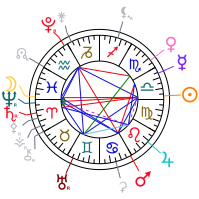
| Sun | 3°08' | Libra | |
| Moon | 26°52' | Pisces | |
| Mercury | 24°06' | Libra | |
| Venus | 7°33' | Scorpio | |
| Mars | 28°52' | Cancer | |
| Jupiter | 18°43' | Leo | |
| Saturn | 11°57' | Я | Aries |
| Uranus | 5°36' | Я | Gemini |
| Neptune | 3°00' | Я | Aries |
| Pluto | 3°10' | Я | Aquarius |
| Chiron | 29°41' | Я | Aries |
| True Node | 29°33' | Я | Aquarius |
| True Lilith | 13°23' | Я | Sagittarius |
Full Moon


| Personality | Views |
|---|---|
| Serena Williams | 183,025 |
| M Pokora | 114,096 |
| Olivia Newton-John | 93,134 |
| Russ (rapper) | 79,324 |
| Christina Milian | 73,260 |
| Jim Caviezel | 71,795 |
| Bryan Ferry | 63,605 |
| Martin Heidegger | 60,099 |
| Thomas Stearns Eliot | 53,460 |
| Francis of Assisi | 50,979 |
| Personality | Views |
|---|---|
| Avril Lavigne | 327,568 |
| Gwyneth Paltrow | 298,523 |
| Lil Wayne | 213,031 |
| Jenna Ortega | 175,076 |
| Mitski | 127,262 |
| Madrid (Spain) | 85,972 |
| Amma (spiritual leader) | 66,647 |
| Syria | 61,564 |
| Francesco Totti | 48,929 |
| Louis XIII of France | 42,990 |

 Title
Section
Title
Section