


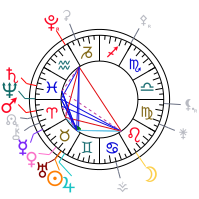
| Sun | 3°44' | Taurus | |
| Moon | 27°15' | Libra | |
| Mercury | 16°10' | Я | Aries |
| Venus | 22°31' | Aries | |
| Mars | 24°25' | Pisces | |
| Jupiter | 22°22' | Taurus | |
| Saturn | 15°57' | Pisces | |
| Uranus | 21°58' | Taurus | |
| Neptune | 28°42' | Pisces | |
| Pluto | 2°05' | Aquarius | |
| Chiron | 20°16' | Aries | |
| True Node | 15°39' | Я | Aries |
| True Lilith | 21°31' | Virgo |
Full Moon

 Tue. 23 Apr., 11:51 PM UT
Max Planck: Astrological Article and Chart
You will find below the horoscope of Max Planck with his interactive chart, an excerpt of his astrological portrait and his planetary dominants.
Birth data and astrological dominants
 Add to favourites (43 fans) Add to favourites (43 fans) |


 | Born: | Friday, April 23, 1858 (time unknown) | ||
| In: | Kiel (Germany) | |||
| Sun: | 2°59' Taurus | |||
| Moon: | 8°50' Virgo | |||
| Dominants: | Taurus, Virgo, Sagittarius Venus, Neptune, Mercury Earth, Water / Fixed | |||
| Numerology: | Birth Path 4 | |||
| Pageviews: | 28,227 | |||
NB This chart is arbitrarily calculated for noon. If you know the time of birth of Max Planck, please send us your information with your source, at stars@astrotheme.com. To thank you, we shall be glad to send you the portrait (34 pages) of this celebrity, on demand.
Horoscopes having the same aspect Mercury conjunction Jupiter (orb 0°07'): Brigitte Bardot, Jim Carrey, Anti-Christ, Nick Jonas, Woody Allen, Lenny Kravitz, Jenifer (singer), Michael Douglas, Louis XVI of France, Jaehyun (singer), Richard Nixon, Billy Bob Thornton... Find all the celebrities having this aspect.
Horoscopes having the same aspect Mercury sextile Saturn (orb 0°18'): Cameron Diaz, Meghan, Duchess of Sussex, Emma Stone, Penélope Cruz, Charles III, Mel Gibson, Grimes (musician), Jennifer Garner, Eva Green, Jessica Simpson, Rocco Siffredi, Paul Newman... Find all the celebrities having this aspect.
Celebrities born the same day: Gigi Hadid, William Shakespeare, John Cena, Michael Moore, Silvana Mangano, Shirley Temple, Dev Patel, Anthony Quinn, Prince Louis of Cambridge, Roy Orbison, Jaime King, George Lopez... List of all the celebrities born on April 23.
Horoscopes having the Moon in 8° Virgo : Elon Musk, Serge Gainsbourg, Leona Lewis, Hulk Hogan, Gina Lollobrigida, Anjelica Huston, Noémie Lenoir, Camille Paglia, Barbara Bach, Virna Lisi, Peter Fonda, Pierre Mondy... List of all the celebrities having the Moon in 8° Virgo.
66,468 people and events, 31,160 of which with a known time of birth
Search by profession, aspect, position, category, date, or birthday
Horoscopes clicked on in real-time: 913,339,982 times
Horoscope and chart of Max Planck
Select an object to display more information


March 21 - April 20
1st Fire sign - 1st Cardinal sign (spring equinox) - Masculine
In analogy with Mars, his ruler, and the 1st House
Aries governs the head.
His colour is red, his stone is the heliotrope, his day is Tuesday, and his professions are businessman, policeman, sportsman, surgeon...
If your sign is Aries or your Ascendant is Aries: you are courageous, frank, enthusiastic, dynamic, fast, bold, expansive, warm, impulsive, adventurous, intrepid, warlike, competitive, but also naive, domineering, self-centred, impatient, rash, thoughtless, blundering, childish, quick-tempered, daring or primitive.
Some traditional associations with Aries: Countries: England, France, Germany, Denmark. Cities: Marseille, Florence, Naples, Birmingham, Wroclaw, Leicester, Capua, Verona. Animals: Rams and sheeps. Food: Leeks, hops, onions, shallots, spices. Herbs and aromatics: mustard, capers, Cayenne pepper, chilli peppers. Flowers and plants: thistles, mint, bryonies, honeysuckles. Trees: hawthorns, thorny trees and bushes. Stones, Metals and Salts: diamonds, iron, potassium phosphate.
For more information, see the page dedicated to the sign of Aries.
April 21 - May 20
1st Earth sign - 1st Fixed sign - Feminine
In analogy with Venus, his ruler, and the 2nd House
Taurus governs the neck and the throat.
Her colour is green or brown, her stone is the emerald, her day is Friday, her professions are cook, artist, estate agent, banker, singer...
If your sign is Taurus or your Ascendant is Taurus: you are faithful, constant, sturdy, patient, tough, persevering, strong, focused, sensual, stable, concrete, realistic, steady, loyal, robust, constructive, tenacious. You need security, but you are also stubborn, rigid, possessive, spiteful, materialistic, fixed or slow.
Some traditional associations with Taurus: Countries: Switzerland, Greek islands, Ireland, Cyprus, Iran. Cities: Dublin, Palermo, Parma, Luzern, Mantua, Leipzig, Saint Louis, Ischia, Capri. Animals: bovines. Food: apples, pears, berries, corn and other cereals, grapes, artichokes, asparagus, beans. Herbs and aromatics: sorrels, spearmint, cloves. Flowers and plants: poppies, roses, digitales, violets, primroses, aquilegia, daisies. Trees: apple trees, pear trees, fig-trees, cypresses, ash trees. Stones, Metals and Salts: copper, calcium and potassium sulphate, emeralds.
For more information, see the page dedicated to the sign of Taurus.

May 21 - June 21
1st Air sign - 1st Mutable sign - Masculine
In analogy with Mercury, his ruler, and the 3rd House
Gemini governs the arms, the lungs and the thorax.
His colour is green or silver, his stone is the crystal, his day is Wednesday, his professions are journalist, lawyer, presenter, dancer, salesman, travel agent, teacher...
If your sign is Gemini or if your Ascendant is Gemini: you are expressive, lively, adaptable, quick-witted, humorous, sparkling, playful, sociable, clever, curious, whimsical, independent, polyvalent, brainy, flexible, ingenious, imaginative, charming, fanciful but also capricious, scattered, moody, shallow, inquisitive, opportunistic, unconcerned, selfish, fragile, ironical or changeable.
Some traditional associations with Gemini: Countries: Belgium, Wales, United-States, Lower Egypt, Sardinia, Armenia. Cities: London, Plymouth, Cardiff, Melbourne, San Francisco, Nuremberg, Bruges, Versailles. Animals: monkeys, butterflies, parrots, budgerigars. Food: dried fruits, chestnuts, ground-level vegetables: peas, broad beans, etc. Herbs and aromatics: aniseed, marjoram, lemon balm, cumin. Flowers and plants: lilies of the valley, lavenders, myrtle, ferns, Venus-hair-ferns, bittersweets. Trees: nut trees such as chestnut trees. Stones, Metals and Salts: agates, mercury, silicas and potashes.
For more information, see the page dedicated to the sign of Gemini.

June 22 - July 22
1st Water sign - 2nd Cardinal sign (summer solstice) - Feminine
In analogy with the Moon, her ruler, and the 4th House
Cancer governs the stomach and the breast.
Her colour is white or black, her stone is the moonstone, her day is Monday, her professions are catering, the hotel trade, property, antique dealer, archaeologist...
If your sign is Cancer or your Ascendant is Cancer: you are emotional, sentimental, peaceful, imaginative, sensitive, faithful, resistant, protective, vulnerable, generous, romantic, nostalgic, tender, poetic-minded, motherly or fatherly, dreamy, indolent, greedy, devoted but also timorous, unrealistic, evasive, passive, anxious, dependent, stubborn, moody, passive, lazy, touchy, stay-at-home or inaccessible.
Some traditional associations with Cancer: Countries: Holland, Scotland, North and West Africa, New-Zealand, Paraguay, Algeria. Cities: Amsterdam, Manchester, Tokyo, New York, Istanbul, Stockholm, Milan, Venice, Genoa, Cadix, Alger, Tunis, Bern, Magdeburg. Animals: crabs, animals with shells. Food: milk, fishes, watery fruits and vegetables, turnips, white and red cabbages. Herbs and aromatics: tarragon, verbena, saxifrage. Flowers and plants: geraniums, white roses and white flowers in general, water lilies, morning glory, bear's breeches, and lilies. Trees: all trees full of sap. Stones, Metals and Salts: pearls, silver, lime and calcium phosphate.
For more information, see the page dedicated to the sign of Cancer.

July 23 - August 22
2nd Fire sign - 2nd Fixed sign - Masculine
In analogy with the Sun, his ruler, and the 5th House
Leo governs the heart and the spine, and the eyes, according to some authors.
His colour is gold or orange, his stone is the diamond, his day is Sunday, his professions are actor, manager, jeweller, fashion and arts, and action (e.g. fireman)...
If your sign is Leo or your Ascendant is Leo: you are proud, determined, strong-willed, loyal, solemn, generous, ambitious, courageous, heroic, conquering, creative, confident, seductive, happy, daring, fiery, majestic, honest, magnanimous, charismatic, responsible, noble, dramatic but also domineering, vain, susceptible, bossy, stubborn, intolerant, self-centred, violent, quick-tempered, nonchalant.
Some traditional associations with Leo: Countries: Italy, Romania, Sicily, Czechoslovakia, Iraq, Lebanon, Southern France. Cities: Rome, Prague, Bombay, Madrid, Philadelphia, Chicago, Los Angeles, Bath, Bristol, Portsmouth, Syracuse, Damas. Animals: lions and felines in general. Food: meat and especially red meat, rice, honey, cereals, grapes, iron-rich vegetables: watercress, spinach etc. Herbs and aromatics: saffron, mint, rosemary, common rue (Ruta graveolens). Flowers and plants: marigolds, sunflowers, celandines, passion flowers. Trees: palm trees, laurel, walnuts, olive trees, lemon and orange trees. Stones, Metals and Salts: gold, rubies, magnesium and sodium phosphate.
For more information, see the page dedicated to the sign of Leo.

August 23 - September 22
2nd Earth sign - 2nd Mutable sign - Feminine
In analogy with Mercury, her ruler, and the 6th house
Virgo governs the intestine.
Her colour is green or yellow, her stone is the agate, her day is Wednesday, her professions are accountant, secretary, writer, computer scientist, nurse, doctor...
If your sign is Virgo or your Ascendant is Virgo: you are brainy, perspicacious, attentive to detail and numbers, analytical, serious, competent, scrupulous, sensible, modest, logical, tidy, well-organized, clean, hard-working, provident, honest, faithful, reserved, shy, helpful, a perfectionist, but also narrow-minded, calculating, irritating, petty, anxious, cold, repressed or caustic.
Some traditional associations with Virgo: Countries: Brazil, Greece, Turkey, West Indies, United-States (the same as Gemini), Yugoslavia, Crete, Mesopotamia, Lower Silesia, State of Virginia. Cities: Paris, Boston, Athens, Lyon, Corinthia, Heidelberg, spa towns in general. Animals: dogs, cats and all pets. Food: root vegetables: carrots, celeriac, kohlrabies, potatoes etc... Also dried fruits such as chestnuts. Herbs and aromatics: the same as Gemini whose ruler is Mercury too, lilies of the valley, lavenders, myrtles, ferns, Venus-hair-ferns, bittersweets, clovers. Flowers and plants: small bright-coloured flowers, especially blue and yellow, such as dandelions, buttercups, yellow dead-nettles, buglosses, forget-me-nots ; cardamoms, oak leaves, acorns. Trees: all nut trees, e.g. the hazelnut tree... Stones, Metals and Salts: sards (red agate), mercury, nickel, potassium sulphate and iron phosphate.
For more information, see the page dedicated to the sign of Virgo.

September 23 - October 22
2nd Air sign - 3rd Cardinal sign (autumn equinox) - Masculine
In analogy with Venus, his ruler and the 7th House
Libra governs the kidneys and the bladder.
His colour is blue or red (not too bright), his stone is the opal, his day is Friday, his professions are in the beauty, luxury or fashion industry, musician, artistic creator, lawyer, mediator...
If your sign is Libra or your Ascendant is Libra: you are sentimental, charming, polite, refined, loyal, a pacifist, fair, distinguished, light-hearted, romantic, learned, ethereal, nice, well-groomed, a perfectionist, calm, sweet, tolerant, sociable, elegant, considerate, seductive, aesthetic, indulgent, but also hesitant, weak, indecisive, selfish, fragile, fearful, indolent, cool or even insensitive.
Some traditional associations with Libra: Countries: Japan, Canada, Indo-China, South Pacific Islands, Burma, Argentina, Upper Egypt, Tibet. Cities: Lisbon, Vienna, Frankfurt, Leeds, Nottingham, Johannesburg, Antwerp, Fribourg. Animals: lizards and small reptiles. Food: berries, apples, pears, grapes, artichokes, asparagus, beans, spices, corn and other cereals. Herbs and aromatics: mint, Cayenne pepper. Flowers and plants: hydrangea, big roses, blue flowers and those associated with Taurus also ruled by Venus, namely, poppies, digitales, violets, primroses, aquilegia, and daisies. Trees: ash trees, poplars, apple trees, pear trees, fig-trees, cypresses. Stones, Metals and Salts: sapphires, jade, copper, potassium and sodium phosphate.
For more information, see the page dedicated to the sign of Libra.

October 23 - November 21
2nd Water sign - 3rd Fixed sign - Feminine
In analogy with Pluto, her ruler with Mars, and the 8th House
Scorpio governs the sexual organs and the anus.
Her colour is black or dark red, her stone is the malachite, her day is Tuesday, her professions are gynaecologist, psychiatrist, detective, the military, army, stockbroker, asset managemer...
If your sign is Scorpio or your Ascendant is Scorpio: you are secretive, powerful, domineering, resistant, intuitive, asserted, charismatic, magnetic, strong-willed, perspicacious, passionate, creative, independent, vigorous, generous, loyal, hard-working, persevering, untameable, possessive, cunning, ambitious, sexual, proud, intense, competitive but also aggressive, destructive, stubborn, anxious, tyrannical, perverse, sadistic, violent, self-centred, complex, jealous.
Some traditional associations with Scorpio: Countries: Morocco, Norway, Algeria, Syria, Korea, Uruguay, Transvaal. Cities: Washington, New Orleans, Valencia, Liverpool, Milwaukee, Fes, Halifax, Hull, Cincinnati. Animals: insects and other invertebrates. Food: the same strong tasting food as for Aries: red meat, garlic, onions, leeks, spices. Herbs and aromatics: aloes, witch hazels, nepeta, mustard, capers, peppers. Flowers and plants: geraniums, rhododendrons, thistles, mint, honeysuckles. Trees: blackthorns, bushes. Stones, Metals and Salts: opals, steel and iron, calcium and sodium sulphate.
For more information, see the page dedicated to the sign of Scorpio.

November 22 - December 20
3rd Fire sign - 3rd Mutable sign - Masculine
In analogy with Jupiter, his ruler, and the 9th House
Sagittarius governs the thighs and the liver.
His colour is indigo, orange or red, his stone is the carbuncle, his day is Thursday, his professions are explorer, commercial traveller, pilot, philosopher, writer, clergyman...
If your sign is Sagittarius or your Ascendant is Sagittarius: you are charismatic, fiery, energetic, likeable, benevolent, tidy, jovial, optimistic, extraverted, amusing, straightforward, demonstrative, charming, independent, adventurous, straightforward, bold, exuberant, freedom-loving, but also angry, egotistical, authoritarian, inconstant, unfaithful, brutal, unreliable, unconscious, tactless, or derogatory.
Some traditional associations with Sagittarius: Countries: Spain, Australia, Hungary, South Africa, Arabia, Yugoslavia. Cities: Stuttgart, Toledo, Budapest, Cologne, Avignon, Sheffield, Naples, Toronto. Animals: fallow deers, hinds, and the family Cervidae. Food: grapefruits, raisins, onions, leeks, bulb vegetables. Herbs and aromatics: aniseeds, sage, bilberries, cinnamon, borage, mosses, sage, blueberry, patience, balsam. Flowers and plants: dandelions, carnations, thistles. Trees: mulberry trees, chestnut trees, ash trees, lemon trees, oaks. Stones, Metals and Salts: topaz, tin, silica, potassium chloride.
For more information, see the page dedicated to the sign of Sagittarius.

December 21 - January 19
3rd Earth sign - 4th Cardinal sign (winter solstice) - Feminine
In analogy with Saturn, her ruler, and the 10th House
Capricorn governs the knees, the bones and the skin.
Her colour is black, or grey, green or brown, her stone is the jade, her day is Saturday, her professions are politician, researcher, jurist, scientist, engineer, administrator...
If your sign is Capricorn or your Ascendant is Capricorn: you are serious, cold, disciplined, patient, focused, thoughtful, ambitious, indomitable, cautious, lucid, persistent, provident, steady, introverted, stern, wilful, hard-working, responsible, persevering, honest, realistic, loyal, reserved, resolute, moralistic, quiet, rigorous, attached and reliable. But you may also be curt, withdrawn, calculating, petty, cruel, unpleasant, ruthless, selfish, dull, rigid, slow or sceptical.
Some traditional associations with Capricorn: Countries: India, Mexico, Afghanistan, Macedonia, Thrace, the Yugoslavian coast, the Orkneys and Shetland Islands, Albania, Bulgaria, Saxony. Cities: Delhi, Oxford, Brussels, Mexico, Port-Saïd, Gent, Constance, Mecklenburg, all the administrative centres of capital cities. Animals: goats, pigs and animals with split hooves. Food: meat, potatoes, barley, beets, spinach, medlars, onions, quinces, flour and starchy food in general. Herbs and aromatics: indian hemp, comfreys, centaureas, hemlocks, henbanes. Flowers and plants: ivies, wild pansies, amaranths, pansies. Trees: pines, willows, flowering ashes, aspens, poplars, alders. Stones, Metals and Salts: turquoises, amethysts, silver, lead, calcium phosphate, calcium fluorine.
For more information, see the page dedicated to the sign of Capricorn.

January 20 - February 18
3rd Air sign - 4th Fixed sign - Masculine
In analogy with Uranus his ruler, with Saturn, and the 11th House
Aquarius governs the ankles and the legs.
His colour is navy blue or indigo, his stone is the sapphire, his day is Saturday, his professions are astrologer, high technologies, scientist, astronaut, psychiatrist, actor, electrician...
If your sign is Aquarius or your Ascendant is Aquarius: you are idealistic, altruistic, detached, independent, original, surprising, gifted, contradictory, innovative, humanistic, likeable, friendly, self-confident, impassive, quiet, intuitive, creative, charitable, elusive, disconcerting, generous, tolerant, paradoxical, and you cannot stand any kind of constraint. But you may also be marginal, resigned, distant, utopian, maladjusted, eccentric and cold.
Some traditional associations with Aquarius: Countries: Russia, Sweden, Poland, Israel, Iran, Abyssinia. Cities: Moscow, Salzburg, Bremen, Hamburg, Saint Petersburg. Animals: long distance big birds such as the albatross. Food: citrus fruits, apples, limes, dried fruits and easily preserved food. Herbs and aromatics: peppers, hot red peppers, star-fruits, and generally herbs that are spicy or with an unusual flavour. Flowers and plants: orchids, dancing ladies, polygonatum. Trees: fruit trees. Stones, Metals and Salts: aquamarines, aluminium, sodium chloride and magnesium phosphate.
For more information, see the page dedicated to the sign of Aquarius.

February 19 - March 20
3rd Water sign - 4th Mutable sign - Feminine
In analogy with Neptune her ruler with Jupiter, and the 12th House
Pisces governs the feet and the blood circulation.
Her colour is green or purple or turquoise blue, her stone is the amethyst, her day is Thursday, her professions are seamanship and and faraway travels, musician, social and emergency worker, doctor, writer and jobs in remote places...
If your sign is Pisces or your Ascendant is Pisces: you are emotional, sensitive, dedicated, adaptable, nice, wild, compassionate, romantic, imaginative, flexible, opportunist, intuitive, impossible to categorized, irrational, seductive, placid, secretive, introverted, pleasant, artistic, and charming. But you may also be indecisive, moody, confused, wavering, lazy, scatterbrained, vulnerable, unpredictable and gullible.
Some traditional associations with Pisces: Countries: Portugal, Scandinavia, small Mediterranean islands, Gobi desert, Sahara. Cities: Jerusalem, Warsaw, Alexandria, Seville, Santiago de Compostela. Animals: fishes, aquatic mammals and all animals living in the water. Food: melons, cucumbers, lettuces, vegemite sugar, pumpkins. Herbs and aromatics: lemon, chicory, limes, mosses. Flowers and plants: water lilies, willows, aquatic plants. Trees: fig-trees, willows, aquatic trees. Stones, Metals and Salts: heliotropes, moonstone, platinum, tin, iron phosphate and potassium sulphate.
For more information, see the page dedicated to the sign of Pisces.
Sun Aspects
Sun conjunction Midheaven orb +0°19'
Sun conjunction Pluto orb +3°01'
Sun trine Moon orb +5°50'
Sun inconjunction Mars orb +1°49'

The Sun represents vitality, individuality, will-power and creative energy and honours. For a woman, it also represents her father, and later her husband. The Sun is one of the most important symbols in the birth chart, as much as the Ascendant, then the Moon (a bit less for a man), the ruler of the Ascendant and the fast-moving planets.
It's element is fire; it is hot and dry, it governs Leo, is in exaltation in Aries and is in analogy with the heart. It represents the boss, authority, beside the father and the husband ; the age of the Sun goes from 20 years old to about 40, following the Venus age when one is aware of his seductive power.
Temperament: Bilious
Characterology: Emotive, Active, Secondary, passionate type.
For more information, see the page dedicated to the Sun.
Sun in Taurus
You spend your fortune and your energy advisedly. You are realistic and you distrust revolutions, sudden changes and love at first sight. You are very attached to your roots and you create a steady basis for yourself. You may be considered to be stubborn and you grant your confidence after thorough reflection only. "Resistance" is Taurus' keyword. This sign is believed to be untiring, hard-working and stable to the utmost. People readily credit you with the ability to remind everyone of the necessities of concrete situations and to moderate people's excesses. In principle, you are apt for long-term management, you can protect the foundations of an activity as the reliable guardian of assets and the guarantor for stability. Your distrust for novelties is your strength. It requires much more than an alluring idea to persuade you to change your direction. Scepticism is a quality here: it is safer to take advantage of past experiences rather than to rely on very hypothetical sporadic strokes of luck. Taurus is not a weather wane! However, it is important that you learn to question yourself and to respond to new opportunities in a timely manner.
Sun Dominant
If the Sun is part of your natal chart's planetary dominants, in astrology, you are said to be a Solarian: you loathe pettiness and Machiavellian manoeuvre, and you are fond of natural nobleness as well as of direct and honest attitudes. You endeavour to get out of muddled or dark situations as quickly as possible. Your need for transparency may lead you to make cut-and-dried judgments such as yes or no, and black or white. However, your honesty commands your entourage's consideration. At times, you come across as authoritarian. It is true that you never want to be thought of the notable absentee, and that you manage to make people pay attention to you, as well as to your plans and your assessments. To this end, the Solarian sometimes develops a great talent for placing himself under the spotlight without missing a single opportunity to arouse interest. Some other Solarians, although more discreet, still manage to be the focus of any debate, even in situations of exclusion. It is your way of being present even though you are actually not there... More than other people, you appreciate the esteem extended to you. It is useless to cheat with you, since in all areas you consider establishing enduring relationships only with those who love you, admire you, respect you, or express some degree of affection to you. Your will to straighten out your inter-personal relationships is your strength and sometimes, your Achilles' heel. You cannot achieve anything behind the scenes. Therefore, your comportment is marked with heroism, and your stands are devoid of ambiguity, in the sense that your commitments are unfailing, and your rebuffs, final.
Interpretation of the 2° Taurus symbolic degree
"A mature woman fills up many baskets with the grapes she picks. Another woman, concealing her face under a large robe, watches her." (Janduz version)
Success and prosperity are achieved in the second part of life, at the moment when they are most needed. Profits and pleasures are linked to maturity. This degree often indicates that marriage is contracted with an older person for financial reasons. In some cases, it gives a strong interest in mathematics.
N.B.: symbolic degrees belong to a branch of fatalistic astrology. Their interpretation must be regarded with the utmost caution, especially given the fact that different authors give different meanings to symbolic degrees. This is the reason why they are not included in our Astrotheme reports.
If you wish, you can receive immediately in your mailbox your detailed astrological portrait, a nice gift for yourself or for your close friends and relatives, who will deeply appreciate it.
Moon Aspects
Moon trine Pluto orb +2°49'
Sun trine Moon orb +5°50'
Moon trine Midheaven orb +5°30'
Moon trine Venus orb -7°46'
Moon square Mars orb -7°39'
Moon semi-square Saturn orb +1°33'

The Moon represents instinctive reaction, unconscious predestination, everyday mood, sensitivity, emotions, the feminine side of the personality, intuition, imagination. For a man, she represents his mother and later his wife, and his relationship with women in general. For a woman, the Moon is almost as important as the Sun and the Ascendant. Her element is water, she is cold and moist, she rules Cancer, is in exaltation in Taurus and is in analogy with the stomach.
She symbolizes the mother, wife, the crowd, the Moon is associated with birth and childhood. Tradition also matches her with the end of life, after Saturn the old age, it is thus customary to go back to one's place of birth to die: the end of life meets the very beginning.
Temperament: Lymphatic
Characterology: Emotive, non Active and Primary type or Non-Emotive, non Active and Primary, Nervous or Amorphous type.
For more information, see the page dedicated to the Moon.
Moon in Virgo
On the day and at the time of your birth, the Moon was in the sign of Virgo. You have a strong need for security and your constant concern is to keep your intimate environment under control. You treasure and you protect all the things that make you feel comfortable. You have no exaggerated ambitions, no grandiose and boundless dreams. You only strive to organize all the elements of your everyday life, to find a place for each thing and to improve yourself. You can relax only if your habits are not disturbed by external events. You are selective in your intimate sphere and with your attachments, you are perfectly organized and in line with the self-set rules you establish as time goes by. For you, life is a puzzle composed of human pieces, a chessboard where you move according to an obvious logic. Daily landmarks and well-known items are important to you. You have the soul of a collector.
Moon Dominant
If the Moon is part of your natal chart's planetary dominants, in astrology, you are said to be a Lunarian: the driving force behind your actions is mainly the pursuit of well-being and tranquillity. Your sensitive and romantic self lives on those periods of rest during which you let your imagination wander at will. This is your way of finding inspiration and balance. Nothing is allowed to disturb your feeling of fulfilment and security within a harmonious cell, be it a family or a clan. More than other people, the Lunarian is attached to those moments during which one forgets one's worries and lets oneself cast adrift aimlessly, with no other goal than to be lulled into an ambiance, a situation, or a perfect moment. Many people do not understand such absences and their meaning, which is to regain strength. These people readily describe you with such unflattering terms as apathy and nonchalance. Never mind! Some inspirations require surrendering as well as striking a balance derived from alternate action and passivity. Your qualities are expressed to the fullest in situations which demand familiarity and privacy. Your capacities to respect and blend into your environment is at least as valuable as some other people's aggressive dispositions. However, you are well-advised to avoid indolence and renunciation out of laziness or indifference.
Interpretation of the 8° Virgo symbolic degree
"A man and a woman wearing a mask stand at both ends of a table on which there are bags of money and beautiful fruits. The woman protects the money with her hand while the man grasps a fruit." (Janduz version)
Sociable and generous character lacking willpower. It seems that money falls on one's laps, whether it comes through inheritance or through work. However, one does not know how to deal with it, and it becomes a source of troubles because of a female's machinations. One is driven by greed and passions and may fall prey of dishonest people.
N.B.: symbolic degrees belong to a branch of fatalistic astrology. Their interpretation must be regarded with the utmost caution, especially given the fact that different authors give different meanings to symbolic degrees. This is the reason why they are not included in our Astrotheme reports.
If you wish, you can receive immediately in your mailbox your detailed astrological portrait, a nice gift for yourself or for your close friends and relatives, who will deeply appreciate it.
Mercury Aspects
Mercury conjunction Jupiter orb +0°07'
Mercury conjunction Venus orb +5°58'
Mercury conjunction Uranus orb +5°08'
Mercury square Ascendant orb -2°22'
Mercury sextile Neptune orb -1°14'
Mercury sextile Saturn orb -0°18'
Mercury opposite Mars orb -8°34'

Mercury represents communication, logical and rational mind, intellectual skills. Earth is its element, it is cold and dry, and it rules Virgo and Gemini, is in exaltation in Virgo and is in analogy with the arms, hands, nervous system.
It represents tradesmen, lawyers, messengers; the age of Mercury goes from 8 or 10 years old to about 15..
Temperament: Nervous
Characterology: Emotive, non Active and Primary type or Non-Emotive, Active and Primary, Nervous or Sanguine type.
For more information, see the page dedicated to Mercury.
Mercury in Taurus
Mercury describes your relations, your communication skills and the way you relate to the external world. However, other astrological elements also influence these areas. The sign Mercury occupies is significant only if Mercury is part of your planetary dominantes. In your chart, Mercury is in Taurus. You need to ascertain the worth of whatever you want to assimilate. You display caution in the areas of relationship and the integration of knowledge. You do not let anything threaten what is already acquired and you never question your certainties. You strive to reinforce your positions with moderation and good sense. The bases of your relationship are solid, your friendships are lasting and your fields of interest, patiently investigated. You may have to show more flexibility.
Mercury Dominant
If Mercury is part of your natal chart's planetary dominants, in astrology, you are said to be a Mercurian: the tradition points out the importance of communication. From idle but enriching chatters to observation gift, such a dominant endows you with a wide range of expression. Human beings have one thousand facets and one thousand masks they wear according to circumstances and the fortunes of the game of life. You take the role of an observer who is avid for novelties, discoveries, and surprises. Everything catches your attention and becomes an opportunity for new encounters, relationships, and learning. The world amazes you, amuses you sometimes, and stimulates your curiosity. Because the most important thing is to discover, and because you consider that each new situation is packed with potentialities, you try to fill the gaps in your knowledge. Although your open-mindedness may scatter your centres of interest, it also enables you to carefully avoid sticking to only one immutable and rigid view. The slightest sign enables you to perceive the other side of the coin, as well as the infinite complexity of people and of situations. On the human plane, you seek the dialogue and the information without which you know that you are not able to fully grasp the nature of your interlocutor. This keen interest in the Unknown sharpens your inter-relational skills. All these qualities are traditionally associated with Mercury.
Interpretation of the 22° Taurus symbolic degree
"A king is seated on a throne in the company of his followers. A silhouette wrapped in a black veil stands behind him. In front of him, a man falls flat on his back." (Janduz version)
This degree describes a reversal of fortune at the pinnacle of the career. The fall is commensurate with the social status and indicates a risk of dishonour and all kinds of losses. One relies too blindly on one's own strength and undertakes projects without having carefully assessed its assets and weaknesses. The danger of fall also applies to physical accidents, as well as moral and social matters.
N.B.: symbolic degrees belong to a branch of fatalistic astrology. Their interpretation must be regarded with the utmost caution, especially given the fact that different authors give different meanings to symbolic degrees. This is the reason why they are not included in our Astrotheme reports.
If you wish, you can receive immediately in your mailbox your detailed astrological portrait, a nice gift for yourself or for your close friends and relatives, who will deeply appreciate it.
Venus Aspects
Mercury conjunction Venus orb +5°58'
Venus conjunction Jupiter orb +5°51'
Venus square Ascendant orb +3°36'
Moon trine Venus orb -7°46'
Venus sextile Saturn orb +5°39'

Venus represents the way one loves, relationships, sharing, affectivity, seductive ability. For men, she also corresponds to the kind of woman he's attracted to (but not especially in marriage which is more symbolized by the Moon, Venus is the lover and not the wife). Her element is the Air, she is moist, rules Taurus and Libra, is in exaltation in Pisces and is in analogy with the kidneys, the venous system, the bladder, the neck.
She represents the artists, tradesmen, occupations linked to beauty and charm; the age of Venus goes from 15 to about 25 years old.
Temperament: Sanguine and Lymphatic
Characterology: Emotive, non Active and Primary type or Emotive, non Active and Secondary type.
For more information, see the page dedicated to Venus.
Venus in Taurus
Venus describes your affective life. On the day of your birth, she is found in Taurus. The most important thing for you is to retain sensations and feelings. You taste them, you savour them with sensuality and often, with greed. You respond to all palpable and tangible things. Your amorous life, like your artistic sensitivity, constantly involves your demanding and selective sensuality. There can be no balance without love. Passion is wild, imperious and final. Your strongly developed sensuality is demanding. Sensual pleasure is as important, more important in some cases, than cerebral connivance. You are not content with short-lived unions... You want to take the time to enjoy your love, to savour its happiness and its spices. Your ideal is to couple the comfort of a lasting relationship with sensual fulfilment. Appetite is fine but it may tend to become bulimia! A demanding sensuality may be tyrannical. The sign of Taurus in its "pure essence" becomes the victim and the slave of its passions. Of course, you are not the manifestation of this "Taurus in its pure essence". But it is likely that you have to handle the necessities of your mighty and complex affectivity. Your memory for feelings is very strong... You never forget loyalty and similarly, you never forget your grudges.
Venus Dominant
If Venus is part of your natal chart's planetary dominants, in astrology, you are said to be a Venusian: you are a sensual and emotional person particularly receptive to the natural likes and dislikes aroused by your contact with people. You are prone to frequent instinctive aversions and true passions which are exclusively driven by the feeling of love. The heart has its reasons which Reason knows nothing of... Your balance is based on the richness of your affective life. Without love, the Venusian is resourceless, lost, and deprived of any reason for living. You have an obvious and strong will to charm and to arouse the attachments without which you cannot properly function. Every area of your life is thus marked by your affectivity. The danger is that you may "be taken in" by charm. In such cases, you would prefer to keep your emotions under better control. Thus, hyper-sensitivity has its own inconveniences. Nevertheless, better than anyone else, you know how to play with feelings and attractions. Although you are sometimes caught in the traps of an over sensitive emotionalism, feelings remain your best assets in many circumstances. There is another aspect to the Venusian dominant. According to the Tradition, this planet rules the Arts, and you are endowed with some degree of artistic dispositions, ranging from good to excellent.
Interpretation of the 16° Taurus symbolic degree
"Amid a barren landscape, a man swims against the current of a river, while on the bank, a bull tied to a tree strives to free itself." (Janduz version)
Superficial, stubborn, and clumsy character prone to misjudgements. Hard work and relentless efforts yield little profit because one fails to understand the forces in action and pursues unrealistic goals. However, if the natal chart concurs, this degree describes an outstanding figure, totally impervious to criticism and unpopularity, who persistently struggles against entrenched routine with a view to improving the fate of people. Although he cannot achieve his noble objectives, and may end up in exile or in prison, he sows invaluable seeds, and with time, his ideals turn into well-accepted standards.
N.B.: symbolic degrees belong to a branch of fatalistic astrology. Their interpretation must be regarded with the utmost caution, especially given the fact that different authors give different meanings to symbolic degrees. This is the reason why they are not included in our Astrotheme reports.
If you wish, you can receive immediately in your mailbox your detailed astrological portrait, a nice gift for yourself or for your close friends and relatives, who will deeply appreciate it.
Mars Aspects
Mars opposite Uranus orb -3°26'
Sun inconjunction Mars orb +1°49'
Mercury opposite Mars orb -8°34'
Mars opposite Jupiter orb -8°42'
Mars inconjunction Midheaven orb +2°09'
Mars trine Neptune orb -7°20'
Moon square Mars orb -7°39'

Mars represents the desire for action and physical energy, sexuality, strength. For a woman, Mars corresponds to the kind of man she's attracted to (but not especially in marriage which is rather symbolized by the Sun, Mars is the lover, not the husband). Fire is its element, it is hot and dry, and it rules Aries and Scorpio (along with Pluto), is in exaltation with Capricorn and is in analogy with the muscles and the spleen.
It represents the soldiers, sportsmen, warriors, surgeons, blacksmiths... ; the age of Mars goes from 42 to 50 years old.
Temperament: Bilious
Characterology: Emotive, Active, Primary type. It is a Choleric.
For more information, see the page dedicated to Mars.
Mars in Sagittarius
The planet Mars indicates how you react to life concrete stimulations. It also describes your fighting spirit, your abilities to stand for yourself and to take action. With Mars in Sagittarius, your dynamism is aroused when you have to go ahead, to discover new life settings and to broaden your horizon. You have the soul of an adventurer! Your nature is straightforward, direct and enthusiastic and it is difficult for you to tell lies and to follow the tortuous paths of diplomacy. You do not fear danger and your scope of action has no limit. Because you feel concerned about all things, you readily commit yourself in collective struggles or actions. You feel that it is important to go beyond your limitations and to take action, especially in favour of events that are not related to you personally. You always inscribe an element into a wider content. This is how original solutions may emerge, even if it means that you have to exercise more pragmatism: reality may be impossible to ignore.
Mars Dominant
If Mars is part of your natal chart's planetary dominants, in astrology, you are said to be a Marsian: in your hand-to-hand struggle for life, you demonstrate an acute and active sense of confrontation with the world, with other people, and with your own destiny. You need to take action and to fight for your projects and your desires. You perceive all situations with deep intensity, and you react to the here and now without bothering to step back in order to ensure that events are under your control. You take up challenges with excessive foolhardiness as a consequence of your impulsiveness. However, better than anyone else, you know how to mobilise your resources in case of crisis. You take action whenever it is necessary to do so, and you are present in a timely manner. With Mars, your attitudes are dictated by the realities of the moment, by your emotions, and by everything which proved to have worked in the past. When this dominant is not well integrated, it may bring about an aggressive or impulsive behaviour. Therefore, you must learn to control your hyper-sensitivity and your fits of temper. You are also endowed with Marsian qualities: the fighting spirit and the taste for duel without which one may find oneself overwhelmed by events. When this willpower is well channelled, its precious energy enables to cope with all sorts of contingencies. There are a thousand ways to win, and a thousand challenges to take up with the enthusiasm and the dynamism which make life so worthy. A certain idea of life which is wild, passionate, and in tune with events.
Interpretation of the 1° Sagittarius symbolic degree
"A man in uniform brandishes a sword while a child shoots stones with a catapult." (Janduz version)
Authoritarian, quarrelsome, and stubborn character. The natural aggressiveness must be canalised in an occupation requiring a great deal of energy and stamina such as the military, the Bar, or any sport. One may be involved in numerous lawsuits.
N.B.: symbolic degrees belong to a branch of fatalistic astrology. Their interpretation must be regarded with the utmost caution, especially given the fact that different authors give different meanings to symbolic degrees. This is the reason why they are not included in our Astrotheme reports.
If you wish, you can receive immediately in your mailbox your detailed astrological portrait, a nice gift for yourself or for your close friends and relatives, who will deeply appreciate it.
Jupiter Aspects
Mercury conjunction Jupiter orb +0°07'
Venus conjunction Jupiter orb +5°51'
Jupiter conjunction Uranus orb +5°15'
Jupiter square Ascendant orb -2°14'
Jupiter sextile Neptune orb -1°21'
Jupiter sextile Saturn orb -0°11'
Mars opposite Jupiter orb -8°42'

Jupiter represents expansion and power, benevolence, large vision and generosity. Its element is Air, it is hot and moist, and it rules Sagittarius and Pisces (along with Neptune), is in exaltation with Cancer and is in analogy with the hips and endocrinal system.
It represents the governors, magistrates, professors, religious men too; the age of Jupiter goes from 50 to 55 or even 70 years old.
Temperament: Sanguine
Characterology: Emotive, Active, Primary type; it is an extrovert Choleric. Actually the humid version of Mars, inclined to action like him.
For more information, see the page dedicated to Jupiter.
Jupiter in Taurus
The planet Jupiter symbolizes expansion, broadness and generosity. Jupiter is associated with the functions of synthesis, enthusiasm and optimism. In your natal chart, his house position is more important than his sign position because, like Saturn, Uranus, Neptune and Pluto, he is a slow planet. Many people born in the same period have Jupiter in the same sign. This is the reason why the sign occupied here is less meaningful than when it is occupied by the so-called fast planets, i.e. the Sun, the Moon, Mercury, Venus and Mars. Therefore, some caution is to be exercised as you read what follows. Jupiter in Taurus amplifies your practical sense and your capacity to improve your material life. You can experience a long-lasting fulfilment. You are often a bon viveur who likes life's good things. You manage and develop your patrimony with a lot of luck and generosity. Your taste is very good and your loyalty is genuine.
Jupiter Dominant
If Jupiter is part of your natal chart's planetary dominants, in astrology, you are said to be a Jupiterian: because this planet brings about a keen interest in social and professional success, the Tradition considers it to be beneficial. Indeed, you know how to adjust to events and to jump at the chance when it arises. The members of your entourage gladly entrust you with high responsibilities because they are often impressed by your learning skills and your adaptation abilities as you deal with new structures and new languages. What is the secret of your good star? It is your self-confidence which wins public support. Now, what is the secret of your charm? Definitely, enthusiasm, euphoria, and exaltation. Exaggeration also. When this dominant is well integrated, it is a factor of affluence and optimism, and a certain degree of joviality enables you to easily fit into various spheres. It constitutes your main asset to manage your life. However, you must at times curb your desire for integration, lest your sense of opportunity turns into extreme opportunism. Here also, the key to success lies in a correct estimate of everyone's chances and possibilities. Although management is one of your forte, and you can adjust your objectives to current realities better than other people, you lack the hindsight which enables you to avoid short-term vagaries and daily fluctuations. If you strive too much to adapt, you run a risk of betraying yourself. This is the other traditional side of the coin with "The Greater Benefic"!
Interpretation of the 22° Taurus symbolic degree
"A king is seated on a throne in the company of his followers. A silhouette wrapped in a black veil stands behind him. In front of him, a man falls flat on his back." (Janduz version)
This degree describes a reversal of fortune at the pinnacle of the career. The fall is commensurate with the social status and indicates a risk of dishonour and all kinds of losses. One relies too blindly on one's own strength and undertakes projects without having carefully assessed its assets and weaknesses. The danger of fall also applies to physical accidents, as well as moral and social matters.
N.B.: symbolic degrees belong to a branch of fatalistic astrology. Their interpretation must be regarded with the utmost caution, especially given the fact that different authors give different meanings to symbolic degrees. This is the reason why they are not included in our Astrotheme reports.
If you wish, you can receive immediately in your mailbox your detailed astrological portrait, a nice gift for yourself or for your close friends and relatives, who will deeply appreciate it.
Saturn Aspects
Saturn trine Neptune orb -1°33'
Mercury sextile Saturn orb -0°18'
Jupiter sextile Saturn orb -0°11'
Venus sextile Saturn orb +5°39'
Moon semi-square Saturn orb +1°33'
Saturn sextile Uranus orb -5°27'

Saturn represents concentration, effort, perseverance, time, the hard reality, inevitable consequences. Earth is its element, it is cold and dry, and it rules Capricorn and Aquarius (along with Uranus), is in exaltation in Libra and is in analogy with the bones (skeleton) and the skin.
It represents the grandparents, old people, scientists, knowledgeable men, Saturn corresponds to old age; it goes from 70 years old until death.
Temperament: Nervous
Characterology: Non-Emotive, Active and Secondary type or Emotive, non Active and Secondary type or sometimes Non-Emotive, non Active and Secondary type; it is a Phlegmatic, a Sentimental or an Empathic type
For more information, see the page dedicated to Saturn.
Saturn in Cancer
The planet Saturn symbolizes contraction, effort, time, limitation and concentration. Saturn eliminates anything that is not authentic, sooner or later. It is impossible to cheat him as he gives an irresistible desire to form a coherent whole with oneself, in responsible and wise ways. He is the great purifier. He represents our limitations but also our truth. In your natal chart, the house position where Saturn is posited is more important than his sign position because, like Jupiter, Uranus, Neptune and Pluto, he is a slow planet. Many people born in the same period have Saturn in the same sign. This is the reason why the sign occupied here is less meaningful than when it is occupied by the so-called fast planets, i.e. the Sun, the Moon, Mercury, Venus and Mars. Therefore, some caution is to be exercised as you read what follows. Saturn in Cancer decreases your emotionalism. You are less vulnerable as you build a protective carapace, with all the good and the bad consequences that may be implied. You are provident and wise in the family and real estate areas, may be a bit too much.
Saturn Dominant
If Saturn is part of your natal chart's planetary dominants, in astrology, you are said to be a Saturnian: you gladly leave to other people the decision to take life as it comes. As far as you are concerned, you prefer to take advantage of your experiences in order to discover, to grow, and to question yourself.
Interpretation of the 22° Cancer symbolic degree
"A man sleeps in a field, in broad daylight, near another man who yawns and stretches himself, while two marauders steal their working tools." (Janduz version)
Carefree, neglectful, and lazy character. Nevertheless, owing to sheer good luck, brilliant success and happiness are achieved around mid-life. One must then put up every effort in order to make them last, because otherwise, one is most likely to end up in poverty and loneliness.
N.B.: symbolic degrees belong to a branch of fatalistic astrology. Their interpretation must be regarded with the utmost caution, especially given the fact that different authors give different meanings to symbolic degrees. This is the reason why they are not included in our Astrotheme reports.
If you wish, you can receive immediately in your mailbox your detailed astrological portrait, a nice gift for yourself or for your close friends and relatives, who will deeply appreciate it.
Uranus Aspects
Mercury conjunction Uranus orb +5°08'
Jupiter conjunction Uranus orb +5°15'
Mars opposite Uranus orb -3°26'
Uranus sextile Neptune orb +3°54'
Saturn sextile Uranus orb -5°27'
Uranus square Ascendant orb -7°30'

Uranus represents individual freedom, originality, independence, marginality, avant guard inspiration, ultra modernism. Fire is its element, it is dry, and it rules Aquarius, is in exaltation with Scorpio and is in analogy with the brain and the nerves.
It represents inventors, odd characters, revolutionaries.
Temperament: Nervous to the extreme
Characterology: Emotive, Active, Secondary type; it is a Passionate type.
For more information, see the page dedicated to Uranus.
Uranus in Taurus
The planet Uranus symbolizes originality, independence and cerebral energy bursting suddenly. Uranus triggers the irresistible need for freedom that we have in ourselves. Uranus tends to break the constraints that have become unbearable and gives us the courage and the will to get rid of what has become a burden; when he is well aspected, he also indicates genius. In your natal chart, Uranus' house position is more important than his sign position because, like Jupiter, Saturn, Neptune and Pluto, he is a slow planet. Many people born in the same period have Uranus in the same sign. This is the reason why the sign occupied here is less meaningful than when it is occupied by the so-called fast planets, i.e. the Sun, the Moon, Mercury, Venus and Mars. Therefore, some caution is to be exercised as you read what follows. The sign positions of Uranus, Neptune and Pluto have a collective meaning. They do not influence your personality, unless they are involved in numerous aspects or when they emphasize a personal point of your natal chart such as your Ascendant's ruler, an angular planet, i.e. a planet near the Ascendant, the Midheaven, the Nadir or the Descendant. In such cases, the activity of the slow planet is very highlighted. Uranus in Taurus develops your power and your inertia. You may accumulate a lot of energy and... brutally release it with incredible strength or you may become despotic.
Uranus Dominant
If Uranus is part of your natal chart's planetary dominants, in astrology, you are said to be a Uranian: personal values are prevailing. Inner certainties fuel an inflexible will and a desire to call attention on yourself as well as to follow your beliefs through. This planet prompts you to behave with determination, to put forward your own truth, and to start your personal revolution. More than other people, you are willing to keep some degree of autonomy in all circumstances, and you often display an individualistic nature. In order to achieve your ideal of freedom and independence, you may act like a despot as you try to convince and to impose your views, whether smoothly or forcefully. Regardless of the flexibility of your comportment, some situations demand an absolute firmness as well as uncompromising, frank and straightforward attitudes. People may criticise you for your intransigence and say that you are a hardliner. Outsider's opinions don't matter! The most important thing is that you act in all conscience and reach your primary objectives. More than anyone else, you know how to use your willpower and to focus your energy on a precise aim, relentlessly, whatever the consequences might be. In the chapter of qualities, let's mention a definite sense of responsibility, an innovative mind open to techniques and modern ideas, as well as a natural self-discipline which overcomes many an obstacle. Therefore, people are well-advised not to hound you into a corner.
Interpretation of the 27° Taurus symbolic degree
"A man strives in vain to climb a pole while children laugh at his clumsiness. An exhausted woman holding a horse by the bridle walks towards them." (Janduz version)
Active, ambitious, and conceited character. Owing to limited intellectual abilities and to lack of competence, projects are doom to fail. Furthermore, instead of acknowledging the kindness of protectors, one takes it for granted and believes that it is the just reward for one's worth. One must face the sad reality, understand that one lacks qualifications, and start to learn a job. Otherwise, one will remain a total laughing stock.
N.B.: symbolic degrees belong to a branch of fatalistic astrology. Their interpretation must be regarded with the utmost caution, especially given the fact that different authors give different meanings to symbolic degrees. This is the reason why they are not included in our Astrotheme reports.
If you wish, you can receive immediately in your mailbox your detailed astrological portrait, a nice gift for yourself or for your close friends and relatives, who will deeply appreciate it.
Neptune Aspects
Saturn trine Neptune orb -1°33'
Mercury sextile Neptune orb -1°14'
Jupiter sextile Neptune orb -1°21'
Uranus sextile Neptune orb +3°54'
Mars trine Neptune orb -7°20'

Neptune represents escapism, impressionability, daydreaming, delusions, carelessness, deception or intuition, dishonesty or inspiration, telepathy. Water is its element, it is moist, it rules Pisces, is in exaltation in Cancer, though some authors say it is Leo, and is in analogy with the vegetative system.
It represents dreamers, mediums, magicians, merchants of illusion, drug addicts.
Temperament: rather Lymphatic
Characterology: Emotive, non Active, Primary or Secondary type; it is a Sentimental, or sometimes Amorphous type.
For more information, see the page dedicated to Neptune.
Neptune in Pisces
The planet Neptune symbolizes extreme receptivity, intense emotional sharpness, impressionability and inspiration; it is the planet of mediums, mystics and religious faith. In an astrological chart, it indicates dilution, vagueness, understanding one's environment through emotions and the absence of clear and determined limits and structures. In your natal chart, Neptune's house position is more important than his sign position because, like Jupiter, Saturn, Uranus and Pluto, he is a slow planet. Many people born in the same period have Neptune in the same sign. This is the reason why the sign occupied here is less meaningful than when it is occupied by the so-called fast planets, i.e. the Sun, the Moon, Mercury, Venus and Mars. Therefore, some caution is to be exercised as you read what follows. The sign positions of Uranus, Neptune and Pluto have a collective meaning. They do not influence your personality, unless they are involved in numerous aspects or when they emphasize a personal point of your natal chart such as your Ascendant's ruler, an angular planet, i.e. a planet near the Ascendant, the Midheaven, the Nadir or the Descendant. In such cases, the activity of the slow planet is very highlighted. Neptune in Pisces is in his own sign and, according to the Tradition, he is most potent and at his best; Neptune's values are magnified in this sign of unlimited things and compassion. Your empathy is splendid, your sensitivity is that of a poet, your heart is that of a lover and your imagination is incredible. Your dedication is exemplary.
Neptune Dominant
If Neptune is part of your natal chart's planetary dominants, in astrology, you are said to be a Neptunian: your intuition is highly developed. You are of a contemplative nature, and you are particularly receptive to ambiances, places, and people. You gladly cultivate the art of letting-go, and you allow the natural unfolding of events to construct your world. You follow your inspirations, for better or for worse. At times, you display an extraordinary clairvoyance gift. You seem to be able to read your subconscious like a book, and you track down subtle underlying mechanisms, flaws, or open breaches. This innate intuition might explain the strokes of good luck which the Neptunian is sometimes credited with. However, you may also be the victim of illusions and misleading intuitions. You are an idealist, and you let your deepest aspirations prevail over the realities of the moment. Then, you set off in quest of some quixotic objective, living like a Don Quixote who relentlessly pursues an impossible dream. You have a great talent for psychology and the mysteries of the human soul. Since you instinctively perceive people's intents and motivations, as you swim in the complexity of human nature, you feel in your element. The subtlety of your perceptiveness is the source of both special affections and irrevocable rejections. What is the danger of such a dominant? If it is not offset by other influences in your natal chart, you may not have an iron will. Your trump card is your instinct, which may be developed to the extent that it becomes clairvoyance.
Interpretation of the 23° Pisces symbolic degree
"Under a dark sky enlightened by a moon crescent and a flash of lightning, two men are wrestling." (Janduz version)
Assertive, courageous, and discerning character endowed with physical and intellectual strength. One is free to use one's personal qualities at the service or justice and the collective good, or on the contrary, in the pursuit of reprehensible goals. In both cases, many hurdles and setbacks disrupt one's happiness and success. However, thanks to one's fortitude, one can overcome ordeals with flying colours. It is in the dark hours of the night that danger lurks.
N.B.: symbolic degrees belong to a branch of fatalistic astrology. Their interpretation must be regarded with the utmost caution, especially given the fact that different authors give different meanings to symbolic degrees. This is the reason why they are not included in our Astrotheme reports.
If you wish, you can receive immediately in your mailbox your detailed astrological portrait, a nice gift for yourself or for your close friends and relatives, who will deeply appreciate it.
Pluto Aspects
Sun conjunction Pluto orb +3°01'
Pluto conjunction Midheaven orb +2°41'
Moon trine Pluto orb +2°49'

Pluto represents deep transformations, mutations and eliminations, sexuality and magnetism, power and secrets, destruction with a view to regeneration, the phoenix rising from the ashes. Its element is indefinite; burning (like lava in fusion ?), it rules Scorpio, is in exaltation in Pisces and is in analogy with the sexual organs and excretion.
It represents dictators, sadistic people, violent characters, is instinctive and powerful but also mysterious with hidden strengths.
Temperament: rather Bilious
Characterology: Emotive or non-Emotive, Active, Primary type; it is a Passionate Choleric type.
For more information, see the page dedicated to Pluto.
Pluto in Taurus
The planet Pluto symbolizes deep disruptions and upheavals, domination and sexual instincts, and the inner power we have in ourselves. Pluto destroys in order to reconstruct and he provokes painful crises that are needed in metamorphosis. Pluto is our deepest instincts' brutal force. It is the hidden and unconscious violence that can explode in us with incredible intensity before being projected in our actions; in itself, the planet is not negative: the might and the intensity of its energy are beyond the conceivable but it can be funnelled. Pluto is the only possibility we have at our disposal to overcome our inner blocks and to eliminate outgrown situations that have become inextricable. Pluto's energy is valuable because of its usefulness for the irreversible destruction of what constitutes a problem and not because of its negative side and its perversity. Pluto allows to reconstruct and to regenerate parts of our personality or whole stretches of our life, provided that we manage to funnel his wild energy and to step back. It is impossible to tame this energy, given its essence. However, it is possible to take advantage of it for a precise aim, through a temporary identification of some parts of us with this energy. In such a case, the outcome is our final evolution and even, our transformation. In your natal chart, Pluto's house position is more important than his sign position because, like Jupiter, Saturn, Uranus and Neptune, Pluto is a slow planet. Many people born in the same period have Pluto in the same sign. This is the reason why the sign occupied here is less meaningful than when it is occupied by the so-called fast planets, i.e. the Sun, the Moon, Mercury, Venus and Mars. Therefore, some caution is to be exercised as you read what follows. The sign positions of Uranus, Neptune and Pluto have a collective meaning. They do not influence your personality and they are not to be really taken into account, unless they are involved in numerous aspects or when they emphasize a personal point of your natal chart such as your Ascendant's ruler, an angular planet, i.e. a planet near the Ascendant, the Midheaven, the Nadir or the Descendant. In such cases, the activity of the slow planet is very highlighted. Pluto in Taurus exacerbates your sensuality, your possessiveness, your jealousy and the domination instinct that are linked to this sign.
Pluto Dominant
If Pluto is part of your natal chart's planetary dominants, in astrology, you are said to be a Plutonian: you sometimes feel like a foreigner who does not belong to the world, to its laws, and its concerns. The rules of life in society are not necessarily yours. You are interested in what is unknown and in the subtle laws of a hidden order. So, you take malicious pleasure in ridiculing the patterns you find too simplistic or too rigid. You also revel in underlining the limits of explanations you deem too common. There is something unconventional about the way you are, the way you think, and the way you act. What is your specificity made of? Is it an extraordinary partner? A life off the beaten path? Or do you only distance yourself from conventional morals? In any case, you have the feeling, sometimes quite vague, that you come from nowhere, and that you do not belong to any definite group... In short, it means that you cannot be simplified in order to conform to existing models. The gap between you and ordinary mortals is also an element of your strength. Your deep clear-sightedness, firstly, enables you to put things into perspective and to grant them only the attention they deserve. Your other remarkable asset is your capacity to intervene from behind the scenes, to secretly organise events, and to bring about the desirable outcome without seeming to impose or to dictate anything. However, you must still overcome one of the major difficulties of this dominant, which is to get people to accept your difference and to smoothly fit into your environment.
Interpretation of the 6° Taurus symbolic degree
"A beautiful cow is grazing in a park while a good-looking woman admires her face in a hand mirror." (Janduz version)
Superficial, trusting, and carefree character. Good-looking features and sex appeal are the main assets which bring about happiness in love and a comfortable lifestyle, effortlessly. Should the natal chart concur, conceit, money, and lust for power prevail over moral concerns. In any case, there is a propensity for lechery. One must not overindulge in sensual pleasures because this degree indicates a danger of violent death or ruthlessness, whether one is the perpetrator or the victim.
N.B.: symbolic degrees belong to a branch of fatalistic astrology. Their interpretation must be regarded with the utmost caution, especially given the fact that different authors give different meanings to symbolic degrees. This is the reason why they are not included in our Astrotheme reports.
If you wish, you can receive immediately in your mailbox your detailed astrological portrait, a nice gift for yourself or for your close friends and relatives, who will deeply appreciate it.

Chiron is almost renowned and used everywhere. Most astrologers consider it as a kind of "mediator" between Saturn and outer planets. Consequently, Chiron is of Saturn's nature and at the same time is influenced by Uranus, the first slow-moving planet. Astrologically, it symbolizes wisdom, patience and the faculty to reduce others' sufferings: it is said to be the "great healer" of the zodiac. Like all the secondary bodies, it must be in close conjunction with planets or angles in order to fully express its action.

Ceres, the biggest of the four minor asteroids used besides Chiron, is associated with the mythological goddess of growing plants and harvest and also symbolizes physical constitution, vitality and fertility. She's also known as Demeter, according to the astrologer Zipporah Dobyns, linked to the symbolism of the mother but in a less emotive and more physical way than the Moon. Ceres is thought to be the ruler of Virgo, in exaltation in Gemini, in exile in Pisces and in fall in Sagittarius. Keywords associated with Ceres could be order, practical sense, worry, precision, modesty, method, sobriety, motherhood, fertility, the Earth: a kind of a more cerebral Moon...

Pallas is sometimes used in modern Astrology: she represents intelligence, abstract and global thinking talents. It is usually considered to be a determining element in political strategy.

Juno is the asteroid corresponding to the adaptation to the marital partner and to the defence of individual rights; it is thus used in the field of marriage.

Vesta is rarely used and brings the ability to efficiently devote oneself to a cause.

The North Node (True Node here) represents the goals that must be achieved during life, in the karmic sense according to some traditions. Its position in house indicates in what field an effort is necessary in order to evolve. The North Node is often called the Dragon's head, it is usually considered beneficial, a bit like Jupiter with the planets. The Lunar nodes are fictional points and not actual heavenly bodies: they are the intersections of the Moon with the Ecliptic (the path made by the Sun in its orbit as seen from the Earth). The axis of the Lunar nodes moves 19 degrees each year, namely a bit more than three minutes each day.
The South Node is diametrically opposed to the North Node, therefore it faces it (it's not drawn here, it's the same symbol but upside down). It symbolizes what has already been achieved or acquired, in a karmic sense: it's the past from which it's advised to move on in order to progress. The South Node is rather negative, of a Saturnian nature: the experience through suffering.
Interpretation of the 17° Pisces symbolic degree
"A man falls off as he jumps his horse over a fence. In a meadow, three wild horses fight each other." (Janduz version)
Daring, violent, and improvident character. It is necessary to avoid all forms of conflicts, learn to exercise some patience, and carefully ponder over the situation before taking action. Success can be achieved in sports, provided that one receives a good training. This degree portends dangers linked to horses and transportation in general. Expatriation or working abroad is strongly advised against.
N.B.: symbolic degrees belong to a branch of fatalistic astrology. Their interpretation must be regarded with the utmost caution, especially given the fact that different authors give different meanings to symbolic degrees. This is the reason why they are not included in our Astrotheme reports.

Lilith or the Dark Moon (True Lilith here) represents the uncrossable threshold, taboos, the individual's provocative and fascinating side, including on a sexual level. She symbolizes violence and "untameability", the radical and deep-seated refusal to submit. The keywords for Lilith can be sterility, sadism, perversity, castration, sadomasochism, eroticism, orgasm, forbidden fantasies, marginality, cruelty; redemption, illumination, rebelliousness... Lilith's opposite point is called Priapus; it is the Lunar perigee, the position where the Moon is closest to the Earth. It symbolizes man's primitive nature, the horror hidden in our deepest self; masochism, extreme sensuality, impulsiveness, irrationality and excess. Physically speaking, the Dark Moon is the focal point unoccupied by the Earth: it is not a concrete body but a mathematical point.
Interpretation of the 28° Scorpio symbolic degree
"A woman in a ceremonial dress brandishes a sceptre around which a dragon-headed snake is coiled." (Janduz version)
Ambitious, intelligent, and clever character exuding strong magnetism and sex-appeal. Personal charm and shrewdness are the keys to success. One does not hesitate to resort to indiscretion and often reveals what is supposed to remain a secret. However, if the natal chart indicates great moral integrity, success can be achieved in diplomacy and in all activities requiring mediation and negotiation skills.
N.B.: symbolic degrees belong to a branch of fatalistic astrology. Their interpretation must be regarded with the utmost caution, especially given the fact that different authors give different meanings to symbolic degrees. This is the reason why they are not included in our Astrotheme reports.

The Part of Fortune is an ancient concept, used by Ptolemy and other astrologers before him. Firstly, it has nothing to do with fortune! In modern astrology, it is actually used to enhance a planet or angle when in close conjunction with it: it thus amplifies the meaning associated to the point affected by its presence. It is calculated in the following way:
Part of Fortune = AS + Moon - Sun (it is the Moons position when the Sun rises)
The classical Part of Fortune, of which the calculus method is unchanged whether in a diurnal or nocturnal chart, is usually distinguished from the diurnal/nocturnal Part of Fortune which is calculated by the formula AS + Sun - Moon for a nocturnal chart, and AS + Moon - Sun in a diurnal chart.
We currently use the latter formula for our astrological programmes.
For more information, see the page dedicated to the Arabian parts.

The First House or Ascendant represents one's behaviour in the eyes of others, and also one's health. It corresponds to the way the individual acts in the world. It is the image of the personality seen by others and the person's visible behaviour expressed outwardly. The 1st House is in analogy with Aries and thus Mars too, and then the Sun. It is an angular house, the most important one with the Midheaven, maybe even more so due to its link with the body and health.

The Tenth House still called the Midheaven, is the highest point amidst the houses, at the top of the chart, in the South, and relates to destiny in general and career (and not daily work as meant by the Sixth House). The Midheaven represents our achievements and goals in the social sphere, our social position in society, and becomes more and more important as we get older. It is in analogy with Capricorn and Saturn. The Tenth House is the most important angular house along with the Ascendant.
The First House or Ascendant represents one's behaviour in the eyes of others and also one's health. It corresponds to the way the individual acts in the world. It is the image of the personality as seen by others and the person's visible behaviour expressed outwardly. The 1st House is in analogy with Aries and thus Mars too and then the Sun. It is an angular house, the most important one with the Midheaven, maybe even more so due to its link with the body and health; the Ascendant is as important as the Sun in a natal chart.
The Second House is the sphere of material security, the money we earn, our possessions, also in a symbolic meaning (close people etc). It is in analogy with Taurus and Venus. It is a succedent house, quite important.
The Third House is the sphere of social and intellectual apprenticeship, studies, relationships with close people and surroundings, short trips, light-hearted and quick contacts, correspondences. It is in analogy with Gemini and Mercury. It's a cadent house, less important than the angular and succedent ones.
The Fourth House also called Immum Coeli is the sphere of inner emotions, family, the father, home and roots, but also the home one creates. It's Home Sweet Home, security and cocoon. It is in analogy with Cancer and the Moon. It's an angular and important house.
The Fifth House is the sphere of pleasures and love affairs (but not commitment or marriage), creations and entertainments, children, arts and game. It is in analogy with Leo and the Sun. It's a succedent and quite important house.
The Sixth House is the sphere of apprenticeship and effort in the work environment, daily life, health on a daily basis and not operations or long-term diseases, relationships with co-workers or subordinates, desire for improvement, analysis and detail. It is in analogy with Virgo and Mercury. It is a cadent house, less important than the angular and succedent ones.
The Seventh House also called the Descendant (in front of the Ascendant) is the sphere of partnership, marriage, contracts, relationships with others, the outer world. It is in analogy with Libra and Venus, and Saturn to a lesser extent. It is an angular and important house.
The Eighth House is the sphere of emotional security, the depths of the self, secrets and paranormal, transcendence, sexuality, mysteries, upheavals, surgical operations, others' money (investments, inheritances), crises, transformation after evolution, death. It is in analogy with Scorpio and Pluto, and Mars to a lesser extent. It is a succedent and quite important house.
The Ninth House is the sphere of high studies, both physical and mental journeys (philosophy, spirituality), rebelliousness, changes of scenery, desire for dealing with the unknown. It is in analogy with Sagittarius and Jupiter. It is a cadent house, less important than the angular and succedent ones.
The Tenth House still called the Midheaven, is the highest point amidst the houses, at the top of the chart, in the South, and relates to destiny in general and career (and not daily work as meant by the Sixth House). The Midheaven represents our achievements and goals in the social sphere, our social position in society, and becomes more and more important as we get older. It is in analogy with Capricorn and Saturn. The Tenth House is the most important angular house along with the Ascendant.
The Eleventh House is the sphere of friendship and protection, projects, search for social acceptance and security, collective and humanitarian actions. It is in analogy with Aquarius and Uranus, and Saturn to a lesser extent. It's a succedent and quite important house.
The Twelfth House is the sphere of hidden things, enemies, closed or remote places (hospital, prison, convent etc.), ordeals, secrecy, solitude, long-term illnesses but also sincere devotion and genuine compassion. It is in analogy with Pisces and Neptune.

The Vertex, sometimes called counter-Ascendant, is a fictitious point which is at the intersection of two great circles, the Ecliptic and the great vertical circle (Prime Vertical) in the West of the birthplace, linking the East, the Zenith, the West, and the Nadir. It is always located in the West of the chart around the Descendant. It is the chart's fifth angle, so to speak, less important than the other angles. Its interpretation is controversial, because certain astrologers pay no attention to it.
The Vertex is sometimes considered to be the second Descendant because, like the latter, it is related to communication and exchanges. It has to do with associations and fated encounters, those that are not chosen, and reveals the type of sensitivity and reactivity we have in our dealings with other people: a refined and tolerant way in Libra, straightforward and spontaneous in Aries, etc.

The East Point is a fictitious point at the intersection of two great circles, the Ecliptic and the great vertical circle (Prime Vertical) in the East of the birthplace, linking the East, the Zenith, the West, and the Nadir. It is always located in the East of the chart, around the Ascendant.
The East Point is sometimes considered to be a second Ascendant, less important, but also related to how one is seen by other people, and to how one expresses one's personality.

Cupido is a hypothetical trans-Neptunian planet, the existence of which is not proven. It was invented by Alfred Witte, founder of the famous Hamburg School, and by his student, Friedrich Sieggrün. N.B.: numerous astrologers believe neither in the influence of Cupido, nor in that of all hypothetical planets, asteroids, Arabic parts or other fictitious points.
On the upside, Cupido is related to socialisation, the arts, and marital life. On the downside, it indicates vanity, addiction to pleasures, and being strongly influenced by groups of people.

Hades is a hypothetical trans-Neptunian planet, the existence of which is not proven. It was invented by Alfred Witte, founder of the famous Hamburg School, and by his student, Friedrich Sieggrün. N.B.: numerous astrologers believe neither in the influence of Hades, nor in that of all hypothetical planets, asteroids, Arabic parts or other fictitious points.
Hades corresponds to intellectual rigour, service rendered to people, the purpose of being useful. On the downside; it leads to carelessness, indifference, apathy, and mess.

Zeus is a hypothetical trans-Neptunian planet, the existence of which is not proven. It was invented by Alfred Witte, founder of the famous Hamburg School, and by his student, Friedrich Sieggrün. N.B.: numerous astrologers believe neither in the influence of Zeus, nor in that of all hypothetical planets, asteroids, Arabic parts or other fictitious points.
Zeus is related to creativity, as well as to organisational and leadership capacities. On the downside, it may lead to aggressiveness and to excessive militancy.

Kronos is a hypothetical trans-Neptunian planet, the existence of which is not proven. It was invented by Alfred Witte, founder of the famous Hamburg School, and by his student, Friedrich Sieggrün. N.B.: numerous astrologers believe neither in the influence of Kronos, nor in that of all hypothetical planets, asteroids, Arabic parts or other fictitious points.
Kronos is related to authority and cleverness. In tough aspect, it may make the person conceited, presumptuous, or elitist.

Apollon is a hypothetical trans-Neptunian planet, the existence of which is not proven. It was invented by Alfred Witte, founder of the famous Hamburg School, and by his student, Friedrich Sieggrün. N.B.: numerous astrologers believe neither in the influence of Apollon, nor in that of all hypothetical planets, asteroids, Arabic parts or other fictitious points.
Apollon is related to the ability to synthesise, as well as to broad-mindedness, and fame. In difficult aspect, it may bring about superficiality or extravagance.

Admetos is a hypothetical trans-Neptunian planet, the existence of which is not proven. It was invented by Alfred Witte, founder of the famous Hamburg School, and by his student, Friedrich Sieggrün. N.B.: numerous astrologers believe neither in the influence of Admetos, nor in that of all hypothetical planets, asteroids, Arabic parts or other fictitious points.
Admetos is related to the deepness of the mind, asceticism, simplicity, and analytical mind. In tough aspect, it may make the person nit-picking, inflexible, and narrow-minded.

Vulcanus is a hypothetical trans-Neptunian planet, the existence of which is not proven. It was invented by Alfred Witte, founder of the famous Hamburg School, and by his student, Friedrich Sieggrün. N.B.: numerous astrologers believe neither in the influence of Vulcanus, nor in that of all hypothetical planets, asteroids, Arabic parts or other fictitious points.
Vulcanus, sometimes said to be the higher octave of Saturn, provides strength to improve collective relations, to structure things, to be efficient, and to get straight to the point. On the downside, he may bring about arrogance and scattered efforts.

Poseidon is a hypothetical trans-Neptunian planet, the existence of which is not proven. It was invented by Alfred Witte, founder of the famous Hamburg School, and by his student, Friedrich Sieggrün. N.B.: numerous astrologers believe neither in the influence of Poseidon, nor in that of all hypothetical planets, asteroids, Arabic parts or other fictitious points.
Poseidon brings about wisdom, a clear mind, and sometimes spirituality. On the downside, it may make the person dogmatic, manipulative, or out of touch with reality.

Proserpina, sometimes referred to as Persephone, is a trans-Plutonian hypothetical planet. N.B.: numerous astrologers believe neither in the influence of Proserpina, nor in that of all hypothetical planets, asteroids, Arabic parts or other fictitious points.
Proserpina is related to mysteries, revival and reconstruction, as well as cycles. She enriches the unconscious, and gives the possibility to combine modern life with spirituality, the East with the West, and mysticism with concrete life.


Biography of Max Planck (excerpt)
Max Karl Ernst Ludwig Planck (April 23, 1858 in Kiel, Germany – October 4, 1947 in Göttingen, Germany) was a German physicist. He is considered to be the founder of quantum theory, and therefore one of the most important physicists of the twentieth century.
Life and work
Early childhood
Planck came from a traditional, intellectual family. His paternal great-grandfather and grandfather were both theology professors in Göttingen, his father was a law professor in Kiel and Munich, and his paternal uncle was a judge.
Planck was born in Kiel to Johann Julius Wilhelm Planck and his second wife, Emma Patzig. He was the sixth child in the family, though two of his siblings were from his father's first marriage.
Astrological portrait of Max Planck (excerpt)
Disclaimer: these short excerpts of astrological charts are computer processed. They are, by no means, of a personal nature. This principle is valid for the 66,468 celebrities included in our database. These texts provide the meanings of planets, or combination of planets, in signs and in houses, as well as the interpretations of planetary dominants in line with modern Western astrology rules. Moreover, since Astrotheme is not a polemic website, no negative aspect which may damage the good reputation of a celebrity is posted here, unlike in the comprehensive astrological portrait.
Introduction

Here are some character traits from Max Planck's birth chart. This description is far from being comprehensive but it can shed light on his/her personality, which is still interesting for professional astrologers or astrology lovers.
In a matter of minutes, you can get at your email address your astrological portrait (approximately 32 pages), a much more comprehensive report than this portrait of Max Planck.
N.B.: as this celebrity's birth time is unknown, the chart is arbitrarily calculated for 12:00 PM - the legal time for his/her place of birth; since astrological houses are not taken into account, this astrological profile excerpt is less detailed than those for which the birth time is known.
The dominant planets of Max Planck
When interpreting a natal chart, the best method is to start gradually from general features to specific ones. Thus, there is usually a plan to be followed, from the overall analysis of the chart and its structure, to the description of its different character traits.
In the first part, an overall analysis of the chart enables us to figure out the personality's main features and to emphasize several points that are confirmed or not in the detailed analysis: in any case, those general traits are taken into account. Human personality is an infinitely intricate entity and describing it is a complex task. Claiming to rapidly summarize it is illusory, although it does not mean that it is an impossible challenge. It is essential to read a natal chart several times in order to absorb all its different meanings and to grasp all this complexity. But the exercise is worthwhile.
In brief, a natal chart is composed of ten planets: two luminaries, the Sun and the Moon, three fast-moving or individual planets, Mercury, Venus and Mars, two slow-moving planets, Jupiter and Saturn, and three very slow-moving planets, Uranus, Neptune and Pluto. Additional secondary elements are: the Lunar Nodes, the Dark Moon or Lilith, Chiron and other minor objects. They are all posited on the Zodiac wheel consisting of twelve signs, from Aries to Pisces, and divided into twelve astrological houses.
The first step is to evaluate the importance of each planet. This is what we call identifying the dominant planets. This process obeys rules that depend on the astrologer's sensitivity and experience but it also has precise and steady bases: thus, we can take into account the parameters of a planet's activity (the number of active aspects a planet forms, the importance of each aspect according to its nature and its exactness), angularity parameters; (proximity to the four angles, Ascendant, Midheaven, Descendant and Imum Coeli or Nadir, all of them being evaluated numerically, according to the kind of angle and the planet-angle distance) and quality parameters (rulership, exaltation, exile and fall). Finally, other criteria such as the rulership of the Ascendant and the Midheaven etc. are important.
These different criteria allow a planet to be highlighted and lead to useful conclusions when interpreting the chart.
The overall chart analysis begins with the observation of three sorts of planetary distributions in the chart: Eastern or Western hemisphere, Northern or Southern hemisphere, and quadrants (North-eastern, North-western, South-eastern and South-western). These three distributions give a general tone in terms of introversion and extraversion, willpower, sociability, and behavioural predispositions.
Then, there are three additional distributions: elements (called triplicity since there are three groups of signs for each one) - Fire, Air, Earth and Water - corresponding to a character typology, modality (or quadruplicity with four groups of signs for each one) - Cardinal, Fixed and Mutable - and polarity (Yin and Yang).
There are three types of dominants: dominant planets, dominant signs and dominant houses. The novice thinks astrology means only "to be Aries" or sometimes, for example, "to be Aries Ascendant Virgo". It is actually far more complex. Although the Sun and the Ascendant alone may reveal a large part of the character - approximately a third or a half of your psychological signature, a person is neither "just the Sun" (called the sign) nor just "the first house" (the Ascendant). Thus, a particular planet's influence may be significantly increased; a particular sign or house may contain a group of planets that will bring nuances and sometimes weaken the role of the Ascendant, of the Sun sign etc.
Lastly, there are two other criteria: accentuations (angular, succedent and cadent) which are a classification of astrological houses and types of decanates that are occupied (each sign is divided into three decanates of ten degrees each). They provide some additional informations.
These general character traits must not be taken literally; they are, somehow, preparing for the chart reading. They allow to understand the second part of the analysis, which is more detailed and precise. It focuses on every area of the personality and provides a synthesis of all the above-mentioned parameters according to sound hierarchical rules.
Warning: when the birth time is unknown, which is the case for Max Planck, a few paragraphs become irrelevant; distributions in hemispheres and quadrants are meaningless, so are dominant houses and houses' accentuations. Therefore, some chapters are removed from this part.
For all paragraphs, the criteria for valuation are calculated without taking into account angles and rulerships of the Ascendant and of the Midheaven. The methodology retains its validity, but it is less precise without a time of birth.
Elements and Modes for Max Planck
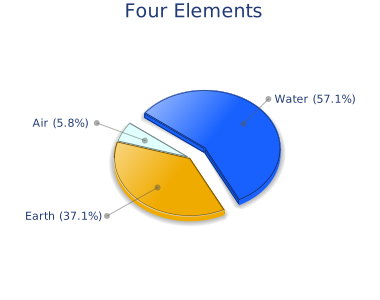
Like the majority of Earth signs, Max Planck, you are efficient, concrete and not too emotional. What matters to you is what you see: you judge the tree by its fruits. Your ideas keep changing, words disappear, but actions and their consequences are visible and remain. Express your sensitivity, even if it means revealing your vulnerability. Emotions, energy and communication must not be neglected; concrete action is meaningless if it is not justified by your heart, your intellect or your enthusiasm.
The predominance of Water signs indicates high sensitivity and elevation through feelings, Max Planck. Your heart and your emotions are your driving forces, and you can't do anything on Earth if you don't feel a strong affective charge (as a matter of fact, the word "feeling" is essential in your psychology). You need to love in order to understand, and to feel in order to take action, which causes a certain vulnerability which you should fight against.
Air is under-represented in your natal chart, with only 0.00% instead of the average 25%. Air symbolizes the values of communication, exchanges with others, but also adaptability and flexibility abilities: if you don't get out of your cocoon to talk, to show interest in others, and to socialize, you may have problems understanding others. Because of your lack of flexibility or of your refusal to adapt yourself, you may be suddenly overwhelmed by events. You should get into the habit of talking, of phoning, and of thinking in terms of "mobility, flexibility, adaptability, change" in every circumstance. It will spare you so many troubles!
The twelve zodiacal signs are split up into three groups or modes, called quadruplicities, a learned word meaning only that these three groups include four signs. The Cardinal, Fixed and Mutable modes are more or less represented in your natal chart, depending on planets' positions and importance, and on angles in the twelve signs.
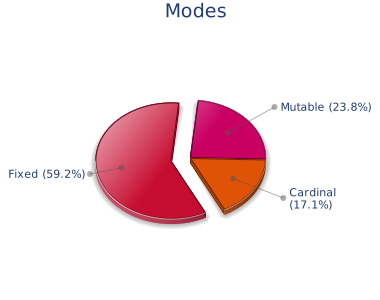
The Fixed mode corresponds to a majority of elements in your chart, Max Planck, and represents the desire for security and durability: you are able to concretely appreciate a situation and its stability. You definitely prefer to play the role of a loyal, obstinate and hard-working person, rather than to try new and risky experiences - beware, however, not to confuse obstinacy with intransigence. You structure, cement, and strengthen everything you find on your way: it is your nature, although you are not especially interested in swiftness: slow and steady...
Dominants: Planets, Signs and Houses for Max Planck
The issue of dominant planets has existed since the mists of time in astrology: how nice it would be if a person could be described with a few words and one or several planets that would represent their character, without having to analyse such elements as rulerships, angularities, houses, etc!
The ten planets - the Sun throughout Pluto - are a bit like ten characters in a role-play, each one has its own personality, its own way of acting, its own strengths and weaknesses. They actually represent a classification into ten distinct personalities, and astrologers have always tried to associate one or several dominant planets to a natal chart as well as dominant signs and houses.
Indeed, it is quite the same situation with signs and houses. If planets symbolize characters, signs represent hues - the mental, emotional and physical structures of an individual. The sign in which a planet is posited is like a character whose features are modified according to the place where he lives. In a chart, there are usually one, two or three highlighted signs that allow to rapidly describe its owner.
Regarding astrological houses, the principle is even simpler: the twelve houses correspond to twelve fields of life, and planets tenanting any given house increase that house's importance and highlight all relevant life departments: it may be marriage, work, friendship etc.
In your natal chart, Max Planck, the ten main planets are distributed as follows:

The three most important planets in your chart are Venus, Neptune and Mercury.
With Venus among your dominant planets, one of your first reflexes is... to please! Your look, your charm, and your seduction are omnipresent elements in your behaviour.
Your approach to things is connected to your heart, and for you, no real communication can flow if your interlocutors exude no sympathy or warmth. Cold and logical reasoning, clear thoughts and good sense are not important to you: if there is no affective bond with your environment, no connection can be established with the Venusian that you are, and nothing happens.
You have a strong artistic side, and you never neglect subjective but clear concepts such as pleasure, beauty, and also sensuality. However, sometimes to the detriment of efficiency, durability, logic, and... detachment.
With Neptune as one of your three dominant planets, you are a secretive and ambiguous person, often confused or unclear about your own motivations! Indeed, you are endowed with unlimited imagination and inspiration, as well as with an extreme sensibility that may turn you into a psychic or a clairvoyant. On the other hand, your impressionability is such that you may have difficulties in separating what is concrete and solid from illusions or dreams.
A mystic, a visionary or a poet, you daydream, like any Neptunian, and you see what few people only can see, all of this being shrouded in aesthetic mists when you are fired with enthusiasm.
A boundless, infinity-loving man like you is inevitably likely to be more vulnerable and easily hurt because of your acute perception of events. In such cases, you are hit full in the face, and you may sink into gloomy daydreamings and dark melancholy.
That said, this mysterious aura definitely gives you an indefinable charm in the eyes of your close friends who are often fascinated by your unique ability to feel and to see what ordinary people can never see!
With Mercury among your dominant planets, you are certainly cerebral, nervous, swift, curious, quick-witted, and you love to communicate. Your psychological pattern is intellectual, all the more so since Mercury is important, with its whole set of assets but also of weaknesses, obviously.
Your sensitivity, emotions, and heart's impulses give precedence to thinking, which can lead people to believe that you are a playful and witty but heartless person, intellectualizing situations and juggling with words and numbers whilst ignoring human aspects of things. Of course, it is said that cats always land on their feet - this is your Mercurian strength and your trump card!
Your weakness lies in your nervousness, and you may miss your goal because of your "over-intellectualization" that may be detrimental to other kind of energies such as instinct, spontaneity, heart, sensitivity, etc.

In your natal chart, the three most important signs - according to criteria mentioned above - are in decreasing order of strength Taurus, Virgo and Sagittarius. In general, these signs are important because your Ascendant or your Sun is located there. But this is not always the case: there may be a cluster of planets, or a planet may be near an angle other than the Midheaven or Ascendant. It may also be because two or three planets are considered to be very active because they form numerous aspects from these signs.
Thus, you display some of the three signs' characteristics, a bit like a superposition of features on the rest of your chart, and it is all the more so if the sign is emphasized.
With the Taurus sign so important in your chart, you are constructive, stable, and sensual. Good taste, sense of beauty, manners, and unfailing good sense - all these qualities contribute to your charm and seductive power. Furthermore, if some people criticize your slow pace and your stubbornness, you rightly reply that this is the price for your security, and that you like the way it is - slow and steady....
Virgo, associated with perfectionism, numbers and reason, is among your dominant signs: you inherit its sense of responsibility and tidiness, a clear mind, an unfailing logic, as well as a need to be useful and to fulfil your task to the best of your abilities. Obviously, people may think that you are too modest or reserved, suspicious or pessimistic because of your exceedingly critical mind, but aren't logic and wisdom great qualities? Of course, they are. Moreover, you keep your feet on the ground, you never behave irrationally and you are helpful and hardworking - what more can you ask for?!
Sagittarius, an adventurous and conquering fire sign, is dominant in your chart: you are enthusiastic, enterprising, optimistic, very sociable, and mobile - you have itchy feet, both physically and mentally. Nobody gets bored with you because you are always planning things and suggesting excursions, at least... when you are around and not already gone on a trip! Obviously, so many movements for one man may scare people off, and some of them may even criticize your brutality or your tendency to loose your temper, but you are so warm and genuine, so expansive, isn't this a good thing? And all the more so, since your sense of humour is overwhelming...
After this paragraph about dominant planets, of Max Planck, here are the character traits that you must read more carefully than the previous texts since they are very specific: the texts about dominant planets only give background information about the personality and remain quite general: they emphasize or, on the contrary, mitigate different particularities or facets of a personality. A human being is a complex whole and only bodies of texts can attempt to successfully figure out all the finer points.
The Moon in Virgo: his sensitivity
Your sensitivity is dominated by your reason, Max Planck, and you tend to analyze your emotional reactions in the slightest details, as if you wanted you hold them at bay so that they cannot overwhelm you or weaken you. Your nature is anxious, shy, you do not like to be in the forefront and you lack self-confidence. You are extremely perfectionist, you need to examine, to organize and to plan everything according to your logic. You like to help and to feel that you are useful, in your own work or through your wise and clever advice. You may also be very demanding and critical, even unbearable, because you are insistent and you find fault in everything. Learn to gain some self-confidence and do not constantly be ready to criticize...
Mercury in Taurus: his intellect and social life
Your mind is calm and balanced; even though you assimilate slowly, your memory is remarkable. Your judgment is based on reflection and reason and draws on past experiences. Max Planck, you are a good adviser, a reliable person whom people can confide in discreetly. You are full of good sense, cautious, methodical and disciplined and you are able to carry many good projects to a successful conclusion. You are very opinionated and determined in your actions. However, your tendency for intolerance and prejudices may offend your entourage. They wish that you exercised more flexibility instead of systematically refusing what cannot be immediately checked. You usually express yourself with a lot of charm and this is what allows you to get people to better accept your well-established habits.
Venus in Taurus and the Sun in Taurus: his affectivity and seductiveness
In your chart, the Sun and Venus are both in Taurus. According to the Tradition, Venus rules Taurus and she thrives tremendously in her sign… in the Sun's company. More than anyone, you are prone to sentimental attachments and you need your loved one to be all yours, as much as you are hers. The attributes of Taurus are the instinct for self-preservation and a relative faithfulness in love and in hatred. Your inclinations and your repulsions are unvarying and you pay special attention to sensual relationships. Not everything makes sense, but everything is sense. In this regard, the Tradition is very clear: it talks about voluptuous pleasure and eroticism. When this configuration is well integrated, it produces the Epicurean, and a person made of desires. But on the negative side, lewdness is condemned, firmly or leniently, according to one's beliefs! More seriously, the Sun-Venus duet in Taurus gives precedence to love fulfilment and plenitude over discovery and first days' amazement. This is probably the basis of the stability your sign is credited with. But make no mistake: the desire to intensify, to retain and to fully enjoy the savour of your relationship makes you a demanding person.
There is so much voluptuousness and so much charm in your personality, Max Planck! You are what is called a “nature” and when confidence is established, slowly but steadily, you become deeply attached to your partner and you can be filled with passion. It may take months, even years, but you are so generous and affectionate that, in most cases, your relationship has many chances to blossom, with time. You are very physical and sensual and you are very keen to delight in your intimate moments. This aspect of your amorous relationship usually contributes to its sustainability. Everything seems idyllic, Max Planck. It would be so if your jealousy and your possessiveness did not get started simultaneously with your powerful feelings. But you have so many assets, so be content!
The Sun in Taurus: his will and inner motivations
Peace, joy of life and sensuality are essential to you: You have a simple and quiet nature. You easily find happiness because you are not competitive. In addition, your relaxed attitude and your common sense always take you to places where you are happy, even though you are not the number one, even though you do not move in haste. The important thing for you is to construct, with patience and persistence. These two qualities yield strong, steadfast, and sustainable efforts that can withstand any pitfalls.
You are gentle, with a slow thinking process, but once you have opted for an orientation, nothing, no one, can make you change your mind. You loathe changes in general, and once you have taken the few major unavoidable decisions in the course of your life, you are on track!
As you are born under this sign, you are loyal, steadfast, strong, patient, enduring, persistent, attached, sensual, realistic, constructive, tenacious, with a strong need for security. But you may also be stubborn, rigid, possessive, materialistic, static and slow.
In love, Sir, more often than not, your passions are strong. It may take you some time to be moved, but once you choice is made, it is a lasting one and you are particularly endearing and loyal. You are not interested in infidelity or in having numerous partners.
Your love emerges slowly but it grows in depth, like a root which solidifies with time. You are not too romantic because you are so practical and conventional… but your style and your sexiness compensate for your lack of idealism. You tend to associate the concept of marriage with that of lifestyle or of the benefits that come with it.
Your physical urges are pressing; you are sensual and pleasure takes an important place in your life. You appreciate partners who cook like a cordon-bleu and who may cause a few gastronomic excesses, but you readily accept them.
Mars in Sagittarius: his ability to take action
Max Planck, you are a real Goliath and you often excel in sport; your thirst for conquests prompts you to constantly launch new challenges. The enthusiasm you put in your undertakings is perfectly well supported by your moral concepts and an idealism compatible with the values of the society you live in. You are pragmatic, enterprising and sometimes, naive. You do not pay attention to details and you launch various great adventurous projects that are all doomed to success. In a few rare cases, you can funnel your huge energy into more philosophical, even spiritual or religious enterprises, where your entire fieriness works wonders. On the sexual plane, your ardour and your spontaneity are your main assets. The danger is that you may spread yourself too thin in the sense that you may forget about faithfulness, particularly during the extensive faraway travels you are so fond of.
Conclusion
This text is only an excerpt from of Max Planck's portrait. If you want to get your own astrological portrait, much more comprehensive that this present excerpt, you can order it at this page. Do you belong to the Jupiterian type, benevolent and generous? The Martian type, active and a go-getter? The Venusian type, charming and seductive? The Lunar type, imaginative and sensitive? The Solar type, noble and charismatic? The Uranian type, original, uncompromising and a freedom-lover? The Plutonian type, domineering and secretive? The Mercurian type, cerebral, inquiring and quick? The Neptunian type, visionary, capable of empathy and impressionable? The Saturnian type, profound, persevering and responsible? Are you more of the Fire type, energetic and intuitive? The Water type, sentimental and receptive? The Earth type, realistic and efficient? Or the Air type, gifted in communication and highly intellectual? 11 planetary dominants and 57 characteristics are reviewed, quantified, and interpreted; then, your psychological portrait is described in detail, in a comprehensive document of approximately 32-36 pages, full of engrossing and original pieces of information about yourself.
Astrological reports describe many of the character traits and they sometimes go deeper into the understanding of a personality. Please, always keep in mind that human beings are continuously evolving and that many parts of our psychological structures are likely to be expressed later, after having undergone significant life's experiences. It is advised to read a portrait with hindsight in order to appreciate its astrological content. Under this condition, you will be able to take full advantage of this type of study.
The analysis of an astrological portrait consists in understanding four types of elements which interact with one another: ten planets, twelve zodiacal signs, twelve houses, and what are called aspects between planets (the 11 aspects most commonly used are: conjunction, opposition, square, trine, sextile, quincunx, semi-sextile, sesqui-quadrate, quintile and bi-quintile. The first 5 aspects enumerated are called major aspects).
Planets represent typologies of our human psychology: sensitivity, affectivity, ability to undertake, will-power, mental process, aptitude, and taste for communication etc., all independent character facets are divided here for practical reasons. The twelve signs forming the space where planets move will "colour", so to speak, these typologies with each planet being located in its particular sign. They will then enrich the quality of these typologies, as expressed by the planets. The Zodiac is also divided into twelve astrological houses. This makes sense only if the birth time is known because within a few minutes, the twelve houses (including the 1st one, the Ascendant) change significantly. They correspond to twelve specific spheres of life: external behaviour, material, social and family life, relationship, home, love life, daily work, partnership, etc. Each planet located in any given house will then act according to the meaning of its house, and a second colouration again enriches those active forces that the planets symbolize. Finally, relations will settle among planets, creating a third structure, which completes the planets' basic meanings. A set of ancient rules, which has stood the test of experience over hundreds of years (although astrology is in evolution, only reliable elements are integrated into classical studies), are applied to organize the whole chart into a hierarchy and to allow your personality to be interpreted by texts. The planets usually analysed are the Sun, the Moon, Mercury, Venus, Jupiter, Saturn, Uranus, Neptune and Pluto, which means two luminaries (the Sun and the Moon) and 8 planets, a total of 10 planets. Additional secondary elements may be taken into account, such as asteroids Chiron, Vesta, Pallas, Ceres (especially Chiron, more well-known), the Lunar nodes, the Dark Moon or Lilith, and even other bodies: astrology is a discipline on the move. Astrological studies, including astrological portrait, compatibility of couples, predictive work, and horoscopes evolve and become more accurate or deeper, as time goes by.
Precision: concerning the horoscopes with a known time of birth, according to the Tradition, we consider that a planet near the beginning (called cuspide) of the next house (less than 2 degrees for the Ascendant and the Midheaven, and less than 1 degree for all other houses) belongs to this house: our texts and dominants take this rule into account. You can also choose not to take this shift into account in the form, and also tick the option Koch or Equal houses system instead of Placidus, the default houses system.
Warning: In order to avoid any confusion and any possible controversy, we want to draw your attention upon the fact that this sample of celebrities is very complete and therefore, it also includes undesirable people, since every category is represented: beside artists, musicians, politicians, lawyers, professional soldiers, poets, writers, singers, explorers, scientists, academics, religious figures, saints, philosophers, sages, astrologers, mediums, sportsmen, chess champions, famous victims, historical characters, members of royal families, models, painters, sculptors, and comics authors or other actual celebrities, there are also famous murderers, tyrants and dictators, serial-killers, or other characters whose image is very negative, often rightly so.
Regarding the latter, it must be remembered that even a monster or at least a person who perpetrated odious crimes, has some human qualities, often noticed by his/her close entourage: these excerpts come from computer programmes devoid of polemical intentions and may seem too soft or lenient. The positive side of each personality is deliberately stressed. Negative sides have been erased here - it is not the same in our comprehensive reports on sale - because it could hurt the families of such people. We are hoping that it will not rebound on the victims' side.
Numerology: Birth Path of Max Planck
Testimonies to numerology are found in the most ancient civilizations and show that numerology pre-dates astrology. This discipline considers the name, the surname, and the date of birth, and ascribes a meaning to alphabetic letters according to the numbers which symbolise them.
The path of life, based on the date of birth, provides indications on the kind of destiny which one is meant to experience. It is one of the elements that must reckoned with, along with the expression number, the active number, the intimacy number, the achievement number, the hereditary number, the dominant numbers or the lacking numbers, or also the area of expression, etc.

Your Life Path is influenced by the number 4, Max, and your destiny implies sustained efforts, long-drawn-out works, and concrete achievements. The path may seem a bit tedious, but it is very promising, provided that you demonstrate some tenacity, loyalty, and patience. You are often invited to display orderly and methodical qualities, and step-by-step, you go through all the stages which may lead you to success, if you do not let hurdles dishearten you throughout your life. Persistence is among your major qualities. You see life as a challenge, and, far from falling into the trap of picking the easy way out, you face problems with calm and lucidity, and you choose the work and steady effort which open the door to success, although evolution requires quite a long time. Your personal path is based on continuous efforts and on maintaining the same immutable direction.
N. B.: when the birth time is unknown, (12:00 PM (unknown)), these portrait excerpts do not take into account the parameters derived from the time, which means, the domification (Ascendant, astrological houses, etc.). Nonetheless, these analyses remain accurate in any case. Regarding the sources of the birth data in our possession, kindly note that the pages we publish constitute a starting point for more detailed research, even though they seem useful to us. When the sources are contradictory, which occurs rarely, after having analysed them, we choose the most reliable one. Sometimes, we publish a birth date just because it is made available, but we do not claim that is it the best one, by no means.